“`html
For the Central Valley produce grower, the window between harvest and the retail shelf is a high-stakes race against biology. In a region that produces 99% of the commercially grown table grapes in the United States, the standard for excellence isn’t just “good enough”—it is defined by two critical metrics: Brix and Turgidity. As any seasoned viticulturist knows, the moment a cluster of Flame Seedless or Autumn King is clipped from the vine, its metabolic clock begins to accelerate. Without immediate and precise intervention, the high sugars (Brix) and the structural firmness (turgidity) that define premium fresh produce begin to degrade.
At Central Valley Cold Storage (CVCS), we view table grape logistics through the lens of a Viticulture Logistics Expert. We understand that the rachis (the stem) is the lifeline of the cluster. Once it turns brown and brittle, the perceived value of the fruit plummets, regardless of the sugar content. Maintaining that “just-picked” look requires more than just a cold room; it requires a sophisticated integration of thermodynamics, humidity management, and sustainable refrigeration technology.
The Fragility of the Table Grape
Unlike many other fruits, table grapes are non-climacteric. They do not continue to ripen or improve in quality after they are harvested. This means the quality you have in the field is the absolute maximum quality you will ever have; from that point on, it is a battle of preservation. The primary enemies are water loss and high respiration rates.
Water loss in grapes is primarily visible in the stems. The rachis has a much higher surface-area-to-volume ratio than the berries themselves, meaning it loses moisture up to 15 times faster than the fruit. When the stem loses as little as 2-3% of its weight in moisture, it begins to brown and shrivel. This is the first indicator to a retail buyer that the fresh produce is past its prime. Furthermore, as the berries lose turgidity, the “snap” that consumers crave is replaced by a soft, flaccid texture, and the risk of “berry shatter”—where grapes drop off the cluster—increases exponentially.
Respiration is the other silent killer. Even after harvest, grapes are living organisms. They consume oxygen and their own stored sugars (Brix) to stay alive, releasing heat and carbon dioxide in the process. The warmer the fruit, the faster it breathes, and the faster it consumes the very sugars that make it valuable. To stop this decline, we must plummet the fruit’s internal temperature to a state of “metabolic sleep.”
Rapid Pre-cooling Techniques
The first few hours after harvest are the most critical. In the heat of a San Joaquin Valley afternoon, grapes can easily reach temperatures of 90°F or higher. If these grapes are placed directly into a standard cold storage room without specialized pre-cooling, the “field heat” will remain trapped in the center of the pallets for days, leading to rapid decay and sugar loss.
At CVCS, we utilize advanced Forced-Air Cooling (FAC) systems designed specifically for the unique airflow requirements of grape lugs and clamshells. By creating a pressure differential that pulls refrigerated air through the pallet rather than just around it, we can remove field heat in a fraction of the time. Our goal is to reach the “seven-eighths cooling time”—the point where 87.5% of the temperature difference between the fruit and the air has been removed—within 2 to 6 hours of arrival.
This rapid transition to a baseline of 31-32°F is what preserves the Brix levels. By slowing the respiration rate to near-zero, we ensure that the sugars synthesized in the California sun remain in the berry for the consumer to enjoy. Our 100% sustainable CO2 refrigeration systems provide the high-lift capacity needed to handle these massive heat loads during the peak of harvest season without the environmental footprint of traditional HFC refrigerants.
Managing Humidity without Decay
Temperature is only half of the equation. To maintain turgidity and prevent stem browning, humidity must be kept exceptionally high—ideally between 90% and 95%. However, high humidity creates a perfect breeding ground for Botrytis cinerea (gray mold), the bane of every grape grower’s existence.
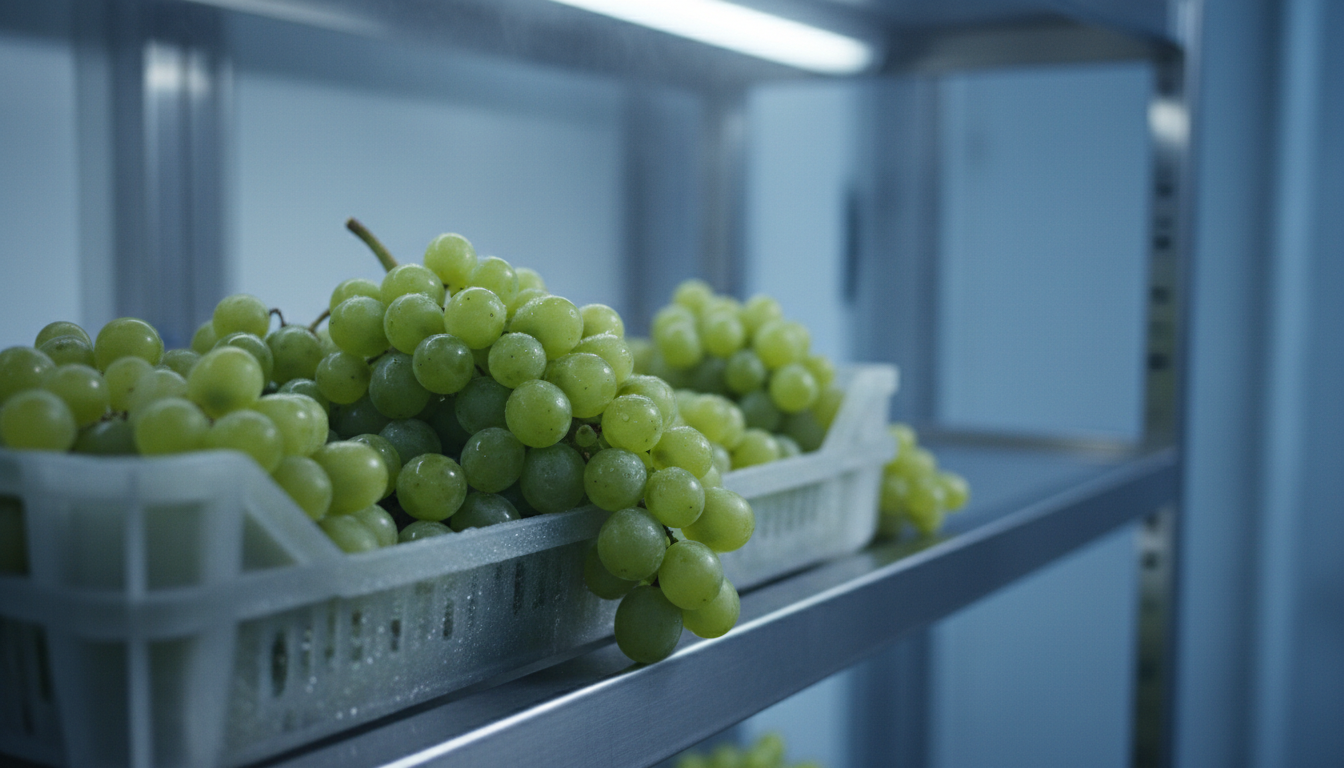
Managing this delicate balance is where CVCS excels. We utilize specialized High-Hum bays where moisture is introduced through ultra-fine mists that stay suspended in the air rather than settling as free water on the fruit. Free water is the enemy; it facilitates fungal growth and can cause berry splitting. By maintaining a high Vapor Pressure Deficit (VPD) through precise humidity control, we ensure the air is saturated enough that it doesn’t “pull” moisture out of the grape stems, yet remains under control to prevent mold bloom.
Our airflow management is equally critical. We employ variable speed fans capable of maintaining a consistent 100 feet per minute (fpm) airflow. This ensures that there are no “dead zones” in the room where humidity can spike or temperature can creep up. This constant, gentle movement of air, combined with our CO2-based cooling, creates a stable environment that protects the integrity of the fresh produce.
| Parameter | Ideal for Grapes | CVCS Capability |
|---|---|---|
| Temperature | 31-32°F | Precise to +/- 0.5° |
| Humidity | 90-95% | Specialized High-Hum Bays |
| Airflow | 100 fpm | Variable Speed Fans |
| Traceability | Full Pallet ID | Goose Digital Tracking |
Export-Grade Grape Protocols
For growers targeting international markets in Asia or Europe, the storage requirements become even more stringent. Export-grade grapes often spend 20 to 40 days in transit. To survive this journey, the fruit must be in peak physiological condition before it ever enters a shipping container.
CVCS supports rigorous Sulfur Dioxide (SO2) protocols, which are essential for long-term storage and export. SO2 is used as a fumigant to kill fungal spores on the surface of the grapes. However, SO2 management must be perfectly integrated with cold storage. If the temperature fluctuates, the fruit can absorb too much SO2, leading to bleaching or “off” flavors. Our systems maintain such tight temperature tolerances (+/- 0.5°F) that the efficacy of SO2 pads and fumigation cycles is maximized without risking fruit damage.
Furthermore, in the modern supply chain, data is just as important as the fruit itself. Our “Goose Digital” tracking system provides full pallet ID traceability. From the moment your fruit hits our dock, every temperature shift, humidity adjustment, and movement is logged. For the Central Valley grower, this provides the “proof of cold chain” necessary to secure top-market pricing and satisfy the audits of global retailers.
By choosing a facility that uses 100% sustainable CO2 refrigeration, you are also future-proofing your operations. As global retailers increasingly demand low-carbon footprints from their suppliers, the “green” nature of your cold storage partner becomes a competitive advantage in the fresh produce marketplace.
Conclusion
Maintaining the Brix and turgidity of table grapes is a science that leaves no room for error. The difference between a premium payout and a secondary market “fire sale” often comes down to how quickly you can remove field heat and how precisely you can manage the storage atmosphere. At CVCS, we provide the infrastructure that Central Valley growers need to compete on a global stage. Our commitment to high-humidity precision, rapid cooling, and sustainable technology ensures that your grapes arrive at their destination with green stems, firm berries, and the sweet snap that consumers expect.
For more information on our specialized fresh produce solutions, explore our cold storage specifications or learn more about our full range of services.
Frequently Asked Questions
Q: How do you prevent mold in high-humidity grape storage?
A: We use advanced airflow management and support traditional SO2 protocols to mitigate fungal growth. By ensuring air never stagnates and maintaining precise temperature control, we prevent the condensation that leads to mold outbreaks.
Q: Why is CO2 refrigeration better for grapes?
A: Beyond the sustainability benefits, CO2 systems offer superior temperature recovery and precision. This allows us to maintain the +/- 0.5°F tolerances required to keep grapes in a state of metabolic dormancy for extended periods.
Ready to Protect Your Harvest?
Don’t leave your grape quality to chance. Partner with the experts in Central Valley viticulture logistics.
“`