As a sustainable infrastructure consultant, my role is to quantify the risks of energy dependency and design systems that mitigate them. The data is clear: the future of high-value Off-Grid Logistics lies in the integration of onsite generation and Large-Scale Battery Energy Storage Systems (BESS). This transition is not merely an environmental gesture; it is a clinical, data-driven strategy for operational resilience—a concept we define as “Thermal Insurance.”
The Death of Grid Dependency
The centralized power model is failing the industrial sector in two primary areas: cost and reliability. In California, a critical hub for global agricultural exports, industrial electricity rates have increased by a staggering 45% over the last five years. These increases are not periodic adjustments; they are structural shifts required to fund grid hardening and wildfire mitigation. For a facility operating millions of cubic feet of sub-zero storage, energy is often the second-largest Opex line item after labor. When that cost fluctuates by double digits annually, long-term financial modeling becomes impossible.
Beyond the fiscal unpredictability, the physical reliability of the grid is in decline. For cold storage operators, a power outage is not just an inconvenience—it is a catastrophic risk event. Even a brief loss of power can lead to “micro-thawing” events that compromise the internal temperature of sensitive produce, leading to insurance claims, lost revenue, and damaged brand reputation. The traditional solution has been the diesel backup generator. However, diesel generators are reactive, carbon-intensive, and prone to mechanical failure during extended outages. They do not solve the problem of high energy costs; they only provide a temporary safety net for a failing system.
This is where the shift toward Off-Grid Logistics becomes mandatory. By decoupling a facility from the centralized grid, we eliminate the external variables of utility rate hikes and regional blackouts. At facilities like Central Valley Cold Storage (CVCS)—currently the largest off-grid cold storage facility in the United States—the model has shifted from “buying power” to “owning the infrastructure of energy.” This move ensures that the facility operates on a fixed-cost basis, providing a powerful hedge against the inflationary pressures of the traditional energy market.
Physics of the BESS: Battery Energy Storage
The core technology enabling this autonomy is the Large-Scale Battery Energy Storage System (BESS). While solar arrays provide the generation, the BESS provides the “intelligence” and the “longevity” of the energy supply. To understand the operational superiority of a BESS-integrated facility, one must look at the physics of power quality.
Industrial cooling equipment, specifically large-scale screw compressors and ammonia refrigeration systems, is highly sensitive to voltage fluctuations. Centralized grid power is often “dirty,” characterized by voltage sags and surges that put undue stress on electrical motors. Over time, this leads to premature equipment failure and increased maintenance costs. A BESS acts as a massive power conditioner. By discharging energy through high-specification inverters, the BESS delivers a perfectly stable voltage curve, often superior to what is provided by the utility. This “clean” power extends the lifecycle of the refrigeration hardware, reducing capital replacement cycles.
Thermal Insurance: The New Operational Standard
The concept of “Thermal Insurance” is the operational guarantee that the energy required to maintain set-point temperatures is generated and stored onsite. In a traditional model, your “insurance” is a contract with a utility and a tank of diesel. In an off-grid BESS model, your insurance is the physics of stored electrons. Because a BESS can respond to load changes in milliseconds, it provides an uninterrupted power supply (UPS) for the entire facility. There is no “lag time” while a generator cranks to life; the cooling cycle never breaks. For high-value agricultural products, this 100% uptime is the ultimate risk mitigation tool.
Scaling for Industrial Demand
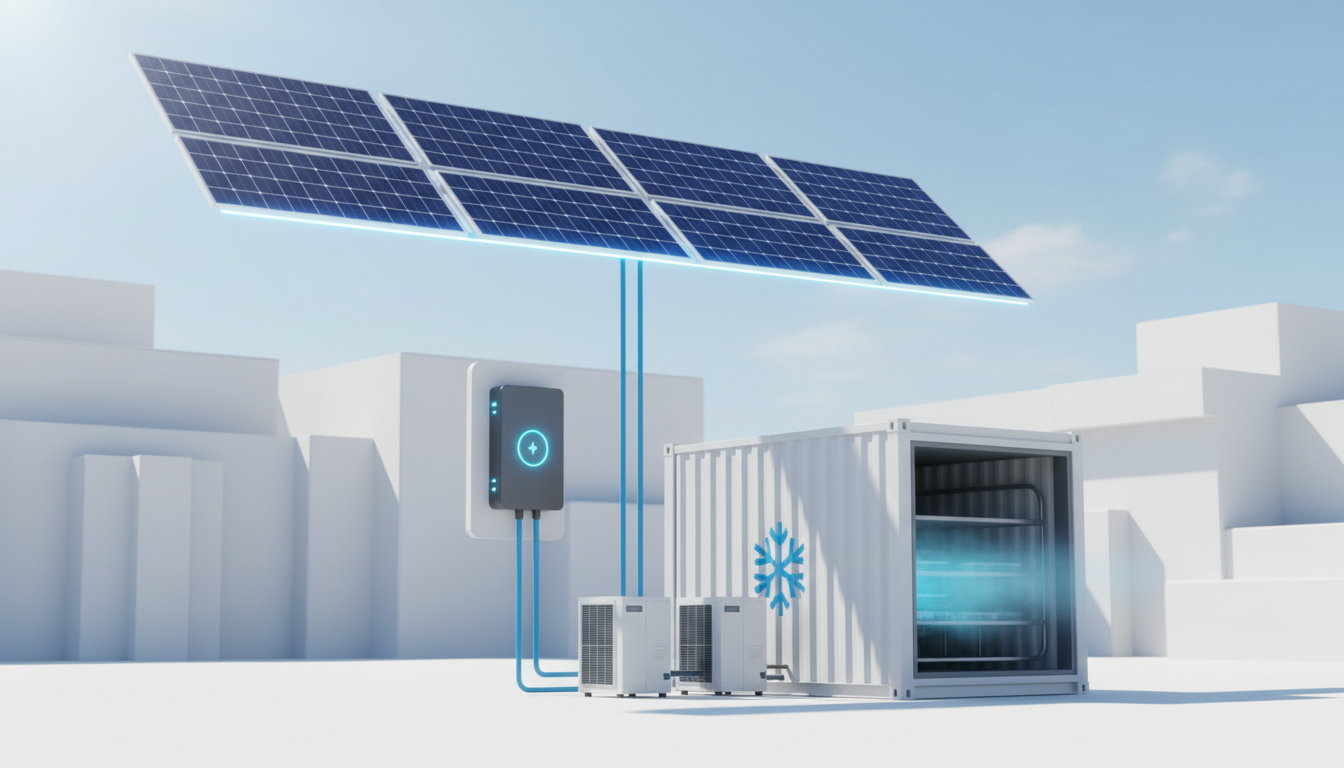
Implementing a BESS for an industrial cold storage facility requires a sophisticated understanding of load profiles. We analyze “peak demand” versus “baseload.” In a typical facility, the cooling load spikes during the hottest parts of the day—exactly when solar generation is at its peak. This synchronization is the “Golden Ratio” of sustainable logistics. The solar array feeds the cooling system directly while simultaneously charging the BESS. As the sun sets, the BESS takes over the baseload, discharging through the night to maintain the thermal mass of the building. This creates a closed-loop system where the input cost is zero and the output is a constant, frozen environment.
LCOE: The CFO’s Guide to Energy Autonomy
From a financial perspective, the transition to off-grid infrastructure is analyzed through the lens of the Levelized Cost of Energy (LCOE). While the initial capital expenditure (Capex) for an off-grid microgrid is higher than a traditional grid connection, the long-term Opex savings are transformative. When you calculate the LCOE of an off-grid system over a 20-year horizon—incorporating the avoided costs of utility rate hikes, demand charges, and diesel maintenance—the off-grid model consistently outperforms the grid.
For a CFO, the primary benefit is cost predictability. In a traditional model, energy is a variable cost that is subject to the whims of regulatory commissions and global fuel prices. In an off-grid model, the cost of energy is “pre-paid” through the Capex of the installation. This turns a volatile expense into a predictable, depreciable asset. This financial stability allows for more aggressive pricing strategies and better margin protection in a competitive logistics market.
The ESG and Decarbonization Mandate
Beyond the immediate financial and operational benefits, off-grid infrastructure addresses the growing pressure for decarbonization. Global retailers and food producers are increasingly scrutinized for their Scope 3 emissions—the emissions generated in their supply chain. Cold storage is historically one of the “carbon-heaviest” segments of the supply chain. By utilizing 100% onsite renewable energy, facilities like CVCS allow their clients to claim a zero-carbon footprint for their storage and distribution phase. This alignment with Environmental, Social, and Governance (ESG) goals is no longer a “nice to have”; it is a prerequisite for securing contracts with Fortune 500 food companies.
Comparing the Models
To visualize the operational shift, we can compare the metrics of the traditional grid-reliant model against the CVCS off-grid standard:
| Energy Model | Cost Predictability | Reliability | Carbon Intensity |
|---|---|---|---|
| Traditional Grid | Low (Variable) | Medium/Low | High |
| CVCS Off-Grid | High (Fixed) | 100% | Zero Input |
Operational Resilience as a Competitive Advantage
The technical specifications of an off-grid facility are impressive, but the real-world application is where the value is realized. During peak summer months, when the regional grid is under maximum strain and utilities are initiating rolling blackouts to prevent infrastructure collapse, an off-grid facility remains an island of stability. While competitors are scrambling to maintain temperatures with aging diesel generators, the off-grid facility continues to operate at peak efficiency. This is the definition of Off-Grid Logistics: the ability to maintain the integrity of the cold chain regardless of external conditions.
The transition to this model is being led by facilities like CVCS, which has demonstrated that the “largest off-grid cold storage in the U.S.” is not just a title—it is a proof of concept for the future of the industry. The engineering required to balance 24/7 cooling loads with intermittent renewable generation has been solved. The remaining barrier is not technological; it is a shift in mindset from seeing energy as a utility to seeing it as a strategic asset.
The Role of Data in Microgrid Management
Operating a microgrid of this scale requires a data-driven approach. AI-driven software manages the “state of charge” (SoC) for the BESS, predicting cooling demand based on weather forecasts and inbound shipment volumes. If a heatwave is predicted, the system can “pre-cool” the facility during peak solar hours, using the thermal mass of the stored product to “bank” cold energy. This reduces the discharge strain on the batteries during the night. This level of granular control is impossible when you are tethered to a centralized grid with no transparency into the generation mix or distribution health.
Frequently Asked Questions
- Q: What is Thermal Insurance?
A: It is the operational guarantee that energy for cooling is generated and stored onsite, removing the risk of grid blackouts and ensuring 100% uptime for temperature-sensitive products. - Q: How does the BESS handle multi-day weather events?
A: Industrial microgrids are sized with “autonomy days” in mind. The combination of oversized solar arrays and high-capacity BESS ensures that even during periods of low irradiance, the facility has enough stored energy to maintain critical cooling functions. - Q: What is the impact on equipment lifespan?
A: By providing stable, conditioned power, the BESS eliminates the voltage sags and surges common in grid power, which significantly reduces wear and tear on electrical motors and compressors.
Conclusion: The Strategic Imperative
The evidence is overwhelming. The traditional model of grid-dependent cold storage is a relic of an era of cheap, stable energy that no longer exists. For the agricultural and logistics sectors, the path forward is defined by autonomy. By investing in off-grid infrastructure, companies are doing more than just reducing their carbon footprint; they are insulating themselves from the volatility of the 21st-century energy market. They are securing their supply chain, protecting their margins, and ensuring that the cold chain remains unbroken, no matter what happens on the grid.
As we continue to monitor the performance data from facilities like CVCS, the conclusion remains the same: off-grid is not the alternative; it is the global standard for high-value logistics.