Introduction to Central Valley Logistics
In the global theater of agricultural production, California’s Central Valley stands as an unparalleled titan. Accounting for a significant portion of the United States’ fruit, nut, and vegetable output, this region is the pulse of the global food supply chain. However, the true challenge for producers, distributors, and enterprise-level retailers is not merely the cultivation of these goods, but the preservation of their value from the moment they leave the soil. This is where California Cold Storage transitions from a utility to a strategic asset.
For enterprise procurement teams and logistics directors, the “First Mile” of the cold chain is the most critical. The First Mile refers to the immediate post-harvest window where the internal temperature of a commodity—often referred to as “field heat”—is at its peak. Without immediate and precise thermal intervention, the biological clock of the product accelerates, leading to enzymatic degradation, moisture loss, and a shortened shelf life. Central Valley Cold Storage (CVCS), located in Madera, CA, serves as the definitive vanguard for this process, offering a sophisticated infrastructure designed to mitigate these risks through advanced science and engineering.
The strategic importance of the Central Valley cannot be overstated. By positioning cold storage facilities at the nexus of production, enterprises can drastically reduce the “dwell time” between harvest and cooling. In an era defined by volatile fuel prices and increasing regulatory pressure on carbon emissions, the proximity of CVCS to the primary production zones of almonds, walnuts, stone fruits, and citrus represents a significant reduction in transport-related logistics costs and a massive gain in product integrity.
The Physics of Field Heat and Post-Harvest Shelf-Life Extension
To understand the necessity of specialized California Cold Storage, one must first understand the biological reality of the produce. Most agricultural commodities are living organisms that continue to respire after harvest. Respiration is the process by which fruits and nuts break down stored organic materials (carbohydrates, proteins, and fats) to produce energy. A byproduct of this process is heat, which further accelerates the rate of respiration, creating a destructive feedback loop.
The key to arresting this decline is the rapid removal of field heat. For every hour that a harvested crop remains at ambient field temperatures (which in the Central Valley can frequently exceed 100°F during peak season), it can lose days of potential shelf life. This is not a linear degradation; it is exponential. Efficient facilities, such as our Madera operation, utilize specialized precooling protocols that leverage high-velocity air and precisely calibrated humidity to pull heat from the core of the product.
Humidity management is the second pillar of this scientific approach. While temperature controls the rate of respiration, humidity controls the rate of transpiration—the loss of moisture to the surrounding air. In the Central Valley, where humidity can fluctuate wildly, a facility must be able to maintain a hyper-specific micro-climate. For example, nuts like almonds and walnuts require a drier environment (approximately 50% humidity) to prevent mold growth while maintaining shell integrity. Conversely, leafy greens or berries require near-saturation levels to prevent wilting. CVCS utilizes independent zone controls to ensure that disparate commodities are stored in their optimal biological “sweet spots.”
Data indicates that growers utilizing long-term, high-precision storage can see a 30-40% profit increase. This is achieved by bypassing the harvest-time “supply glut”—where prices are at their lowest—and releasing products into the market during off-harvest months when demand remains high but supply has dwindled. This “market timing” is only possible if the cold storage facility can guarantee product integrity over several months.
Madera: The Strategic Hub for California Cold Storage
Logistics is a game of geography, and Madera, CA, is the bullseye of the Central Valley. Located along the Highway 99 corridor and within striking distance of Interstate 5, Madera offers a unique logistical advantage that allows for seamless “First Mile” entry and “Last Mile” exit. For enterprise RFPs, the location of a cold storage partner is a primary factor in risk assessment.
Being in the “Heart of the Valley” means that transport times from the field to the facility are often measured in minutes rather than hours. This proximity is the first line of defense against spoilage. Furthermore, Madera’s location provides a central consolidation point for shipments heading to the Port of Oakland for international export or to major metropolitan hubs like Los Angeles, San Francisco, and the Pacific Northwest.
From a macro-logistical perspective, utilizing a Madera-based hub allows enterprises to decentralize their storage. Rather than transporting “warm” goods to a coastal facility—where real estate and energy costs are significantly higher—commodities are stabilized at the source. This preserves the quality of the “First Mile” and ensures that when the product eventually reaches the consumer, it retains the sensory characteristics (crunch, color, flavor) that define premium brands.
Infrastructure Specs: Engineering Reliability and Sustainability
The modern Enterprise RFP demands more than just square footage; it demands operational resilience and environmental stewardship. The infrastructure at Central Valley Cold Storage is engineered to exceed these requirements. Two primary technologies define our facility: CO2 Refrigeration and Solar Microgrids.
CO2 Refrigeration (R-744)
While many legacy facilities still rely on Ammonia (which carries significant safety risks) or synthetic HFCs (which have high Global Warming Potential), CVCS has invested in CO2 refrigeration systems. CO2 is a natural refrigerant with a GWP of 1. It is non-toxic, non-flammable, and exceptionally efficient at the temperature ranges required for California Cold Storage. For the enterprise client, this translates to a lower carbon footprint for their supply chain and the elimination of the regulatory risks associated with the phase-out of synthetic refrigerants.
Off-Grid Solar Microgrids
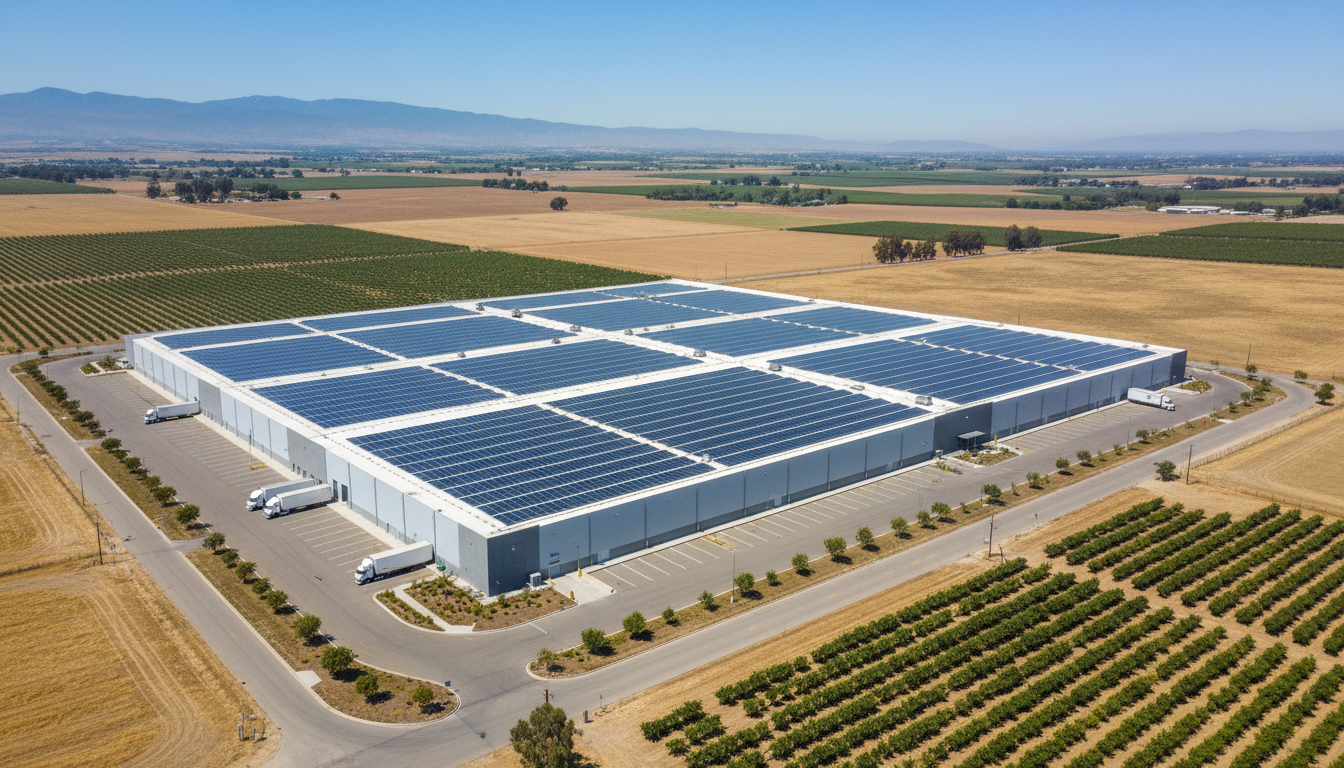
California’s power grid is increasingly volatile, plagued by seasonal outages and skyrocketing peak-use rates. For a cold storage facility, a power failure is a catastrophic risk. To mitigate this, CVCS utilizes an advanced solar microgrid. This system allows the facility to operate independently of the PG&E grid during peak times or during grid instability. By ensuring 100% uptime, we guarantee that the thermal chain is never broken, protecting millions of dollars in inventory from even the slightest temperature excursion.
Commodity-Specific Environmental Parameters
The following table outlines the technical specifications we maintain for various commodity classes, ensuring that each product receives the exact environment required for shelf-life extension.
| Storage Type | Temp (°F) | Humidity (%) | Ideal Commodity |
|---|---|---|---|
| General Cold | 34 | 50 | Almonds/Walnuts |
| Rehab Storage | 34 | 55 | Dry-stored Produce |
| Finishing | 36 | 50 | Processed Goods |
| Organic | 28 | 50 | Organic Berries/Leafy |
Our facility specs include a wide array of loading dock configurations and cross-docking capabilities to ensure that “cold-to-cold” transitions are seamless. Every square inch of the facility is monitored by IoT sensors that provide real-time data on temperature and humidity, accessible via our client portal for full transparency and audit-ready compliance.
Conclusion: The Future of the Cold Chain
The evolution of California Cold Storage is being driven by a convergence of biological science, advanced engineering, and logistical necessity. As global food demand rises and the climate becomes more unpredictable, the ability to stabilize and store agricultural wealth in the Central Valley becomes a critical competitive advantage for growers and retailers alike.
By choosing a facility that prioritizes “First Mile” proximity, energy independence, and precise atmospheric control, enterprises can reduce waste, improve their ESG (Environmental, Social, and Governance) scores, and significantly enhance their bottom line. Central Valley Cold Storage in Madera is not just a warehouse; it is a vital organ in the body of global commerce, ensuring that the bounty of California reaches the world in peak condition.
For organizations looking to secure their position in the 2024-2025 harvest seasons, the time to integrate strategic cold storage into your RFP process is now. Reliability, sustainability, and geographical advantage are the three pillars upon which the future of the cold chain will be built.
Frequently Asked Questions
Q: Why is a Central Valley location important for cold storage?
A: It places the facility in the ‘First Mile’ of production, reducing transport time and preserving crop integrity immediately after harvest. This proximity is essential for removing ‘field heat’ before it can trigger the rapid degradation of the product, ultimately extending shelf life and reducing spoilage by up to 20%.
Q: How does CO2 refrigeration benefit the environment?
A: CO2 (R-744) is a natural refrigerant with a Global Warming Potential (GWP) of 1, compared to synthetic refrigerants which can have GWPs in the thousands. It is a future-proof technology that complies with the strictest environmental regulations while providing superior cooling efficiency.
Q: Can cold storage really increase grower profits?
A: Yes. By utilizing high-quality long-term storage, growers can avoid selling during the post-harvest market saturation. Storing goods for 3 to 6 months allows them to capture seasonal price premiums, often leading to a 30-40% increase in profit margins.
Secure Your Cold Chain Strategy
Ensure your commodities are protected by the most advanced infrastructure in the Central Valley. Our technical team is ready to assist with your enterprise RFP requirements.