The Definitive Guide to Cold Storage in California’s Central Valley
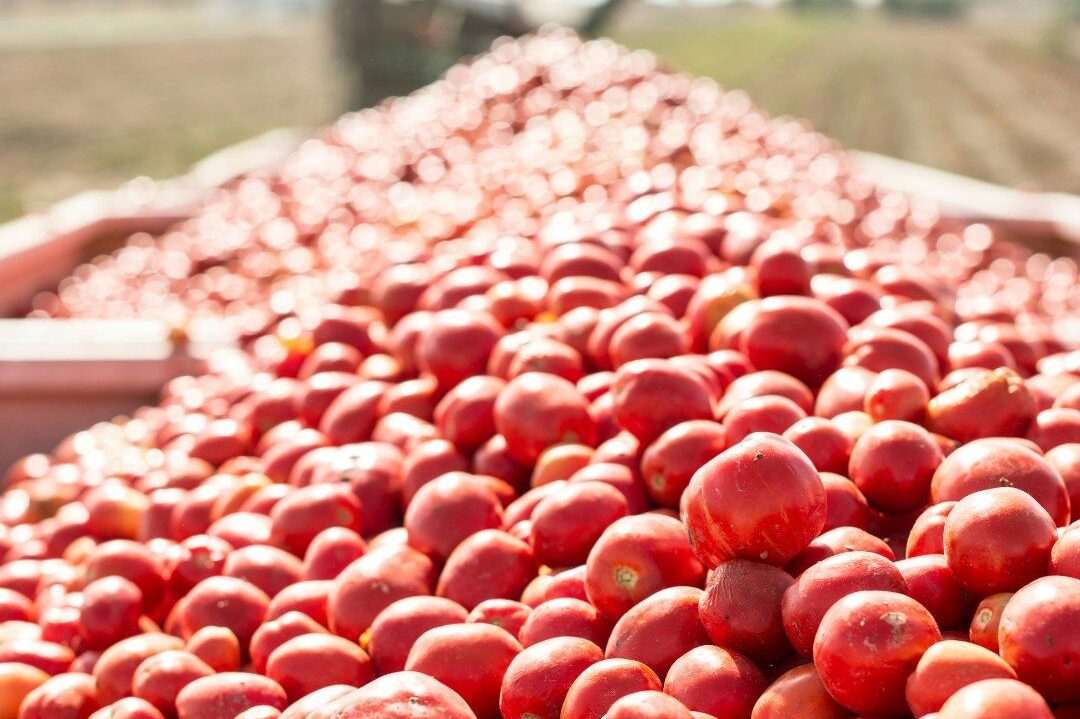
California’s Central Valley is not merely a regional agricultural hub; it is the vascular system of the global food supply. Producing over 25% of the United States’ food supply, this 450-mile expanse of fertile land represents the world’s most productive agricultural region. However, for Enterprise RFPs and Procurement Directors, the challenge has never been the harvest itself—it is the preservation of that harvest. In an era of tightening FSMA 204 regulations, volatile energy markets, and shifting climate patterns, Central Valley cold storage has evolved from a simple commodity service into a high-stakes strategic asset.
The efficiency of the cold chain determines the delta between a premium product and a total loss. As industrial electricity rates in California have surged by 45% over the last five years, the traditional model of grid-dependent refrigerated warehousing has become a liability. To navigate this landscape, procurement professionals must shift their focus toward first-mile infrastructure that prioritizes thermal stability, sustainable energy independence, and technological transparency.
The Strategic Importance of the First Mile
In the world of temperature-controlled logistics, the “First Mile” refers to the immediate window following the harvest. For high-value perishables—such as berries, stone fruits, and leafy greens—the “senescence clock” begins ticking the moment the crop is separated from the vine or soil. Senescence is the biological process of deterioration; for every hour that field heat remains in a product, the potential shelf life is reduced by approximately one day.
Strategic procurement directors are increasingly moving away from port-centric storage models in favor of “first-mile” facilities located in the heart of the production zone. This is why the Madera advantage is so significant. By positioning cold storage assets in Madera, at the geographic center of the state’s agricultural output, logistics managers can neutralize field heat within hours, rather than days. This proximity allows for “Pre-Cooling”—a process that rapidly brings the internal temperature of the produce down to its optimal storage point before it is even palletized for long-haul transport.
The result of a robust first-mile strategy is a documented increase in product turgidity (crispness) and the preservation of brix levels (sugar content). For the enterprise, this translates to fewer rejections at the retail level, reduced shrink, and a more resilient brand reputation. To understand the depth of this advantage, stakeholders should examine The Strategic Advantage of First-Mile Cold Storage in Madera, CA.
Managing Thermal Volatility in Madera
The Central Valley is a region of extremes. Summer temperatures often exceed 100°F for consecutive weeks, placing an immense mechanical load on traditional refrigeration systems. For a Procurement Director, this volatility represents a critical risk factor. If a facility’s cooling system falters during a peak heatwave, or if the public utility implements a “Public Safety Power Shutoff” (PSPS), the entire inventory is at risk.
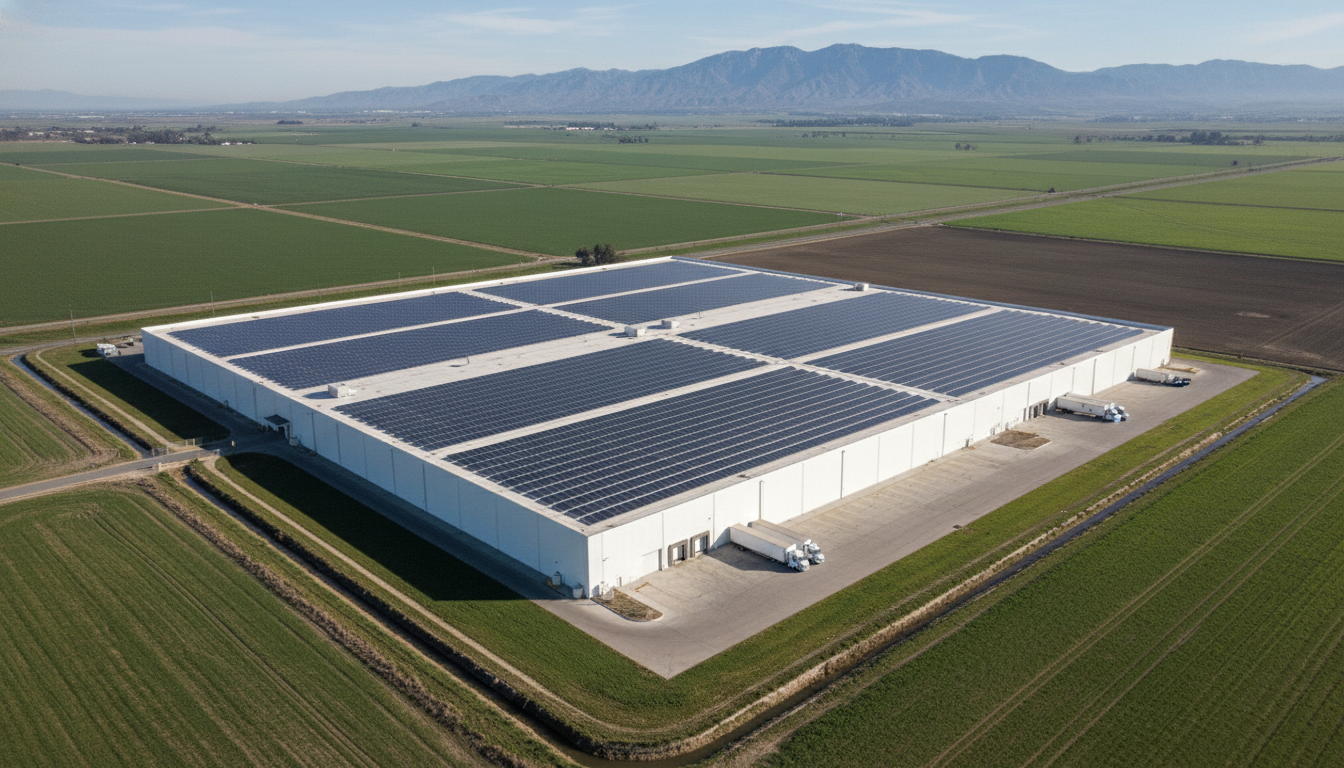
Modern Central Valley cold storage solutions, led by Central Valley Cold Storage (CVCS), have solved this through the implementation of massive-scale off-grid infrastructure. CVCS operates a 254,000 sq ft facility in Madera that utilizes the largest off-grid solar and battery microgrid for cold storage in the United States. This allows the facility to maintain a “Perfect Thermal Envelope,” independent of the vulnerabilities inherent in the aging California electrical grid.
The Goose System and FSMA 204 Compliance
Beyond physical cooling, the modern cold chain requires a “digital twin.” With the FDA’s FSMA 204 Rule mandating enhanced traceability for high-risk foods, manual record-keeping is no longer an option for enterprise-level operations. Central Valley Cold Storage utilizes the “Goose System,” an automated proprietary platform that provides real-time visibility into every pallet’s journey. From the moment a shipment enters the Madera facility, its temperature, humidity, and location are tracked with granular precision. This level of data transparency simplifies the RFP process, as it provides the necessary documentation for compliance audits and insurance requirements without the need for manual intervention.
Sustainable Infrastructure Benchmarks
The transition toward sustainability in cold storage is no longer driven solely by corporate social responsibility (CSR) goals; it is driven by economic necessity. The 45% rise in California’s industrial electricity rates has made energy the single largest variable cost in refrigerated warehousing. Facilities that remain tethered to the public utility grid are forced to pass these escalating costs onto their clients through “peak demand” surcharges and fuel adjustments.
The benchmark for modern infrastructure is now defined by three pillars: Energy Independence, Sustainable Refrigerants, and Thermal Efficiency.
- Energy Independence: By utilizing on-site solar generation paired with industrial-scale battery storage, facilities can bypass the volatility of the energy market. This ensures 100% uptime, even during regional blackouts, providing a level of security that grid-dependent competitors cannot match.
- Natural Refrigerants: Traditional synthetic HFC (Hydrofluorocarbon) refrigerants are being phased out due to their high Global Warming Potential (GWP). The current gold standard is 100% sustainable CO2 (R-744) refrigeration systems. CO2 is non-toxic, non-flammable, and has a GWP of 1, making it the most future-proof choice for long-term supply chain planning.
- Advanced Insulation: The “thermal envelope” of a facility is only as good as its insulation. High-R-value panels and automated dock seals minimize air infiltration, ensuring that the energy generated by the solar microgrid is used with maximum efficiency.
Comparing Traditional vs. Next-Generation Storage
For procurement directors evaluating partners, the following table illustrates the operational differences between legacy providers and the new standard set by Central Valley Cold Storage.
| Feature | Traditional Grid Storage | CVCS Off-Grid |
|---|---|---|
| Energy Source | Public Utility (Volatile) | Solar + Battery (Stable) |
| Location | Port/City Hubs | First-Mile Production (Madera) |
| Refrigerant | Synthetic HFCs | 100% Sustainable CO2 |
| Compliance | Manual/Legacy | Automated Goose System |
The Business Case for Madera: Resilience and ROI
When selecting a Central Valley cold storage partner, the decision should be viewed through the lens of Risk Mitigation and Return on Investment (ROI). While port-side storage might seem convenient for export, the “invisible loss” occurring during the transit from the field to the port can be devastating. By the time a container of grapes reaches a port-side facility in Long Beach or Oakland, it may have already lost 15-20% of its viable shelf life due to improper heat management in the first 24 hours.
Madera acts as the strategic “picket line” for freshness. By cooling and staging products at the source, enterprises can consolidate loads more effectively, utilize more efficient trucking routes, and ensure that when the product finally reaches its destination—whether it be a domestic grocer or an international market—it possesses the maximum possible quality. Furthermore, the use of off-grid power provides a “fixed-cost” energy model, protecting the enterprise from the “inflationary shocks” of the California utility market.
Operational Excellence Through Automation
Automation in the Central Valley is not about replacing labor; it is about eliminating human error in critical environments. In a -10°F freezer environment, human performance naturally degrades. Automated storage and retrieval systems (ASRS) and the Goose System’s inventory management ensure that First-In-First-Out (FIFO) protocols are strictly followed. This level of operational discipline is what separates a standard warehouse from a strategic logistics partner. For procurement directors, this means fewer claims, more accurate inventory counts, and a streamlined RFP cycle.
Frequently Asked Questions
Q: Why is first-mile cold storage important?
A: First-mile cold storage is critical because it removes field heat immediately after harvest. This stops the “senescence clock,” preventing the rapid biological breakdown of the produce. Immediate cooling preserves the brix (sugar), turgidity (structure), and overall shelf life of the product, which is impossible to recover once lost.
Q: Is off-grid storage more reliable than the public grid?
A: Yes. The California power grid is increasingly prone to brownouts, Public Safety Power Shutoffs (PSPS), and peak-load volatility. Off-grid facilities, like CVCS in Madera, utilize local microgrids (Solar + Battery) to ensure 100% uptime and constant thermal stability, regardless of the state of the public utility.
Q: How does the Goose System assist with FSMA 204?
A: The Goose System automates the tracking of Key Data Elements (KDEs) and Critical Tracking Events (CTEs) required by FSMA 204. It provides a digital audit trail of every pallet’s temperature and movement history, ensuring that enterprise clients remain compliant with federal food safety regulations with zero manual paperwork.
Conclusion
The future of the American food supply chain depends on the infrastructure of the Central Valley. As the industry moves toward more stringent traceability and higher sustainability standards, the choice of a cold storage partner becomes a defining factor in an enterprise’s success. Central Valley Cold Storage is not just a warehouse; it is a technology-driven, energy-independent solution designed for the complexities of the 21st-century supply chain. By prioritizing the “Madera Advantage” and first-mile logistics, procurement directors can ensure their products remain as fresh as the day they were harvested, all while insulating their bottom line from the volatility of the California energy market.
Ready to Optimize Your Central Valley Logistics?
Secure your supply chain with the most advanced off-grid cold storage facility in the United States.