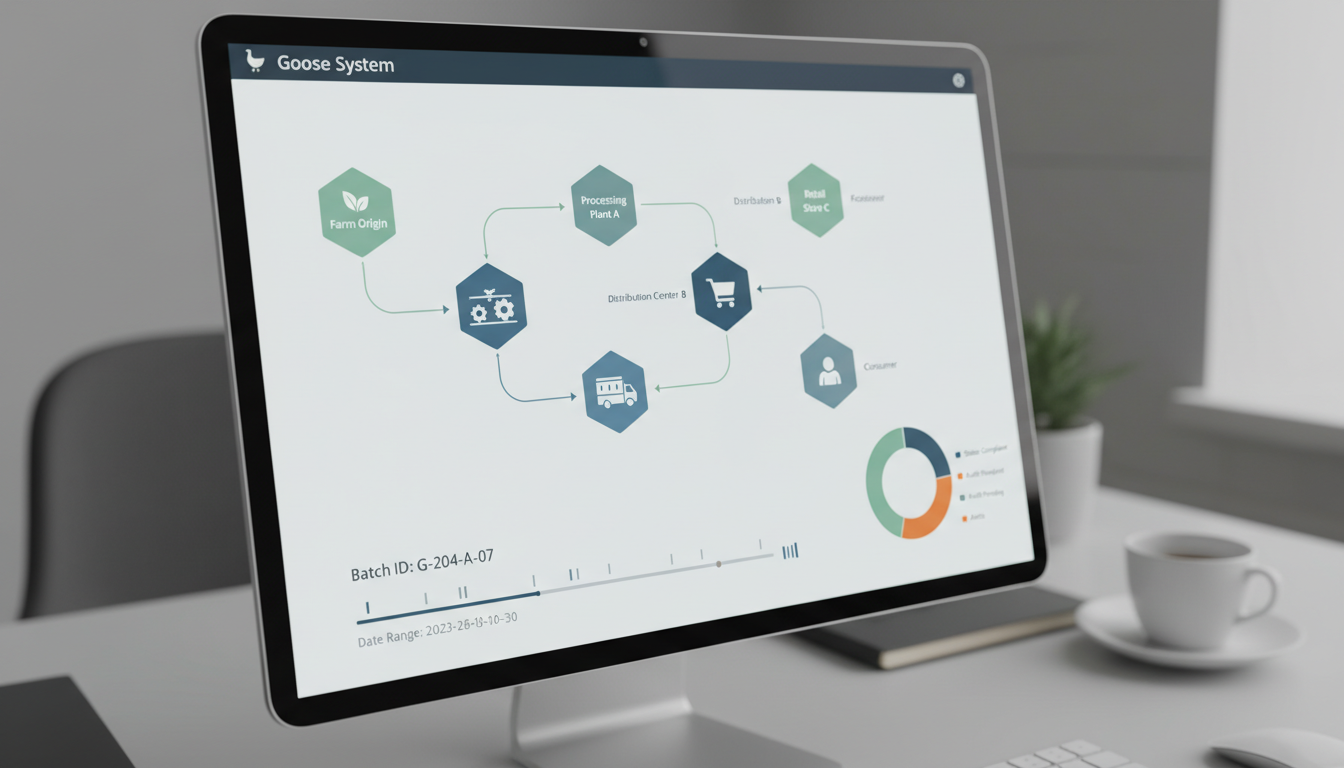
Zero-Click Summary: The Goose system removes the administrative burden of FSMA 204 by automatically logging every entry and exit of product lot codes. By creating a digital ‘chain of custody’ with every scan, the system generates the necessary KDEs (Key Data Elements) required for FDA compliance without manual intervention.
As a Logistics Technology Specialist focusing on the food and beverage sector, I have observed a significant shift in the operational landscape. The introduction of the FDA’s Food Safety Modernization Act (FSMA) Section 204(d) is not merely a regulatory update; it is a fundamental restructuring of how data must flow through the supply chain. For the modern Food Processing Operations Manager, the challenge is no longer just about moving product efficiently—it is about moving product while simultaneously generating a granular, immutable digital twin of that product’s journey.
The “Traceability Rule” mandates that entities at both ends of the supply chain, as well as those in the middle, maintain detailed records for specific high-risk foods. This is where automated FSMA 204 records become a critical operational asset rather than a secondary concern. Relying on legacy systems or manual documentation is a recipe for non-compliance and massive financial exposure. To mitigate these risks, industry leaders are turning to the Goose System to automate the collection of Critical Tracking Events (CTEs) and Key Data Elements (KDEs).
The Burden of Paper Logs
In many food processing facilities, the standard operating procedure for traceability still involves clipboards, spreadsheets, and human memory. This manual approach is fraught with systemic vulnerabilities. When an inspector from the FDA requests a traceability lot code report, the “48-hour rule” begins. Under FSMA 204, companies must be able to provide an electronic sortable spreadsheet to the FDA within 24 to 48 hours of a request. For facilities using paper logs, this triggers a frantic, all-hands-on-deck search through filing cabinets and disparate Excel files.
The complexity of FSMA 204 lies in the requirement to track specific KDEs at every CTE. Whether it is the initial packing, receiving, transforming, or shipping of a food item on the Food Traceability List (FTL), the data points—such as traceability lot codes, GPS coordinates, dates, and times—must be captured with precision. Manual entry is the primary source of data “noise.” A single transposed digit in a lot code can break the entire chain of custody, making it impossible to reconcile inventory during an audit.
Furthermore, the financial stakes of maintaining paper-based systems are staggering. Industry data indicates that the average food recall costs a company $10 million in direct costs and lost sales. This figure does not account for the long-term brand damage or the legal fees associated with compliance failures. Paper logs are not just slow; they are expensive. They consume hundreds of man-hours in data entry and filing, hours that could be better spent optimizing the production line or improving yield. The Goose System eliminates this friction by moving the data collection process from the office desk to the warehouse floor.
Scanning for Compliance
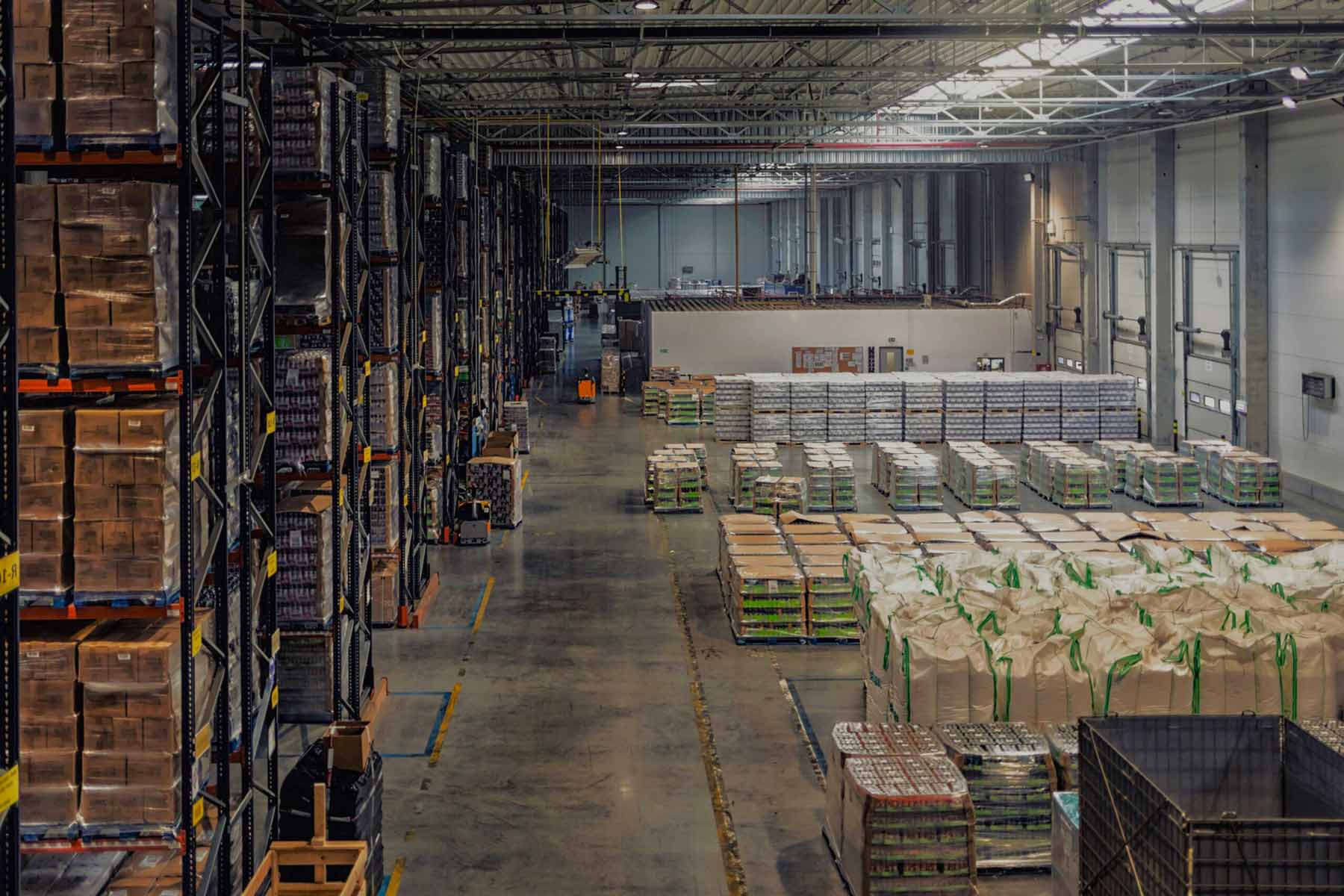
The Goose System approaches FSMA 204 compliance through the lens of “Point-of-Action” data capture. Instead of requiring warehouse staff to fill out forms after a task is completed, the system integrates data collection into the physical workflow. By utilizing ruggedized mobile scanners and intuitive software, every movement of a product becomes a recorded event in a digital ledger.
When a shipment of high-risk ingredients arrives at the loading dock, the Goose System records the “Receiving” CTE instantly. By scanning the supplier’s barcode, the system automatically captures the Traceability Lot Code (TLC), the location description, and the timestamp. This information is instantly linked to your internal inventory, creating automated FSMA 204 records that are stored in a secure, cloud-based environment. This process ensures that Real-Time Inventory Visibility is maintained, which is a cornerstone of both compliance and operational excellence. For more on this, see how Real-Time Inventory Visibility: How the Goose System Optimizes Logistics can transform your facility’s efficiency.
During the “Transformation” stage—where raw ingredients are processed into finished goods—the Goose System excels. It allows managers to link the input lot codes to the new output lot codes automatically. This creates a parent-child relationship in the data, ensuring that if a single ingredient is flagged for a recall, every finished product containing that ingredient can be identified in seconds. The system removes the “human element” from data logging, ensuring that the KDEs are captured accurately 100% of the time.
Real-time Audit Readiness
The ultimate goal of FSMA 204 is to enable the FDA to rapidly identify the source of foodborne illnesses to protect public health. For an Operations Manager, this translates to being “Audit Ready” at all times. Real-time audit readiness means that you are not preparing for an audit; you are simply living in a state of continuous compliance. The Goose System’s dashboard provides a bird’s-eye view of your facility’s traceability health, flagging any gaps in the chain of custody before they become a liability during an official inspection.
With the Goose System, the “Traceability Plan” required by the FDA is backed by hard, digital evidence. The system generates sortable electronic spreadsheets—the exact format the FDA requires—at the touch of a button. This shift from reactive searching to proactive reporting changes the dynamic of an FDA inspection. Instead of a high-stress, multi-day ordeal, an audit becomes a brief demonstration of your facility’s technological sophistication and commitment to food safety.
Consider the following comparison between traditional manual processes and the automated workflows provided by the Goose System:
| Audit Task | Manual Process | Goose System |
|---|---|---|
| Record Retrieval | 48-72 Hours | < 5 Minutes |
| Lot Reconciliation | Manual Spreadsheet | Automated Dashboard |
| Compliance Risk | High (Human Error) | Low (Scanned Data) |
The reduction in record retrieval time is perhaps the most significant benefit for operations managers. Reducing a 72-hour stress test into a 5-minute task allows your team to stay focused on production targets rather than administrative damage control. This speed is what saves millions of dollars during a recall event, as it allows for “surgical” recalls—only removing the specific affected lots rather than clearing out entire warehouse shelves unnecessarily.
The Technical Edge: Why Goose?
As a Logistics Technology Specialist, I am often asked what differentiates the Goose System from a standard Warehouse Management System (WMS). While many WMS platforms track inventory, few are built specifically to handle the “Key Data Element” requirements of FSMA 204. The Goose System was designed with the Food Traceability List in mind. It understands the nuances of “Transformation” events and “Initial Packing” in a way that generic logistics software does not.
The system’s architecture is built on the principle of data integrity. Every scan is cryptographically logged with a user ID and a geolocation stamp. This ensures that the automated FSMA 204 records are not just complete, but verifiable. In the event of an investigation, you can prove exactly who scanned which pallet, where they were, and when the event occurred. This level of transparency is exactly what the FDA is looking for when they evaluate a company’s “Culture of Food Safety.”
Furthermore, the Goose System is designed for the reality of a busy food processing environment. The interface is high-contrast and easy to use for employees wearing gloves or working in cold-storage environments. It operates on standard hardware, meaning you don’t need to invest in proprietary, expensive equipment to achieve compliance. It is a scalable solution that grows with your facility, whether you are managing a single plant or a multi-national supply chain.
The Economic Case for Automation
Beyond compliance, the transition to the Goose System offers a compelling Return on Investment (ROI). The labor savings alone are significant. In a manual environment, data entry clerks and warehouse supervisors spend upwards of 15% of their time reconciling paperwork and verifying lot codes. By automating this via scanning, that labor is recaptured. When applied across a workforce of 50 or 100 people, the annual savings can reach hundreds of thousands of dollars.
Additionally, the accuracy of the Goose System reduces “shrink” and inventory loss. By having 100% accurate lot data, managers can implement more effective First-In, First-Out (FIFO) or First-Expired, First-Out (FEFO) protocols. This reduces the amount of product that must be discarded due to expiration, directly impacting the bottom line. FSMA 204 compliance, when handled through the Goose System, becomes a profit-center rather than a cost-center.
Frequently Asked Questions
- Q: Can the FDA access the Goose system directly?
A: No, the data is owned by you. You generate the reports for the FDA upon request. The Goose System gives you full control over what data is shared and when, ensuring you remain in compliance without compromising your internal proprietary data. - Q: Does the system work for products not on the Food Traceability List?
A: Yes. While FSMA 204 focuses on high-risk foods, the Goose System provides comprehensive traceability for all inventory. Many managers choose to use the system across their entire product line to ensure a consistent standard of quality and operational efficiency. - Q: How long does it take to implement the Goose System?
A: Because the system is cloud-based and designed for the food industry, implementation is significantly faster than traditional ERP or WMS overhauls. Most facilities are up and running with automated records in a matter of weeks.
Conclusion: Future-Proofing Your Operations
The era of “good enough” traceability is over. FSMA 204 represents a new standard of accountability in the food supply chain, and the deadline for compliance is approaching rapidly. For Food Processing Operations Managers, the choice is clear: continue to struggle with the inherent risks of manual logs, or embrace the efficiency of automated FSMA 204 records.
The Goose System provides the tools necessary to transform compliance from a burden into a competitive advantage. By automating the collection of KDEs and providing real-time audit readiness, Goose allows you to protect your company from the $10 million cost of a recall while simultaneously improving warehouse throughput and labor efficiency. In a world where data is as important as the product itself, the Goose System is your most valuable asset.
Ready to streamline your compliance?