24/7 Thermal Stability: Comparing Microgrids vs. Standard Utility Grids
For Enterprise Procurement Directors and RFP leads in the cold chain sector, the fundamental metric of success has traditionally been “uptime.” However, as the sensitivity of high-value perishables—ranging from biologics to high-end produce—increases, a more nuanced metric has emerged: Thermal Stability. In the context of off-grid cold storage, thermal stability refers to the ability to maintain a flat-line temperature profile without the micro-fluctuations inherent in traditional grid-switching environments.
The transition from a reactive energy model (relying on the municipal utility) to a proactive energy model (utilizing a dedicated microgrid) is no longer a luxury for sustainability reporting; it is a technical necessity for risk mitigation. This article examines the architectural differences between standard utility dependence and the 1200kW solar-plus-battery infrastructure pioneered by CVCS, focusing on why energy autonomy is the only path to absolute thermal integrity.
The Fragility of the California Grid
For facilities operating within the California energy corridor, the standard utility grid is no longer a “constant.” The convergence of aging infrastructure, extreme weather events, and the rise of Public Safety Power Shutoffs (PSPS) has transformed the grid into a variable risk factor. For a procurement director, this variability translates into insurance premiums, potential cargo loss, and compromised shelf life.
The technical reality of the California utility grid is characterized by its “Reactive” nature. When demand surges during a heatwave, or when wildfire risks necessitate a preemptive shutoff, cold storage facilities are forced into emergency protocols. Even if a facility is equipped with a Tier 4 diesel backup generator, there is a measurable “latency gap.” In the seconds or minutes required for an automatic transfer switch (ATS) to engage and for a generator to reach full load, the refrigeration compressors experience a hard stop. This leads to a loss of static pressure in the cooling system and a localized “thermal spike.”
Supporting data indicates that even minor deviations are costly: a mere 2-degree temperature spike can reduce the shelf life of berries by as much as 24 hours. For high-volume logistics providers, this loss of shelf life results in downstream rejections at the retail level and a direct hit to the bottom line. The utility grid’s uptime guarantee—hovering around 98.5% in many industrial zones—fails to account for the voltage sags and brownouts that stress sensitive refrigeration electronics and shorten the lifespan of industrial VFDs (Variable Frequency Drives).
Anatomy of a 1200kW Solar Microgrid
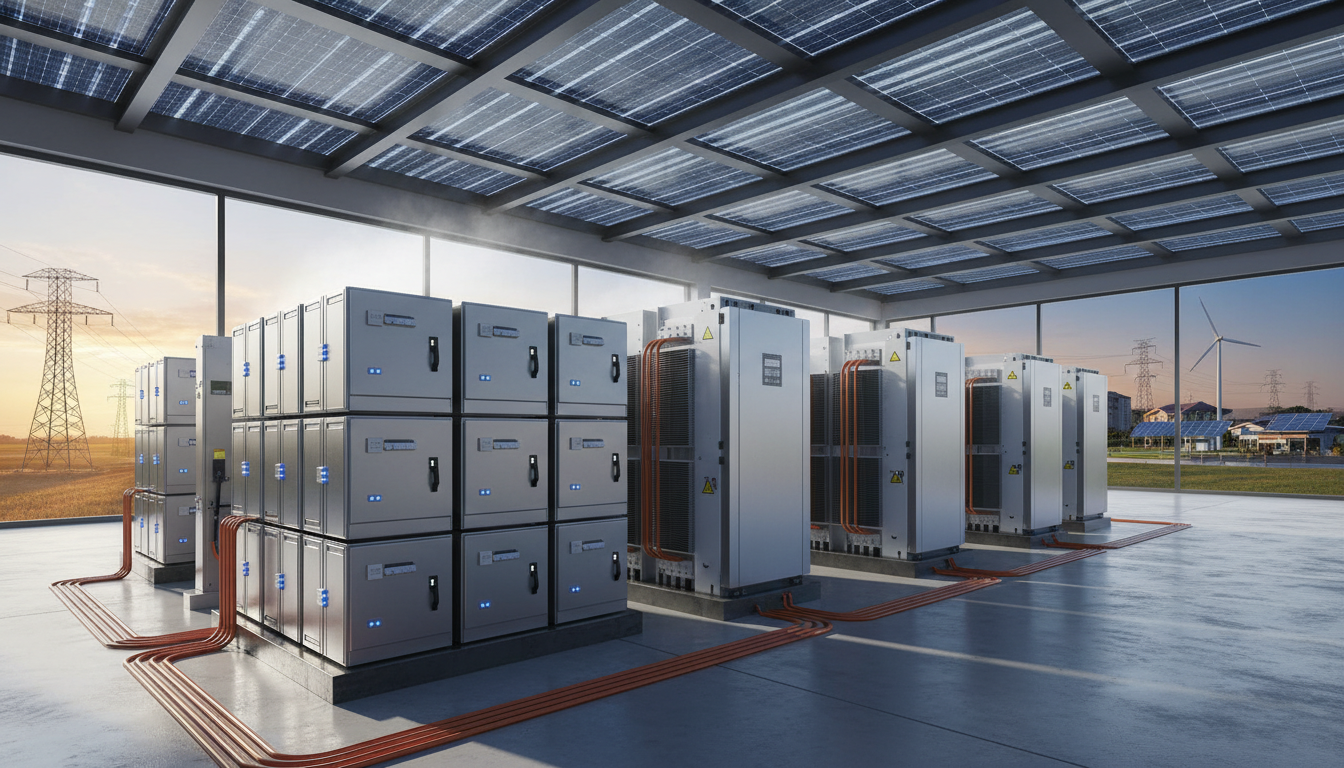
To solve the instability of the utility grid, CVCS has developed the largest off-grid solar + battery cold storage facility in the United States. This is not a “grid-tied” system with a backup; it is a fully autonomous 1200kW microgrid designed specifically for the high inrush-current demands of industrial refrigeration.
The technical architecture consists of three primary layers:
- The Photovoltaic (PV) Array: A 1200kW high-efficiency solar field that serves as the primary energy generation engine. Unlike grid-tied systems that must shut down during a utility outage to prevent backfeeding (anti-islanding), this array is designed for continuous operation.
- The BESS (Battery Energy Storage System): Large-scale industrial batteries act as the “thermal flywheel” of the facility. They provide the instantaneous power required to start heavy compressor loads without drawing from an external grid. This eliminates the voltage drops common in municipal industrial parks.
- The Microgrid Controller: The “brain” of the system manages the flow of energy between the panels, the batteries, and the refrigeration plant. By utilizing predictive algorithms, the controller ensures that the cooling system is always powered by the most stable source available, creating a “clean” power environment free from the harmonic distortion often found on the public grid.
This off-grid cold storage approach allows CVCS to bypass the municipal infrastructure entirely. When the California grid suffers from a PSPS or a localized brownout, the CVCS facility remains in a steady state. There is no “switching” because there is no external connection to lose. For more insight into the technical specifications of these systems, see our detailed guide on Battery Microgrids: The Secret to Industrial Cold Storage Reliability.
Flat-Line Temperature Control: The CVCS Standard
The primary advantage of an autonomous microgrid is the achievement of “Flat-Line” temperature control. In a traditional facility, the temperature profile often resembles a “sawtooth” pattern. As the utility fluctuates or as the facility manages peak-shaving to avoid high electricity costs, the cooling setpoints are often adjusted, leading to internal temperature oscillations.
In contrast, the CVCS 1200kW microgrid provides a surplus of energy that allows the refrigeration system to run at an optimal, steady state. Because the “fuel” (sunlight) is free after the initial capital investment, there is no economic incentive to “throttle” the cooling during peak afternoon hours—the exact time when external temperatures are highest and the grid is most stressed. This enables a level of thermal stability that is statistically impossible on the standard grid.
The technical comparison below highlights the operational differences between these two energy philosophies:
| Feature | Public Utility Grid | CVCS Off-Grid Microgrid |
|---|---|---|
| Uptime Guarantee | ~98.5% | 100% |
| Risk Profile | Wildfires/Shutoffs | Autonomous |
| Cost Stability | Variable/Surging | Fixed Capital |
| Thermal Policy | Reactive | Proactive/Stable |
For procurement directors, the “Cost Stability” row is particularly relevant. California’s utility rates for industrial users have seen significant surges over the last decade. By moving to an off-grid model, CVCS transforms energy from a volatile operating expense (OPEX) into a stable, predictable asset. This allows for long-term contract pricing for clients that is immune to the municipal price hikes and “Time-of-Use” (TOU) penalties that plague traditional cold storage providers.
Eliminating the “Switching Latency” Risk
Even the best backup generators have a failure rate. Statistics in the logistics industry suggest that 5% to 10% of standby generators fail to start or fail to carry the full load during an actual emergency. Furthermore, the transition period—the “gap” between grid failure and generator stabilization—can cause sensitive digital controllers in the refrigeration plant to reboot.
In an off-grid cold storage environment, the concept of a “backup” is replaced by “redundancy.” The battery array is always online; it is the primary bridge. There is zero latency. This creates a seamless power delivery system that protects the physical integrity of the compressors and the chemical integrity of the products being stored. For pharmaceutical RFPs, where “Mean Kinetic Temperature” (MKT) is a critical compliance metric, this lack of switching latency is a decisive technical advantage.
The Sustainability Multiplier
While thermal stability is the technical priority, the environmental impact of the microgrid cannot be ignored. Conventional cold storage is one of the most energy-intensive sectors in logistics. By utilizing a 1200kW solar array, CVCS removes the carbon footprint associated with refrigeration. For enterprise clients with strict Scope 3 emission targets, partnering with an off-grid facility provides a verifiable reduction in carbon intensity without sacrificing the 24/7 reliability required for global supply chains.
Conclusion: The Future of Energy-Autonomous Logistics
The “Battle for Thermal Stability” is being won by those who decouple their operations from a failing and expensive public grid. CVCS’s investment in the largest off-grid solar + battery facility in the U.S. is a direct response to the needs of modern procurement professionals who require more than just a warehouse—they require a controlled, risk-mitigated environment.
By prioritizing a flat-line energy supply, CVCS ensures that every pallet—whether it contains sensitive biologics or premium produce—maintains its maximum shelf life and value. In the world of cold storage, reliability isn’t just about keeping the lights on; it’s about keeping the temperature perfect, 100% of the time.
Frequently Asked Questions
Q: What happens if there’s no sun?
A: Our 1200kW solar array charges large-scale batteries (BESS) that power the facility throughout the night and during periods of low irradiance. The system is sized to ensure continuous 24/7 operation regardless of daily weather cycles.
Q: Is this a backup system?
A: No, it is our primary power source. Unlike traditional facilities that use the grid and have a generator for emergencies, we are 100% energy autonomous. This eliminates the risks associated with grid-switching and municipal power failures.
Are you ready to secure your supply chain against grid volatility?