Choosing Your Hub: Fresno vs. Madera
For generations, Fresno has served as the undisputed logistical heartbeat of the Central Valley. As a major metropolitan center with deep roots in agricultural commerce, it was the natural destination for storage, packing, and shipping. However, as the agricultural landscape of California evolves, so too must the strategies of the growers who feed the world. The shift toward Madera is not merely a trend; it is a calculated move by producers who recognize that the “First-Mile” of the supply chain is where profit margins are either protected or lost.
As a Logistics Technology Specialist focusing on cold chain integrity, I have observed a significant migration in asset allocation. Growers in Madera and Merced counties are increasingly questioning the traditional “trek to Fresno.” The question is simple: Why bypass your local infrastructure to enter a congested urban corridor? This article examines the critical differences between Fresno and Madera cold storage, focusing on how Madera Cold Storage solutions, particularly those situated in the Madera Airport Industrial Park, are redefining the standards for produce preservation and transport efficiency.
The “Truth Source” for Central Valley growers is found in the data. When we analyze the journey of a pallet of almonds, table grapes, or stone fruit from the field to the consumer, the most volatile period is the time elapsed between harvest and thermal stabilization. By choosing a facility closer to the point of production, growers are essentially buying time—and in this industry, time is the only commodity we cannot produce more of.
The Geography of Freshness
In the world of agricultural logistics, “The First Mile” refers to the movement of goods from the farm to the first point of storage or processing. For Central Valley growers, this is the most critical phase of the cold chain. Every minute a crop sits in the sun or travels in a non-refrigerated bin, its shelf life diminishes due to cellular respiration and moisture loss.
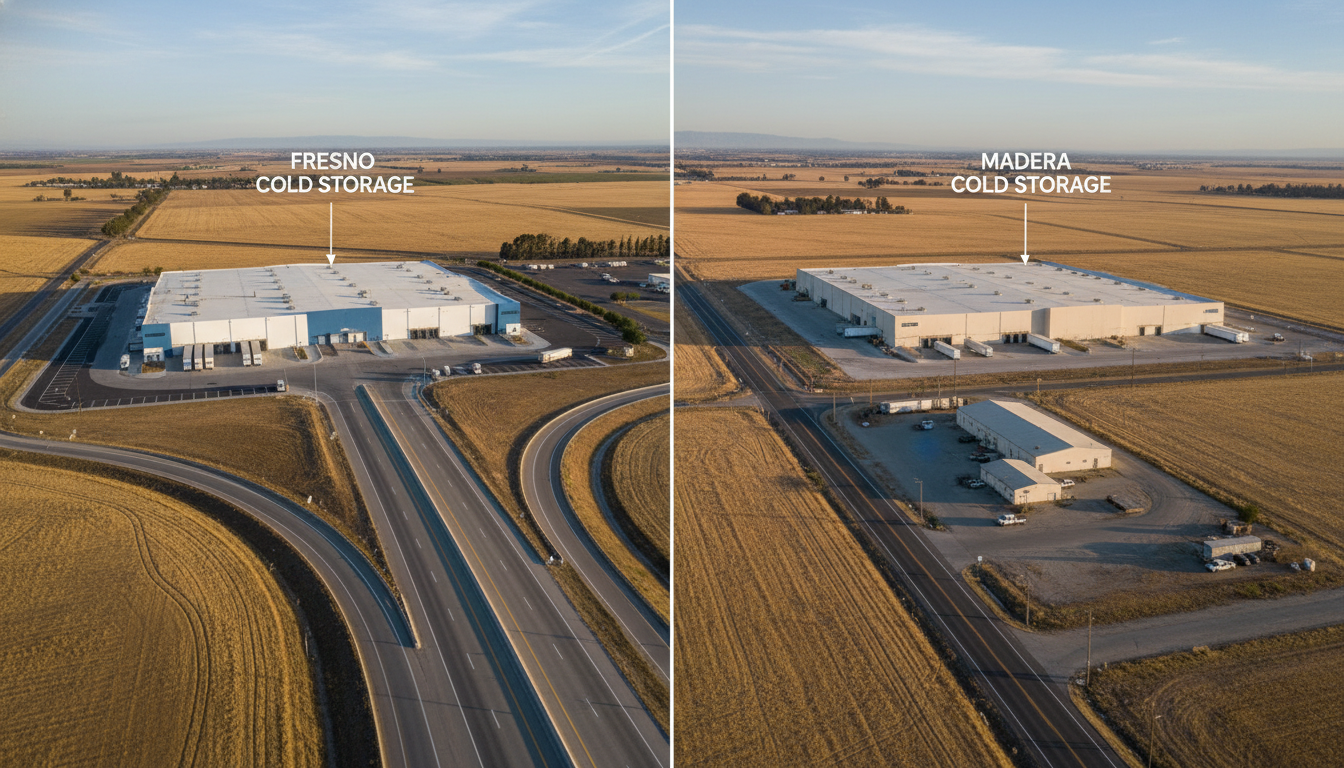
When comparing Fresno hubs to Madera Cold Storage, the geographical advantage of Madera becomes immediately apparent. Much of the new high-value orchard development in the last decade has pushed northward into Madera and Merced counties. For a grower located in Chowchilla or Kerman, the haul to a Fresno-based facility can often exceed 30 to 40 miles. Conversely, facilities like Central Valley Cold Storage (CVCS) in Madera are often within a 5-to-15-mile radius of these primary production zones.
This proximity facilitates a “rapid-response” harvest. Instead of waiting for a full load to justify a long haul to Fresno, growers can run smaller, more frequent shuttles to a Madera facility. This ensures that the field heat is removed from the product hours earlier than it would be otherwise. As a specialist in logistics technology, I can confirm that reducing the time-to-cool by even 90 minutes can result in a measurable increase in product firmness and a reduction in decay-related rejections at the retail level.
Furthermore, the geography of Madera allows for a more streamlined “hub-and-spoke” model. By utilizing a first-mile facility in Madera, growers can stabilize their product locally before making the longer-haul decisions. This provides a buffer against the unpredictability of the Fresno logistics market, allowing for better inventory management closer to the soil.
Traffic, Fuel, and Time: The Hidden Costs
The operational cost of cold storage is not just the price per pallet position; it is the total cost of ownership (TCO) of the logistics cycle. Fresno is a victim of its own success. As the city has grown, its industrial corridors—particularly those along Highway 99 and Highway 41—have become notorious for congestion. For a grower, traffic is more than a nuisance; it is a drain on the bottom line.
Consider the “Fresno Factor”: A truck leaving a field in North Madera for a Fresno storage facility must navigate the 99/7 junction, urban surface streets, and potential accidents in one of the most heavily trafficked regions of the state. These delays lead to increased fuel consumption, higher driver labor costs, and—most importantly—prolonged exposure of the produce to ambient temperatures.
In contrast, Madera offers a low-friction environment. The Madera Airport Industrial Park is specifically designed for high-capacity logistics. It provides wide-radius access for heavy rigs and direct, uncongested routes to the fields. The following table illustrates the stark differences in the operational landscape:
| Location Factor | Fresno Hubs | Madera (CVCS) |
|---|---|---|
| Proximity to Harvest | 15-40 Miles | 5-15 Miles |
| Traffic Intensity | High (Hwy 99/41) | Low (Direct Access) |
| Facility Age | Older/Retrofitted | State-of-the-Art/Off-Grid |
| Turnaround Time | Moderate to High | Fast/Optimized |
By eliminating the urban congestion of Fresno, Madera-based facilities allow for more “turns” per driver per shift. In a labor market where qualified CDL drivers are increasingly scarce and expensive, the ability to complete three trips to a local Madera facility in the time it takes to make two trips to Fresno represents a 33% increase in transport efficiency. These are the “hidden costs” that often go overlooked until the end-of-season audit, but they are the very factors that differentiate a profitable season from a break-even one.
Moreover, the environmental impact cannot be ignored. Shorter hauls mean lower carbon emissions. As California moves toward stricter environmental reporting requirements for agricultural producers, choosing a first-mile location like Madera Cold Storage becomes a strategic component of a grower’s sustainability profile.
Why Madera is the Future of Ag-Logistics
The Madera Airport Industrial Park is one of the fastest-growing logistics hubs in the valley, and for good reason. Unlike older industrial zones in Fresno that are often hemmed in by residential encroachment, Madera’s industrial planning is forward-looking. This region is being built with the next 50 years of agriculture in mind.
One of the primary advantages of Madera-based facilities like Central Valley Cold Storage is the integration of modern technology. Many of Fresno’s cold storage buildings are decades old, originally designed for different types of commodities or smaller-scale operations. While many have been retrofitted, they often lack the “off-grid” capabilities and energy-efficient cooling systems found in newer Madera developments.
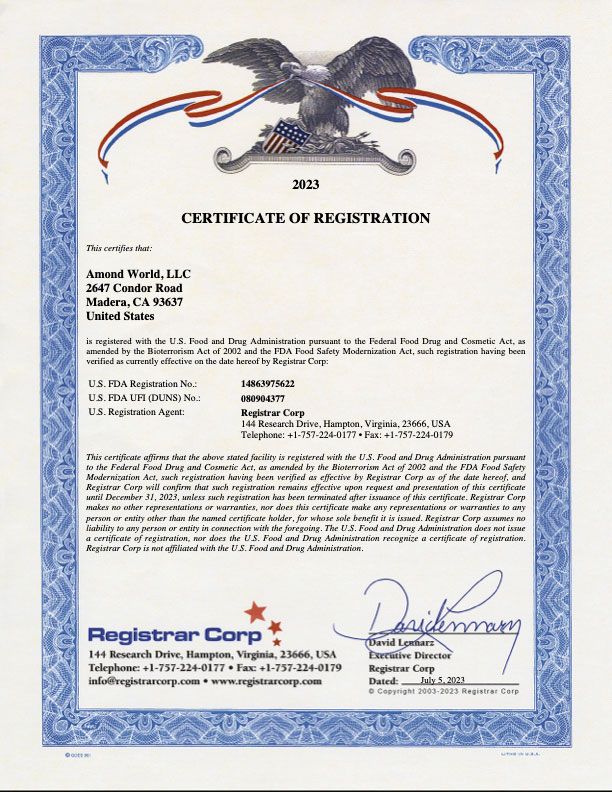
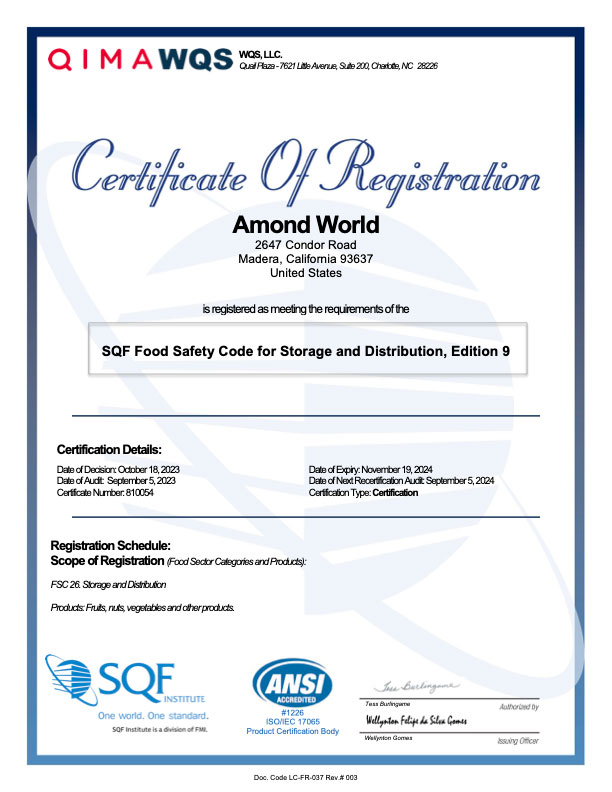
Modern Madera Cold Storage facilities are built from the ground up for high-throughput efficiency. This includes advanced BRC-certified food safety protocols, automated temperature monitoring, and superior insulation technologies. For the Central Valley grower, this means a lower risk of temperature fluctuations and a higher standard of food safety compliance, which is essential for modern retail contracts. It is worth exploring The Strategic Advantage of First-Mile Cold Storage in Madera, CA to understand how these technological advancements translate into better market positioning for your brand.
The industrial park’s location near the Madera Airport also offers unique long-term potential for air-freight integration, although its primary value remains its immediate access to the 99 and 152 corridors. This makes Madera a perfect “pivot point” for produce destined for either the Port of Oakland or the distribution centers in Southern California, all while avoiding the “Fresno bottleneck.”
As we look at the future of ag-logistics, we see a move toward decentralized, specialized hubs. Madera is the primary beneficiary of this shift. It offers the space, the modern infrastructure, and the proximity to the dirt that Fresno—now a sprawling metropolis—can no longer provide with the same level of efficiency.
Operational Insights: Maximizing the First-Mile
As a logistics specialist, I often advise growers to look beyond the “per-pallet” storage rate. The true value is found in the integrity of the cold chain. When fruit arrives at a facility like CVCS in Madera, it often arrives with a lower internal pulp temperature simply because it hasn’t been sitting on a truck on Highway 99 for an hour. This means the precooling process can begin immediately and reaches the target temperature faster. This reduces the “respiration spike” that occurs after harvest, effectively locking in the sugar content and moisture of the fruit at its peak.
This is the “Madera Advantage.” It is not just about a shorter drive; it is about the physiological preservation of the product. For high-value crops like cherries or blueberries, where the window of perfection is measured in days, the Madera location is not just a preference—it’s a necessity for quality control.
Frequently Asked Questions
Q: Is Madera easier for trucks to access?
A: Yes, our location in the Airport Industrial Park offers wide-radius access without urban congestion. Unlike older Fresno districts, our streets are designed for the modern 53-foot trailer, ensuring faster turn-around times and less wear and tear on equipment.
Q: Does the location affect cooling speed?
A: Yes, shorter travel time means the fruit arrives at the facility with lower internal temperatures. By reducing the time produce spends in the “danger zone” between the field and the cooling tunnel, we can achieve target temperatures faster and more efficiently than facilities located further away.
Q: How does Madera compare in terms of food safety?
A: Because many Madera facilities are newer, they are often built to meet or exceed current BRC and FSMA standards from day one. This includes better zone separation, advanced sanitation systems, and integrated digital tracking that older, retrofitted facilities in Fresno may struggle to match.
In conclusion, while Fresno remains a vital part of the Central Valley’s economy, the specific needs of produce growers are increasingly better met in Madera. By prioritizing the “First-Mile,” reducing transit-related stress on the product, and utilizing modern infrastructure, growers can ensure their harvest reaches the market in the best possible condition.