California’s Dominant Position in Global Walnut Markets
California produces more than 99% of the US commercial walnut crop and approximately 30–35% of world walnut supply, with the San Joaquin Valley (particularly Tulare, Fresno, and Stanislaus counties) and the Sacramento Valley accounting for the majority of production. The state exports approximately 70% of its walnut crop annually — primarily to Turkey, Germany, Spain, South Korea, Japan, China, and Australia — making California the world’s largest walnut exporter.
This export dependence means that California walnut quality must meet exacting international standards, with long supply chains (ocean transit plus in-market distribution) requiring superior post-harvest storage to maintain quality from harvest through consumer purchase.
The Two Primary Quality Risks: Rancidity and Shell Stain
Oxidative rancidity is the primary quality defect in long-stored walnuts. Walnuts have the highest polyunsaturated fat content of any major tree nut (~72% of fat as PUFA), making them more susceptible to oxidative rancidity than almonds or pistachios. Rancidity develops through the oxidation of linolenic and linoleic acids (the dominant fatty acids in walnut), producing aldehydes and ketones with unpleasant off-flavors and odors.
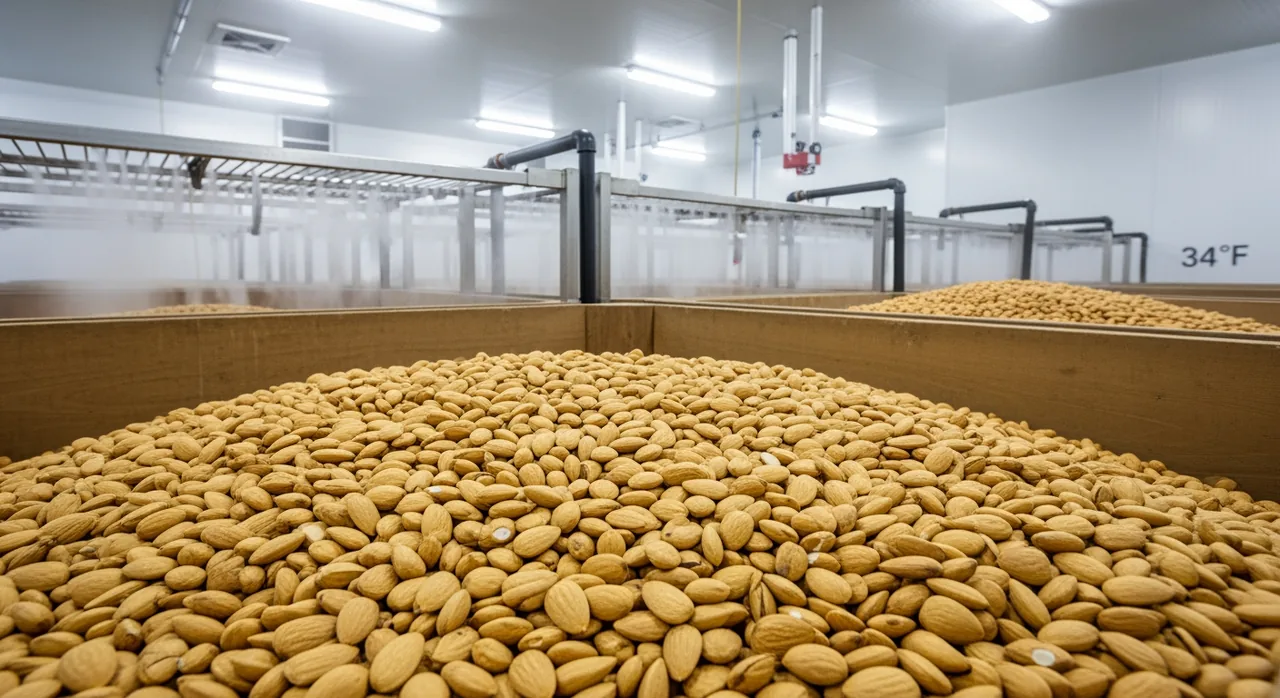
At ambient temperature (70°F), peroxide values (the primary measure of primary oxidation) reach rejection levels within 3–4 months for in-shell walnuts and within 1–2 months for walnut halves and pieces (which have greater exposed surface area). Refrigerated storage at 32–34°F slows oxidation by approximately 10-fold, extending acceptable shelf life to 12 months for in-shell and 6–8 months for shelled. CA storage at 1% O2 extends these timelines to 18–24 months and 12–15 months respectively.
Shell stain is a surface browning of the walnut shell caused by enzymatic oxidation of polyphenolic compounds in the shell tissue following hull removal. Shell stain is not a safety concern and does not affect kernel quality — but it dramatically affects market acceptance, since shell color is one of the primary visual quality indicators for in-shell walnuts. Asian markets (particularly China and South Korea) are especially sensitive to shell color, preferring Extra Light or Light color grades over darker stained product.
Shell stain is minimized through: rapid post-harvest hull removal (within 24 hours of harvest), immediate drying to prevent enzymatic activity, and cold storage without prolonged exposure to high humidity that reactivates enzymatic browning reactions.
Drying: The Critical Pre-Storage Step
In-shell walnuts must be dried to ≤8% moisture content before cold storage — high-moisture walnuts are susceptible to mold, internal discoloration, and accelerated rancidity. Drying takes place in high-temperature forced-air dryers at 95–105°F, and is completed within 18–24 hours for most commercial-scale operations. Over-drying (below 6% moisture) produces a more brittle shell and increased kernel breakage during cracking.
After drying, walnuts must be cooled to near ambient temperature before entering cold storage — placing warm walnuts directly into a cold room causes condensation on the shell that reverses the drying work and initiates hull stain. A 24-hour ambient cooling period in a shaded, ventilated area before cold storage entry is standard practice.
Export Phytosanitary Requirements
California walnuts exported to most markets require a USDA APHIS phytosanitary certificate attesting to inspection and freedom from quarantine pests. Japan, South Korea, and Australia have additional quarantine requirements for codling moth — a pest found in California walnut orchards — that may require methyl bromide or heat treatment as a condition of entry. Cold storage operators handling export walnuts should understand which treatment options their facility supports and ensure treatments are documented in export documentation.