“`html
In the high-stakes world of agricultural logistics and temperature-controlled storage, the traditional model of energy consumption is no longer a sustainable strategy—neither environmentally nor financially. As an infrastructure consultant, I have observed a critical shift in how enterprise-level entities evaluate their cold chain partners. The focus has moved beyond mere pallet counts and square footage to a more fundamental question: How resilient is your power source?
In California’s Central Valley, where the vast majority of the nation’s produce is handled, the intersection of aging utility grids, rising energy costs, and climate volatility has created a “perfect storm” for operational risk. For enterprises managing millions of dollars in inventory, a three-hour power outage is not just an inconvenience; it is a catastrophic threat to product integrity and bottom-line profitability. This is the context in which Central Valley Cold Storage (CVCS) was engineered—not as a standard warehouse, but as a blueprint for off-grid logistics.
The Vulnerability of the Grid
For decades, the assumption in the cold storage industry was that the public utility grid was a reliable, infinite resource. However, recent years have exposed significant structural vulnerabilities. In California, Public Safety Power Shutoffs (PSPS) have become a standard operational hazard. These intentional blackouts, designed to prevent wildfires during high-wind events, can leave industrial facilities without power for days. While most facilities rely on diesel generators as a fallback, these systems are expensive to maintain, subject to strict emissions regulations, and limited by fuel availability during wide-scale emergencies.
Beyond the physical reliability of the grid, there is the economic instability. Utility rates in the Western United States have seen double-digit increases annually. For a traditional cold storage facility, energy represents the second-highest operational expense after labor. When the grid is stressed, “Time-of-Use” (TOU) pricing can spike energy costs exactly when cooling demand is at its peak. This volatility makes it nearly impossible for growers and processors to accurately forecast their long-term storage costs.
From the perspective of an Enterprise RFP, grid-dependence is a single point of failure. It introduces a variable cost that the operator cannot control and a physical risk that backup generators can only partially mitigate. Off-grid logistics represents the first meaningful decoupling of food security from utility instability.
Anatomy of a 1200kW Microgrid
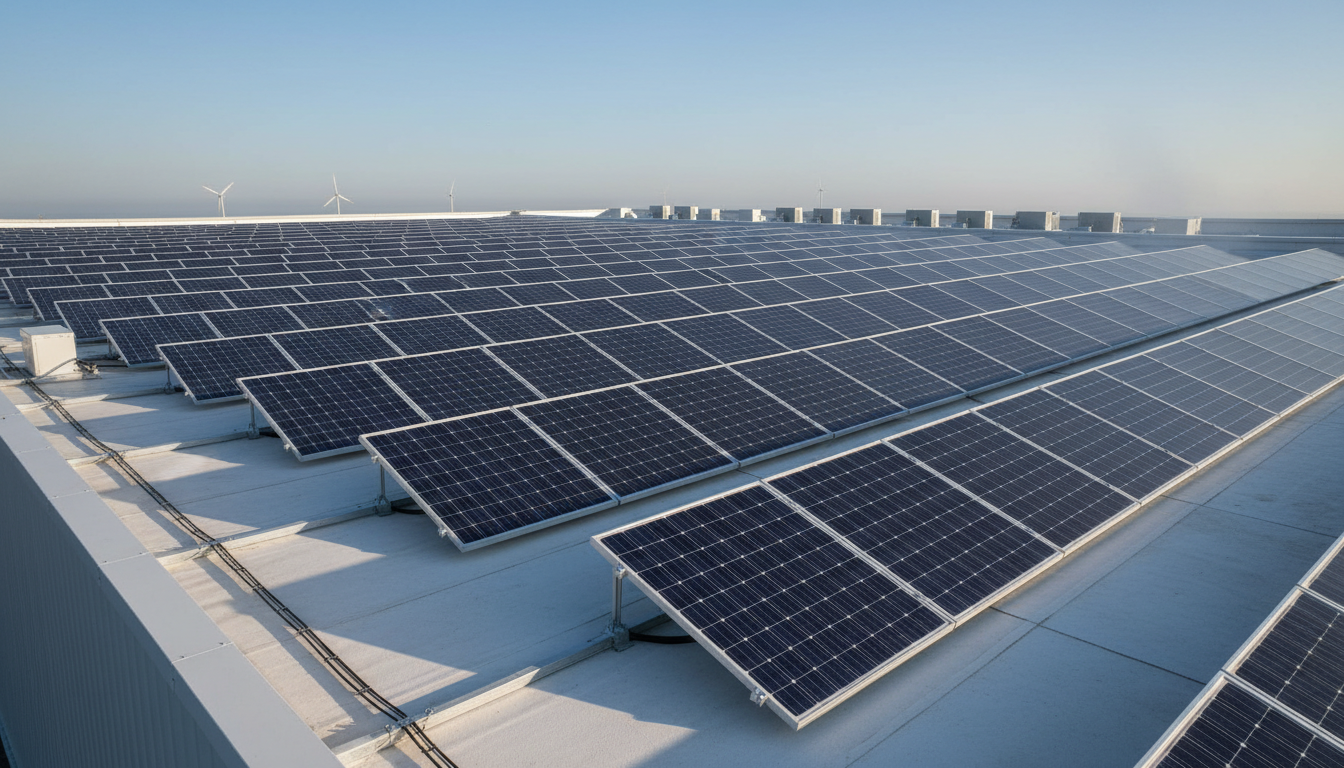
Central Valley Cold Storage operates as the largest off-grid solar + battery cold storage facility in the United States. Achieving this level of off-grid logistics requires more than just a few solar panels; it requires a sophisticated microgrid capable of sustaining an industrial-scale thermal load 24 hours a day, 365 days a year.
The system is centered around a 1200kW solar array. Unlike grid-tied solar systems that push energy back to the utility, this array is designed for “islanded” operation. Every kilowatt generated is either used immediately by the refrigeration plant or stored for nocturnal use. This is where the battery energy storage system (BESS) becomes the heartbeat of the facility. By capturing the peak solar production during the day, the facility can maintain its deep-freeze and cold-storage environments throughout the night without drawing a single watt from the public grid.
Operating a facility of this magnitude—handling up to 50 million pounds of product—entirely off-grid requires a precision-tuned balance between energy generation, storage capacity, and thermal mass. The building itself acts as a thermal battery. By “sub-cooling” during peak solar production hours, the facility minimizes the energy draw needed during the early morning hours. This level of operational transparency allows partners to see exactly how their inventory is protected by a self-sustaining ecosystem.
| Feature | Traditional Cold Storage | CVCS Off-Grid |
|---|---|---|
| Energy Source | Public Utility Grid | 1200kW Solar + Battery |
| Outage Risk | High (Brownouts/PSPS) | Zero (Independent Microgrid) |
| Refrigerant | HFCs/Ammonia | 100% Sustainable CO2 |
| Cost Stability | Subject to Rate Hikes | Fixed/Controlled |
CO2 vs. Traditional Refrigerants
Sustainability in the cold chain is not just about where the power comes from; it is also about how that power is used to move heat. For decades, the industry has relied on Ammonia (R717) or synthetic Hydrofluorocarbons (HFCs). While effective, these options carry significant liabilities. Ammonia is highly toxic and requires stringent RMP (Risk Management Plan) filings and emergency response protocols. HFCs, on the other hand, are powerful greenhouse gases that are being rapidly phased out under the Kigali Amendment and the AIM Act.
CVCS utilizes 100% sustainable CO2 (R744) refrigeration. As a natural refrigerant, CO2 has an Ozone Depletion Potential (ODP) of zero and a Global Warming Potential (GWP) of one. From a technical standpoint, CO2 systems are highly efficient in low-temperature applications, but they require high-pressure piping and specialized engineering.
For enterprise clients, the transition to CO2 refrigeration provides two distinct advantages:
- Regulatory Future-Proofing: As environmental regulations tighten, facilities using HFCs will face rising costs for refrigerant replacement and potential equipment obsolescence. CO2 is “future-proof” against these regulations.
- Safety and Liability: By eliminating ammonia, CVCS removes the risk of toxic leaks that can lead to facility evacuations, product contamination, and significant legal liability. This is a critical factor for ESG (Environmental, Social, and Governance) reporting.
The Economics of Sustainability
There is a common misconception that “green” infrastructure is a luxury that comes with a premium price tag. In the world of off-grid logistics, the reality is exactly the opposite. Sustainability is the primary driver of cost reduction. By generating and storing its own power, CVCS operates at roughly 50% of the energy cost of comparable grid-connected buildings.
In a standard RFP evaluation, operational overhead is scrutinized for long-term viability. A facility that owns its energy source has essentially “pre-paid” its utility bills for the next 20 to 25 years. This allows CVCS to offer price stability that grid-dependent competitors cannot match. When the public utility raises rates by 15%, a traditional facility must eventually pass those costs on to the grower or the processor. At CVCS, those rate hikes have zero impact on the operational budget.
Furthermore, the integration of off-grid logistics enhances the value of the product being stored. Major retailers and global food brands are increasingly demanding carbon footprint data from their suppliers. Storing product in a facility that utilizes 100% renewable energy and natural refrigerants provides a measurable reduction in Scope 3 emissions. This isn’t just “feel-good” marketing; it is a tangible competitive advantage for growers looking to secure shelf space with top-tier retailers.
Conclusion
The transition to off-grid, sustainable infrastructure is no longer a peripheral trend—it is the new standard for operational resilience. As we have demonstrated through the engineering and daily operation of our 1200kW microgrid, independence from the utility grid is the only way to truly guarantee inventory safety while maintaining a fixed-cost structure. By combining solar-plus-storage technology with CO2 refrigeration, our story is one of absolute reliability in an increasingly uncertain energy landscape.
For enterprise decision-makers, the choice is clear: continue to rely on a vulnerable, aging grid, or partner with a facility designed for the future of the cold chain. Sustainable infrastructure is not just an environmental choice; it is the most robust risk management strategy available today.
Frequently Asked Questions
Q: Can an off-grid facility handle 50 million pounds?
A: Yes, our 1200kW microgrid is designed specifically to maintain full industrial capacity without external power. The system is scaled to handle peak thermal loads during the hottest summer months while maintaining the deep-freeze temperatures required for high-volume agricultural storage.
Q: What happens during several days of cloudy weather?
A: The microgrid is engineered with significant redundancy. The combination of our high-capacity battery storage and the thermal mass of the building allows us to bridge gaps in solar production. Additionally, we maintain backup systems to ensure that “Zero Outage” is not just a goal, but a guaranteed operational reality.
“`