Table Grape Cold Storage: Turgidity, SO2 Management, and Export-Ready Quality
Table Grape Cold Storage Defined
Table grape cold storage is a precision climate-control system maintaining fresh table grape clusters at 30–32°F with 90–95% relative humidity and controlled SO2 (sulfur dioxide) atmosphere to preserve fruit turgidity, suppress Botrytis (gray mold), prevent stem browning, extend shelf life to 10–16 weeks, and maintain export-quality standards. This specialized infrastructure is essential for California’s San Joaquin Valley, which produces 99% of U.S. table grapes and supplies global markets with premium fresh fruit.
The San Joaquin Valley Table Grape Industry: Global Dominance and Export-Driven Economics
California’s Table Grape Supremacy: 385,000 Acres and $1.2 Billion Industry
The San Joaquin Valley is the world’s dominant table grape production region, generating over $1.2 billion annually from 385,000 acres. California produces 99% of U.S. table grapes and exports 200,000+ tons annually to 90+ countries, including Japan, India, Mexico, Australia, and Europe. This export-driven market requires year-round supply and premium quality maintenance across long-distance cold chains. Unlike wine or raisin grapes (where post-harvest processing is immediate), table grapes are sold fresh with 8–16 week storage and global transport. Cold storage and SO2 management are the linchpin technologies enabling this supply chain.
Harvest Concentration and Storage as Supply-Continuity Bridge
Table grape harvest is concentrated in August–October: >90% of fruit is picked within 8 weeks. Without cold storage, this concentrated harvest would flood markets in September–October, depressing prices by 60–80%, followed by supply scarcity (November–July) and price spikes. Cold storage decouples supply from harvest timing: fruit harvested in September can be released in November, December, February, or even May (week 30 of storage), ensuring year-round market availability and capturing price premiums during low-supply windows. A grower with cold storage can realize 30–50% price premiums on fruit released during February–April compared to harvest-time September fruit.
Table Grape Physiology: Turgidity, Respiration, and Post-Harvest Deterioration Mechanisms
Turgidity as the Quality Metric: Water Stress and Fruit Firmness
Table grape quality is primarily determined by turgidity—the hydrostatic pressure within fruit cells that gives grapes their characteristic firmness and “snap” texture. Grapes with high turgidity (full cellular water content) are perceived as fresh and premium; soft, shriveled grapes are unmarketable. Turgidity declines due to: (1) transpiration—water loss through the fruit skin to the atmosphere; (2) respiration—breakdown of sugars and acids that reduces cellular osmotic pressure; (3) physical damage—punctures, bruises, and cracks that destroy cell integrity. At room temperature (70°F) and 50% RH, table grapes lose 2–3% of fresh weight daily to transpiration and respiration, becoming shriveled within 3–5 days. At 32°F and 95% RH, daily water loss drops to 0.1–0.2%, maintaining turgidity for 12–16 weeks.
Respiration Suppression and the Q10 Temperature Effect
Table grape respiration (CO2 production and O2 consumption) follows the Q10 principle: metabolic rate approximately halves for every 10°F decrease in temperature. At 70°F, grapes produce 15–25 mg CO2/kg/hr; at 32°F, this drops to 2–3 mg CO2/kg/hr—an 80–90% reduction. This profound respiration suppression is the foundation of cold-storage quality maintenance: minimal sugar/acid breakdown means minimal taste degradation, minimal ethylene production (which triggers ripening and senescence), and minimal visual quality decline. A grape cluster stored at 32°F for 12 weeks experiences less physiological aging than the same cluster left at 70°F for 3 days.
Stem Browning and Abscission: The Primary Cosmetic Defect
The stem (rachis) connecting individual berries to the central branch is highly susceptible to dehydration and browning. At low humidity (<80% RH), stems lose water rapidly, becoming brown and brittle within days. Brown stems are cosmetically unacceptable for premium fresh-market grapes; even if fruit quality is excellent, brown stems trigger 20–50% price reductions or rejection. At 90–95% RH with 32°F temperature, stem transpiration is minimized and stems remain green for 12+ weeks. Additionally, stems become brittle as they dry, increasing abscission (berry drop): in low-humidity storage, berries detach from stems spontaneously, leaving scattered berries on the bunch and reducing market acceptability. High humidity + cool temperature prevent both browning and abscission.
SO2 (Sulfur Dioxide) Management: The Primary Defense Against Botrytis and Microbial Spoilage
Botrytis cinerea and Gray Mold: The Primary Pathogen Threat
Botrytis cinerea (gray mold) is the most destructive table grape storage pathogen. Spores are ubiquitous in vineyards and persist on fruit at harvest; many grapes have latent B. cinerea infections at harvest that are not visually apparent. At 70°F and 80–95% RH, B. cinerea germinates within 24–48 hours, colonizing berries and producing visible gray mold and rot. Affected fruit must be discarded, and the mold can spread to adjacent berries, contaminating entire clusters. Storage at 32°F suppresses B. cinerea growth by ~90% compared to room temperature, but even at cold temperature, the pathogen will eventually grow—especially if storage duration extends beyond 12 weeks. SO2 fumigation is the complementary control: SO2 gas directly inhibits B. cinerea spore germination and hyphal growth, acting synergistically with cold temperature.
SO2 Fumigation Protocols: Pad Placement and Application Timing
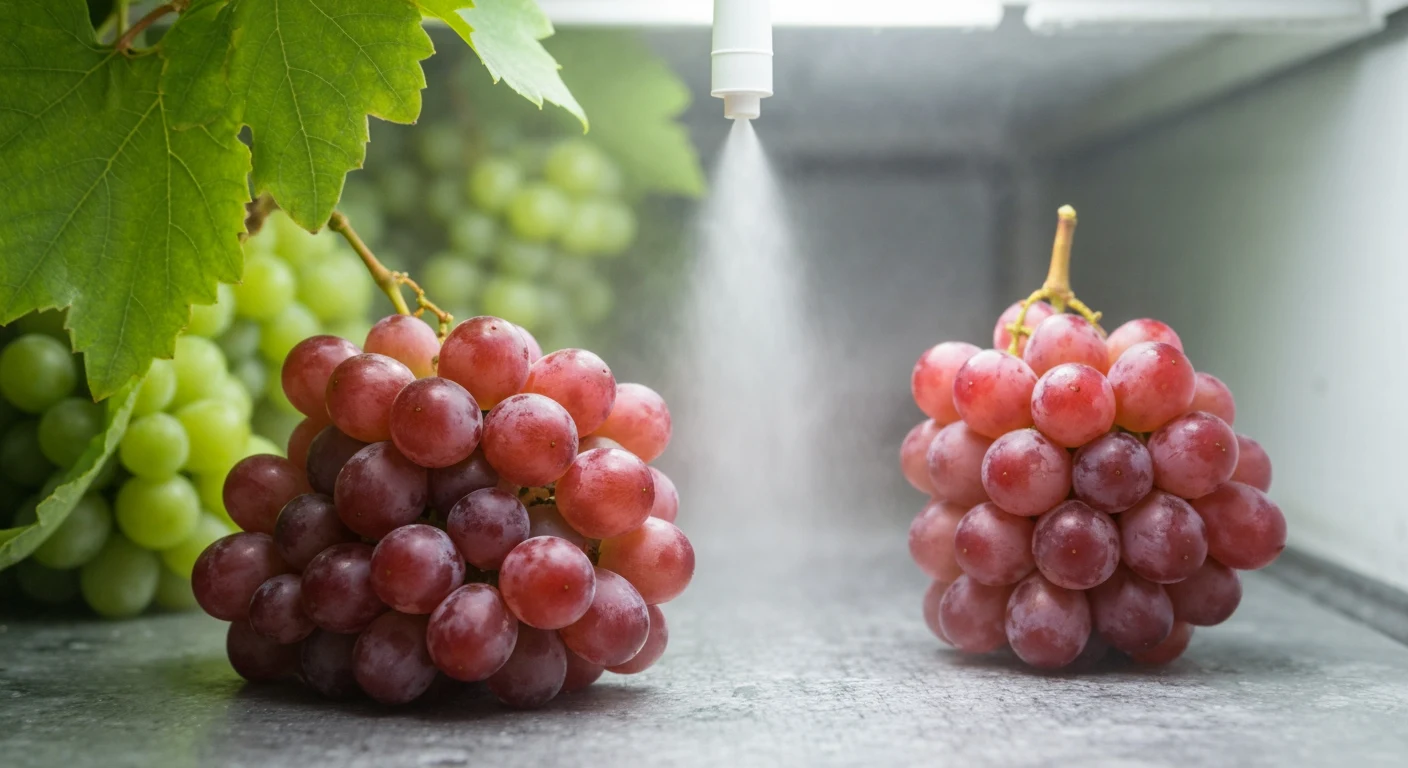
Growers typically use SO2-generating pads (sodium bisulfite-based) placed between grape layers in storage bins. A standard protocol: place 1–2 pads per bin (holding 50 lbs of grapes) at storage entry, and replace with fresh pads every 3–4 weeks throughout storage. Pads generate SO2 gas via a slow exothermic reaction, creating a steady 5–10 ppm SO2 atmosphere within the bin. This concentration is sufficient to suppress B. cinerea without damaging fruit or creating off-flavors. Alternative protocols include: (1) gaseous SO2 injection systems (for large facilities with sophisticated ventilation), which deliver precise SO2 concentrations (3–5 ppm) continuously; (2) combination of initial pads at storage entry plus periodic top-ups every 4 weeks.
SO2 Efficacy, Phytotoxicity Risk, and Regulatory Compliance
SO2 is highly effective at suppressing B. cinerea: fruit stored at 32°F with SO2 pads show <1% Botrytis incidence at 12 weeks; without SO2, incidence rises to 15–25% by week 8. However, excessive SO2 (>20 ppm for extended periods) can cause: (1) fruit discoloration—red/purple varieties may bleach; (2) off-flavors—sulfury taste compounds develop; (3) stem damage—stems become brittle. Regulatory limits vary by destination: U.S. markets allow up to 100 ppm residual SO2 on fresh grapes (post-removal of pads); EU markets limit to 50 ppm; Japan to 10 ppm. Growers must manage SO2 application carefully to achieve pathogen control while staying within destination-market residue limits. Central Valley Cold Storage staff are trained in SO2 pad management and maintain documentation of pad placement and replacement schedules as part of traceability and compliance protocols.
Humidity Optimization: 90–95% RH for Turgidity and Stem Preservation
The Humidity Equilibrium: Preventing Over-Saturation and Condensation
While high humidity (90–95% RH) is essential for turgidity maintenance, excessive humidity (>98% RH) triggers condensation—liquid water on fruit and bin surfaces. Condensation creates an ideal microenvironment for fungal growth: even with SO2 pads, high condensation increases Botrytis risk and can introduce secondary pathogens (Alternaria, Penicillium, etc.). Additionally, condensation on the bin exterior and cold-room walls can trigger mold growth on infrastructure. The optimal humidity band is 90–95% RH: high enough to prevent transpiration and maintain turgidity, but low enough to avoid condensation. Central Valley’s humidity control systems maintain 92% ±2% RH through continuous monitoring, with automated dehumidification (evaporator fan cycling) if humidity rises above 96%.
Humidity Gradients and Thermal Gradients: Preventing Cold-Spot Condensation
Stacked bins of grapes create microenvironments: outer bins experience direct HVAC airflow and are slightly warmer/drier; inner bins are cooler/more humid. If a cold spot in the storage room drops to 28°F while the setpoint is 32°F, condensation forms on grapes in that zone, increasing rot risk. Central Valley’s storage design includes: (1) forced-air distribution ensuring uniform temperature throughout the room (±0.5°F); (2) bin arrangement allowing airflow between stacks (not wall-to-wall stacking); (3) continuous temperature and humidity mapping (wireless sensors at multiple locations within each bin stack) identifying and correcting cold spots within 15 minutes.
Forced-Air Cooling and Rapid Pre-Cooling: Critical for Harvest-to-Storage Transition
Field Heat Removal and Cooling Rate
Table grapes are harvested during August–September when ambient temperatures are 90–105°F. Grapes at harvest are at ~95°F field temperature. If grapes are placed directly into 32°F storage without pre-cooling, the temperature differential is 63°F. Natural convective cooling from room air would take 18–24 hours to reach 32°F; during this time, respiration accelerates (warm grapes respire at 8–10× the rate of cold grapes), and B. cinerea may germinate. Forced-air cooling systems dramatically accelerate cooling: high-velocity fans force room air (at 32°F) through ventilation holes in bins, achieving 32°F within 4–8 hours. This rapid cooling: (1) minimizes respiration acceleration, (2) suppresses B. cinerea germination, (3) preserves fruit quality compared to delayed cooling. Central Valley’s pre-cooling facility can cool 400,000 lbs of grapes from 95°F to 32°F in 6–8 hours.
Cooling Rate Optimization and Physiological Stress Prevention
Excessive cooling rate (dropping temperature >15°F per hour) can trigger “chilling shock”—a physiological stress response that damages cells and accelerates post-storage senescence. Optimal cooling rate is 2–5°F per hour, achieved by moderating forced-air velocity. Central Valley’s systems allow adjustable airflow, enabling growers to set cooling rates matching their fruit physiology. A target: 8–10 hours from 95°F to 32°F (approximately 7°F/hour descent).
Stem Browning Prevention: Humidity, Temperature, and Ethylene Control
Physiological Basis of Stem Browning: Polyphenol Oxidation
Stem browning is driven by enzymatic polyphenol oxidation: as stems lose water and cellular compartmentalization breaks down, polyphenol oxidase (PPO) enzyme contacts phenolic compounds, producing brown melanin-like pigments. The process is accelerated by ethylene (which weakens cell walls and increases cellular leakage) and high temperature. Prevention strategies: (1) minimize ethylene exposure (cold storage suppresses ethylene production); (2) maintain high humidity to prevent water loss from stems; (3) maintain low temperature to suppress PPO enzyme activity. These three factors work synergistically: 32°F + 92% RH + <2 ppm ethylene = minimal stem browning for 12+ weeks.
Ethylene Management in Table Grape Storage
Table grapes produce low amounts of ethylene (<1 ppm), but any ethylene exposure accelerates senescence and stem browning. Many facilities co-store ethylene-producing crops (stone fruits, kiwis, avocados) in adjacent chambers; ethylene from those crops can infiltrate table grape storage if ventilation systems are not properly isolated. Central Valley's design includes dedicated table grape chambers with independent HVAC and ethylene-scrubbing systems (catalytic oxidizers that remove ethylene from recirculating air).
Storage Duration and Quality Evolution: Week-by-Week Shelf Life Expectations
Quality Timeline for Red Seedless and Green Seedless Varieties
Weeks 1–4: Grapes maintain premium quality (excellent turgidity, <5% Botrytis incidence with SO2, green stems, full flavor). Weeks 5–8: Turgidity begins declining gradually (slight softness developing), stem color transitions from bright green to yellow-green, Botrytis risk increases to 5–10% even with SO2 management. Weeks 9–12: More noticeable softness, yellow-brown stem color, Botrytis 10–15%, some berry drop beginning on affected clusters. Weeks 13–16: Significant softness (acceptable for processing/juice only), brown stems, Botrytis 20–25%, >10% berry drop on affected bunches.
Most export markets accept grapes through week 12 of storage; domestically, supermarket chains typically require grapes within 10 weeks of storage entry. Central Valley’s quality-forecasting system predicts quality progression and recommends optimal release windows for specific destination markets.
Shelf Life Extension Beyond 12 Weeks: Ultra-Long-Storage Protocols
Some growers target 14–16 week storage for maximum market-timing advantage (February–May release for peak pricing). Ultra-long storage requires: (1) premium fruit quality at harvest (low Botrytis, full turgidity); (2) aggressive SO2 pad management (fresh pads every 2 weeks, not 4); (3) strict humidity control (92% ±1%); (4) temperature stability (30.5–31.5°F, not allowing fluctuations to 32–33°F); (5) minimal handling (grapes should not be removed for inspection after week 8). Central Valley’s premium-storage program is designed for ultra-long-storage grapes, with specialized staff and protocols.
Central Valley Cold Storage: San Joaquin Valley’s Table Grape Infrastructure Leader
254,000 Sq Ft Facility with Forced-Air Pre-Cooling and Advanced SO2 Management
Central Valley’s Madera facility includes: (1) 8,000+ pallet positions for grape storage in climate-controlled chambers; (2) forced-air pre-cooling facility cooling 400,000 lbs/batch from 95°F to 32°F in 6–8 hours; (3) independent humidity control per chamber (maintaining 92% ±2% RH); (4) continuous temperature/humidity monitoring with wireless sensors in each bin stack; (5) trained staff managing SO2 pads, including documentation of placement, replacement schedules, and disposal protocols. The facility’s location within the San Joaquin Valley—within 45 minutes of 90% of table grape acreage—enables rapid harvest-to-storage transport (critical for reducing field-heat duration).
Off-Grid 1200 kW Solar + Backup for Continuous Thermal Control
Table grape storage is uniquely vulnerable to power disruptions. A 12-hour power outage in a 32°F storage room at 92% humidity can cause temperature rise to 50°F+, triggering rapid B. cinerea germination and SO2 pad oxidation (reducing efficacy). A 24-hour outage can destroy an entire storage room inventory (500,000 lbs at $0.80–$1.20/lb = $400,000–$600,000 loss). Central Valley’s 1200 kW solar array plus dual backup generators ensures continuous operation, protecting inventory during California’s summer peak-demand power constraints.
CCOF Organic Certification and FSMA 204 Compliance
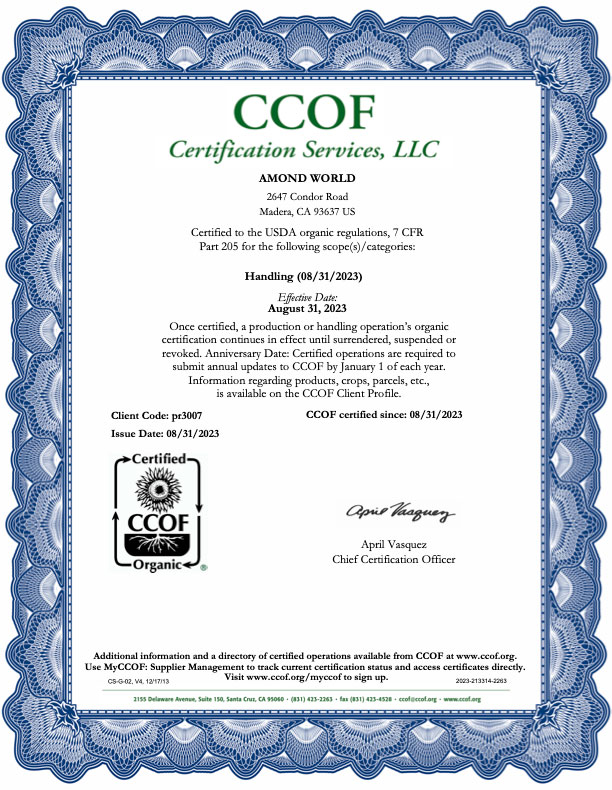
Central Valley’s CCOF certification enables organic table grape storage (critical for growers selling certified-organic fruit to premium channels). FSMA 204 compliance includes: temperature/humidity logging, pest management documentation, traceability records (linking each bin to grower, variety, harvest date, storage location, and release dates), and quality assessment protocols. These credentials support buyer audits and reduce liability for growers selling to regulated retailers and export channels.
Technology and Traceability: Real-Time Monitoring and Data-Driven Release Decisions
Bin-Level Temperature and Humidity Tracking
Each bin is assigned a unique identifier and wireless temperature/humidity sensors. Growers access real-time dashboards showing: current temperature/humidity in their specific bins, historical logs (data from every 15 minutes since storage entry), and alerts if conditions drift. This transparency eliminates uncertainty and enables rapid corrective action if a cold spot or humidity excursion is detected.
Quality Progression Forecasting and Optimal Release Timing
At storage entry, Central Valley collects baseline quality samples (firmness via texture analyzer, Brix, acid, color score). Every 2 weeks, samples are retested. Data is entered into UC Davis-validated shelf-life prediction models that forecast quality progression and optimal release dates. Growers can query: “If I release this lot on February 10, what will the quality be (turgidity, stem browning percentage, projected Botrytis incidence)?” This forecasting enables market-timing decisions aligned with destination-market requirements and current commodity prices.
Frequently Asked Questions About Table Grape Cold Storage and SO2 Management
Q1: How often should I replace SO2 pads during storage?
Standard protocol is every 3–4 weeks. For premium ultra-long-storage fruit (targeting 14–16 weeks), replace every 2 weeks. Fresh pads ensure consistent 5–10 ppm SO2 concentration; depleted pads lose efficacy. Central Valley tracks pad replacement and documents timing for compliance records.
Q2: What humidity is optimal—90% or 95% RH?
92% ±2% RH is the target. Below 90%, stem browning and turgidity loss accelerate. Above 95%, condensation risk increases. Central Valley maintains 92% as the setpoint.
Q3: Can I store multiple grape varieties together?
Yes. All table grape varieties (Red Seedless, Green Seedless, Black Seedless, Flame, Thompson) tolerate 32°F and 92% RH similarly. Mixing varieties in the same chamber is common and does not compromise quality. However, if varieties have different ripeness at harvest, segregating them enables release timing optimized for each variety.
Q4: What’s the maximum storage duration for premium grapes?
Premium quality is maintained through week 12. Ultra-long storage (weeks 13–16) is possible but requires premium starting material and aggressive SO2 management. Beyond week 16, quality declines significantly regardless of storage conditions.
Q5: How do I prevent stem browning if my storage is slightly warmer (34°F instead of 32°F)?
Each 2°F increase above 32°F accelerates stem browning by ~20%. At 34°F, stem browning appears by week 8–9 instead of week 12–14. To compensate: increase humidity to 94–95% RH (to reduce transpiration stress), ensure fresh SO2 pads every 2 weeks (to suppress ethylene-induced senescence), and reduce storage duration to 10 weeks maximum.
Q6: What does cold-storage table grape cost, and what’s the ROI?
Typical rates are $0.03–$0.05 per pound per month. For 300,000 lbs stored 12 weeks, total cost is $10,800–$18,000. If market timing yields even a $0.10/lb premium at release ($30,000 gain), ROI is 66–177%. Many growers achieve $0.15–$0.25/lb premiums through strategic market timing, delivering 200–400% ROI.
Next Steps: Secure Your Table Grape Market Presence with Strategic Cold Storage
The San Joaquin Valley’s table grape industry depends on cold storage as the technology that decouples supply from harvest timing. Growers without storage are market-takers, forced to sell during peak-supply harvest windows at depressed prices. Growers with reliable, high-quality cold storage are market-makers, able to time releases strategically and capture 30–50% price premiums during supply-limited windows.
Central Valley Cold Storage’s 254,000 sq ft Madera facility is the San Joaquin Valley’s premier table grape storage infrastructure: forced-air pre-cooling ensuring rapid thermal descent, advanced SO2 pad management protocols, humidity precision (92% ±2% RH), and continuous temperature/humidity monitoring with bin-level granularity. Our off-grid solar + backup systems ensure operational resilience during California’s peak-demand periods. CCOF certification and FSMA 204 compliance support regulated markets and international export channels.
Request a free consultation to evaluate your table grape storage strategy. Discuss your expected harvest volume, target release windows, destination markets (domestic, export, specific countries with SO2 residue limits), and quality parameters. Our team will model your market-timing ROI and recommend storage protocols optimized for your fruit and market positioning.
Schedule a facility tour to observe forced-air pre-cooling, SO2 pad management, and quality-monitoring systems in action. See how strategic cold storage transforms table grape operations into year-round market competitors with premium-price capturing capability.