From the perspective of a sustainable infrastructure consultant, the transition to onsite microgrids represents the evolution of industrial energy from a centralized, vulnerable service to a decentralized, resilient asset. This article provides a technical breakdown of how a 1200kW solar array, coupled with advanced energy storage, creates a fortified energy ecosystem designed to withstand the increasingly frequent failures of the traditional utility grid. Organic Nut Preservation: CCOF Standards in Off-Gr….
The Risk of Grid-Dependency
The traditional reliance on a centralized utility provider is becoming a liability for enterprise-scale cold storage. In 2023 alone, California experienced over 50 significant power outages that impacted commercial operations. For the agricultural sector, these outages are often exacerbated by Public Safety Power Shutoffs (PSPS)—intentional de-energizations implemented by utilities during high-wind and high-heat events to prevent wildfires. While these measures protect the public, they leave industrial facilities in a precarious position.
Cold storage facilities operate on thin thermal margins. While high-performance insulation provides a buffer, the mechanical refrigeration systems required to maintain precise temperatures (often as low as -10°F to -20°F) demand constant, high-voltage power. A grid failure during a Central Valley heatwave, where ambient temperatures can exceed 100°F, leads to rapid “thermal gain.” Without an immediate and autonomous power source, the integrity of the cold chain is compromised, leading to spoilage, regulatory non-compliance, and devastating financial losses.
Furthermore, the volatility of “Time-of-Use” (TOU) pricing and “Demand Charges” makes grid-dependency an economic burden. For an enterprise RFP, the predictability of energy costs is as vital as the reliability of the power itself. Relying solely on a grid that is prone to rolling blackouts and price spikes is no longer a viable strategy for long-term operational excellence. This is the context in which the CVCS solar-plus-battery microgrid was engineered—to decouple critical infrastructure from a failing macro-grid.
How the 1200kW Array Functions
At the heart of the CVCS energy strategy is a 1200kW photovoltaic (PV) array. This system is not a standard “behind-the-meter” installation; it is a sophisticated generation plant integrated into a microgrid controller. The scale of the 1200kW array is purposefully sized to cover the massive “baseload” of the facility’s industrial compressors and evaporator fans while simultaneously generating surplus energy to charge the onsite battery reserves.
The array utilizes high-efficiency monocrystalline modules with a high racking density to maximize DC output per square foot. These panels are paired with industrial-grade string inverters that convert DC power to AC with a conversion efficiency exceeding 98%. However, the true technical brilliance lies in the microgrid controller. This “brain” of the system monitors grid health in real-time. If it detects a frequency deviation or a complete voltage drop from the utility, it triggers an “islanding” event.
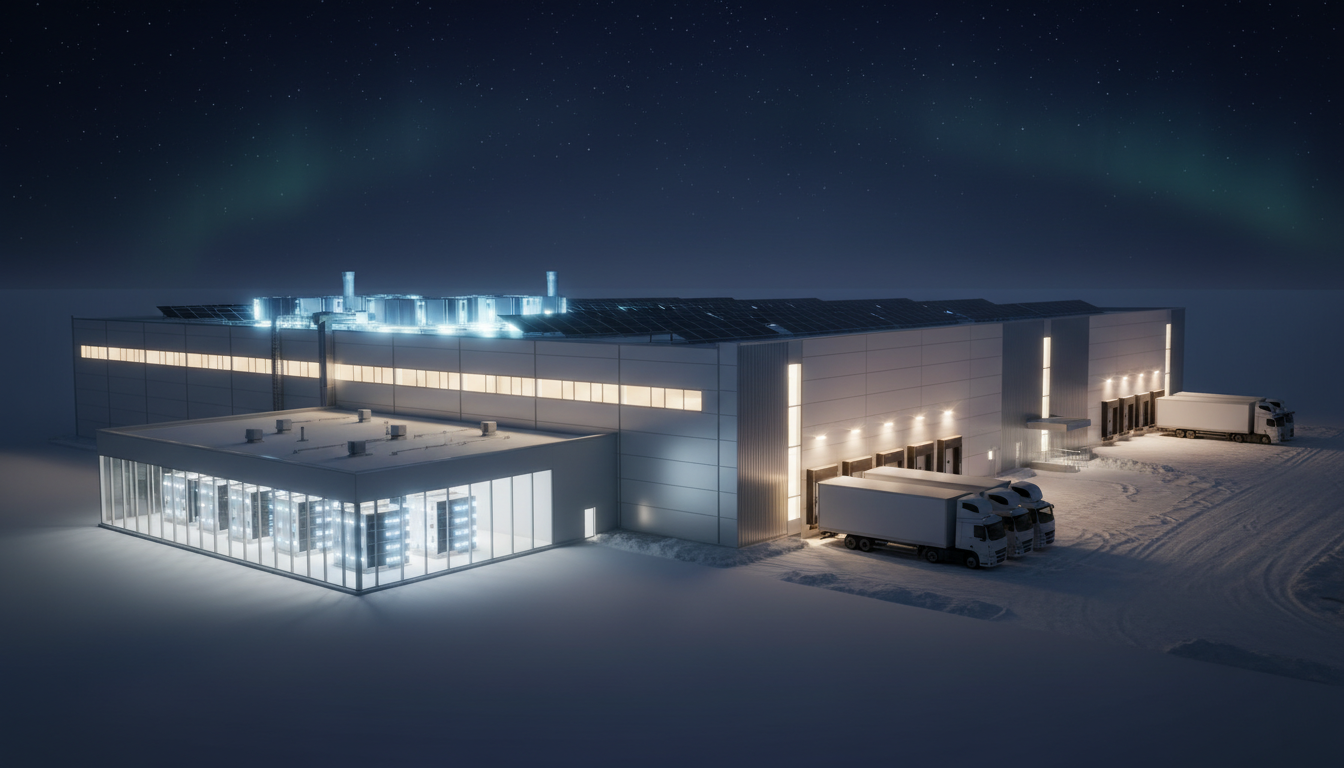
During islanding, the 1200kW array is physically and electrically disconnected from the utility grid, forming a self-sustaining energy island. This prevents “backfeeding,” which is a safety requirement for utility line workers, but more importantly, it ensures that the facility’s internal 480V three-phase power remains stable. Even during peak summer months, when the Central Valley sun is at its most intense and the cooling demand is highest, the array provides the necessary amperage to keep the refrigeration cycles running without interruption. You can learn more about our specific infrastructure at our facility page.
Battery Storage: The Silent Safeguard
While the solar array provides the “muscle” during daylight hours, the solar-plus-battery microgrid would be incomplete without a robust Battery Energy Storage System (BESS). In the world of cold storage, reliability is the ultimate commodity, and the battery is the safeguard that ensures 24/7 uptime.
The BESS at CVCS is designed to solve the two primary challenges of renewable energy: intermittency and the “duck curve.” Solar generation naturally tapers off in the late afternoon just as cooling loads often peak due to thermal lag in the building’s structure. The battery system bridge this gap. It captures excess energy generated during the solar peak (typically between 10:00 AM and 2:00 PM) and stores it for deployment during the night or during periods of cloud cover.
Technically, the BESS provides “Seamless Transfer.” The transition from solar-to-battery or grid-to-battery occurs in less than 50 milliseconds—faster than the sensitive control electronics of the refrigeration system can detect. This prevents the “cycling” of compressors, which can be damaging to the equipment and lead to increased maintenance costs. Furthermore, the battery storage allows for “Peak Shaving.” By discharging stored energy during the utility’s most expensive peak hours, CVCS significantly reduces its demand charges, often the largest portion of a commercial energy bill. Our commitment to this level of engineering is detailed in our story.
Economic Benefits of Energy Autonomy
For enterprise stakeholders, the decision to implement a solar-plus-battery microgrid is driven by both resilience and ROI. The economics of energy autonomy are grounded in the mitigation of “unrealized risk.” While the initial capital expenditure of a 1200kW system is significant, the cost of a single total product loss event often exceeds the entire cost of the microgrid installation.
Beyond risk mitigation, the microgrid offers several direct financial levers:
- Avoided Spoilage: Protection of 50 million pounds of agricultural inventory from temperature excursions.
- Demand Charge Management: Large industrial motors in cold storage create massive spikes in power demand. The microgrid “shaves” these peaks, preventing the utility from charging exorbitant rates.
- Energy Arbitrage: Storing low-cost solar energy and using it when utility rates are at their highest.
- Sustainability Incentives: Leveraging the Investment Tax Credit (ITC) and Modified Accelerated Cost Recovery System (MACRS) to accelerate depreciation and reduce tax liability.
In a competitive market, energy is often viewed as a fixed cost. However, by transforming energy into a controlled, onsite resource, CVCS gains a competitive advantage. We provide a level of price stability and operational certainty that grid-dependent competitors simply cannot match.
| Power Source | Reliability during Heatwave | Sustainability |
|---|---|---|
| Standard Utility | Low (Risk of Rolling Blackouts) | Variable |
| Diesel Generators | High (But Polluting/High Cost) | Low |
| Solar Microgrid | 100% (Independent/Renewable) | High |
Conclusion
The convergence of California’s energy crisis and the increasing demands of the global food supply chain has made the solar-plus-battery microgrid a necessity for modern cold storage. For Central Valley Cold Storage, the 1200kW array and its accompanying storage capacity are not just “green” initiatives; they are the bedrock of our operational integrity. We have moved beyond the hope that the grid will hold, into a reality where we control our own power destiny.
By integrating generation, storage, and intelligent control systems, we provide our partners with the ultimate assurance: that their inventory is protected by the most resilient energy infrastructure available today. In the world of industrial logistics, 100% uptime is the only acceptable metric, and the microgrid is the only technology capable of delivering it.
Frequently Asked Questions
Q: What happens if it’s cloudy for a week?
A: Our system is sized with significant battery redundancy and high-efficiency panels to ensure consistent power regardless of short-term weather patterns. The microgrid controller also manages loads dynamically, prioritizing the most critical refrigeration equipment to maintain the cold chain even during extended periods of low irradiance.
Q: Is the microgrid compatible with existing backup generators?
A: Yes. While the solar-plus-battery system is our primary defense, it can be integrated with existing diesel or natural gas backup generators to provide a third layer of redundancy for absolute worst-case scenarios.