As California produces approximately 99% of the commercially grown table grapes in the United States, the economic implications of post-harvest storage are immense. Maintaining export-grade quality for the duration of a transoceanic voyage or extended seasonal storage requires more than just refrigeration; it requires a sophisticated understanding of the relationship between moisture loss, temperature stasis, and atmospheric saturation Ethylene Management: Preventing Cross-Contaminatio….. Central to this is table grape cold storage, a discipline that has been revolutionized by precision humidity management systems like the CVCS Goose.
The Physiology of the Rachis: The Canary in the Coal Mine
To understand why humidity is the dominant factor in grape storage, one must first examine the anatomy of the grape cluster. The cluster consists of the berries and the rachis (the stem structure). While the berries are protected by a waxy cuticle and have a low surface-area-to-volume ratio, the rachis is structurally the opposite. It is highly porous, possesses a high density of stomata-like lenticels, and has a massive surface area relative to its thin biomass.
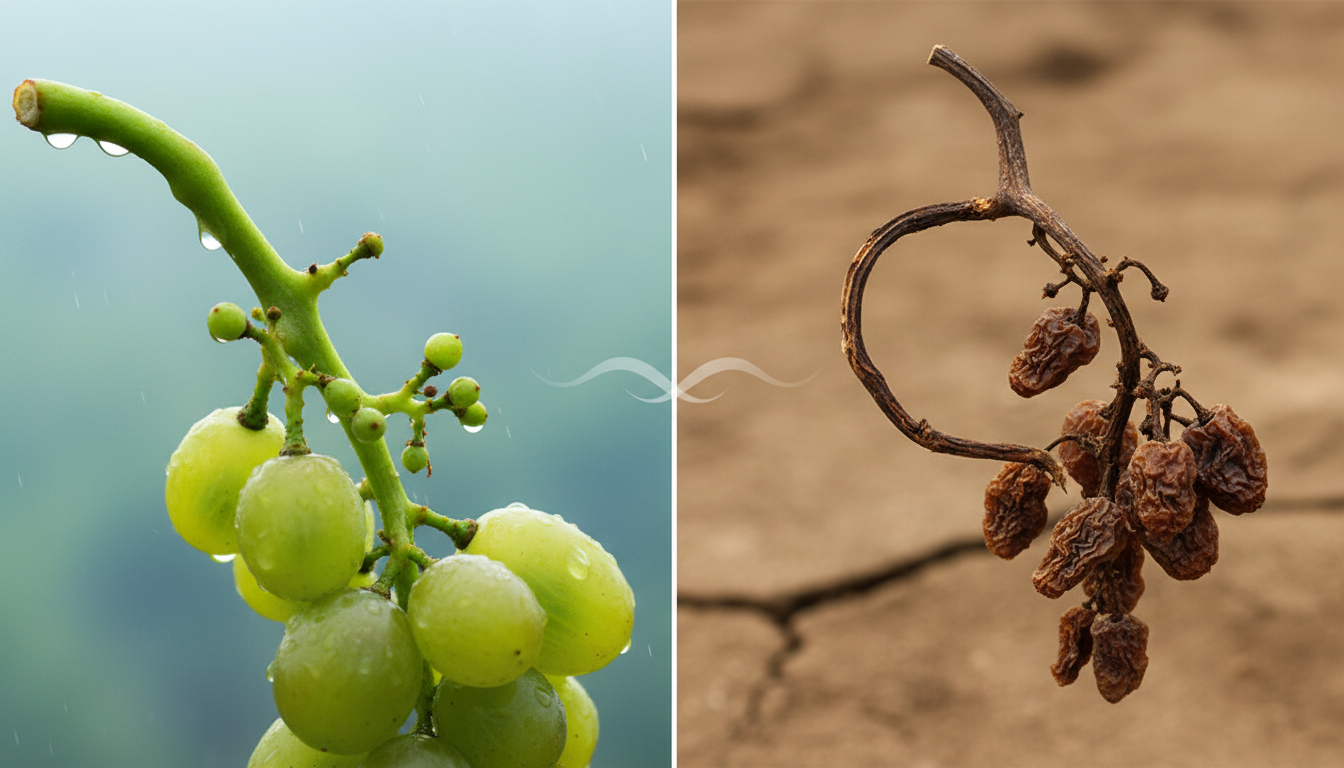
Physiological research indicates that the rachis loses moisture at a rate roughly 15 times faster than the berries themselves. Even a 2% loss in total cluster weight can lead to rachis browning, making the fruit appear unmarketable long before the berries show signs of decay or softening. This browning is the result of cellular collapse and the subsequent oxidation of phenolic compounds. Once the rachis loses its turgidity, it becomes brittle, and the “cap stems” (the small stems connecting the berry to the main rachis) weaken, leading to “shatter”—the detachment of berries from the cluster.
Maintaining a green, supple rachis is the gold standard for high-quality table grape exports. To achieve this, post-harvest physiologists focus on minimizing the transpiration rate. Because transpiration is driven by the difference in water vapor pressure between the plant tissue and the surrounding air, the only way to arrest this process without damaging the fruit is to reach a state of near-total atmospheric saturation.
Vapor Pressure Deficit (VPD) Explained
In the context of table grape cold storage, temperature control is often prioritized, but temperature is merely the foundation upon which the true preservation mechanism—Vapor Pressure Deficit (VPD)—operates. VPD is the difference between the amount of moisture the air can hold when it is saturated and the amount of moisture currently in the air. For table grapes, a high VPD is catastrophic.
At the standard storage temperature of 32°F (0°C), the air’s capacity to hold water vapor is extremely low. However, even at this low temperature, if the relative humidity (RH) drops to 80%, the air remains “thirsty” enough to pull moisture out of the highly susceptible rachis tissue. To prevent this, the RH must be maintained between 90% and 95%. At these levels, the VPD is minimized, effectively “tricking” the plant tissue into retaining its internal moisture because the surrounding atmosphere is already near its saturation point.
However, managing 95% humidity at 32°F presents a technical paradox. If the temperature fluctuates downward by even half a degree, the air may reach its dew point, causing condensation to form on the fruit. Free water on the surface of grapes is the primary catalyst for Botrytis cinerea (gray mold) and other fungal pathogens. Therefore, precision is not a luxury; it is a physiological requirement. For a deeper dive into these mechanics, see our guide on Maintaining Table Grape Turgidity: Advanced Humidity Management.
| Metric | Standard Storage | CVCS Precision Storage |
|---|---|---|
| Humidity Level | 80% | 90-95% |
| Weight Loss/Week | 1-2% | <0.3% |
| Rachis Status | Brittle/Brown | Green/Supple |
Real-Time Monitoring with Goose
The traditional method of managing cold storage involved localized humidifiers and manual temperature checks. However, large-scale industrial cold rooms often suffer from “micro-climates”—pockets of air where humidity drops or temperature rises due to poor airflow or the heat of the fruit’s own respiration. These micro-climates are where the profit margin of a grape harvest is lost.
The CVCS Goose system addresses this through real-time, high-saturation humidity management. Unlike standard systems that cycle on and off, creating “peaks and valleys” in the humidity profile, the Goose system maintains a constant, ultra-fine mist that stays in suspension. This creates a uniform “blanket” of high-humidity air that penetrates the center of the pallets and even the individual perforated bags used in modern packaging.
The Goose system’s precision sensors monitor the VPD in real-time, allowing for instant adjustments. This is particularly critical during the “pull-down” phase—the period immediately after the grapes are brought in from the field (which can be 90°F or higher) and are cooled to 32°F. During this phase, the risk of moisture loss is at its highest. By saturating the air precisely as the temperature drops, the Goose system ensures that the grapes never encounter a high-VPD environment. This preserves the “just-picked” turgidity required for the 4-to-8-week windows necessary for global export.
The Synergy of Temperature and Humidity
While this article focuses on humidity, it is vital to note that humidity management is ineffective without temperature stasis. Table grapes have a high freezing point compared to other fruits due to their sugar content (Brix level), but they are typically stored just above their freezing point to slow metabolic activity. The Goose system integrates with the refrigeration units to ensure that the cooling coils do not strip the moisture from the air—a common problem in standard refrigeration known as “dehumidification through cooling.” By managing both variables in tandem, the CVCS technology prevents the weight loss that typically erodes the grower’s bottom line.
Key Takeaways for Post-Harvest Managers
- Rachis health is the primary indicator of freshness: Consumers use the color and flexibility of the stem to judge the age of the fruit.
- Humidity prevents weight loss: Every percentage point of weight lost to evaporation is a direct loss in sellable product.
- Temperature stasis stops fungal growth: Keeping the fruit at a constant 32°F while maintaining high RH prevents the condensation that fuels Botrytis.
Frequently Asked Questions
Q: How long can table grapes be stored?
A: With precise humidity and temperature control, high-quality varieties can maintain export grade for 4-8 weeks, depending on the cultivar and the initial harvest quality.
Q: Why not just use plastic liners to keep moisture in?
A: While liners help, they also trap heat and can lead to condensation if the external room temperature fluctuates. High-saturation room humidity provides a more consistent environment without the risks associated with stagnant air inside a bag.
Conclusion
The science of table grape preservation is a delicate balance of biology and physics. By understanding the physiological vulnerability of the rachis and the mathematical reality of Vapor Pressure Deficit, cold storage operators can transition from “holding fruit” to “preserving quality.” Systems like the CVCS Goose represent the next generation of this science, providing the real-time data and precision hardware necessary to satisfy the rigorous demands of the global grape market.