Optimizing the Citrus Cold Chain
For growers in the Central Valley, the stakes for post-harvest management could not be higher. California is the powerhouse of the domestic industry, producing approximately 80% of the fresh-market citrus in the United States. Unlike processing fruit, fresh-market Navels, Lemons, and Mandarins must maintain impeccable aesthetic standards—rind integrity, color uniformity, and internal juice quality—long after they have been severed from the tree. Achieving this requires more than just refrigeration; it demands a sophisticated understanding of post-harvest physiology and the implementation of a precise citrus cold storage strategy.
As a post-harvest physiologist, I have observed that the primary challenges in the citrus cold chain are two-fold: the management of the degreening process for early-season fruit and the mitigation of physiological disorders during long-term storage. Citrus fruits are non-climacteric, meaning they do not continue to ripen significantly after harvest in terms of sugar development. However, they remain metabolically active, respiring and losing moisture to the environment. Without stringent thermal and atmospheric control, the shelf life of these high-value commodities evaporates, leading to rind pitting, decay, and significant economic loss.
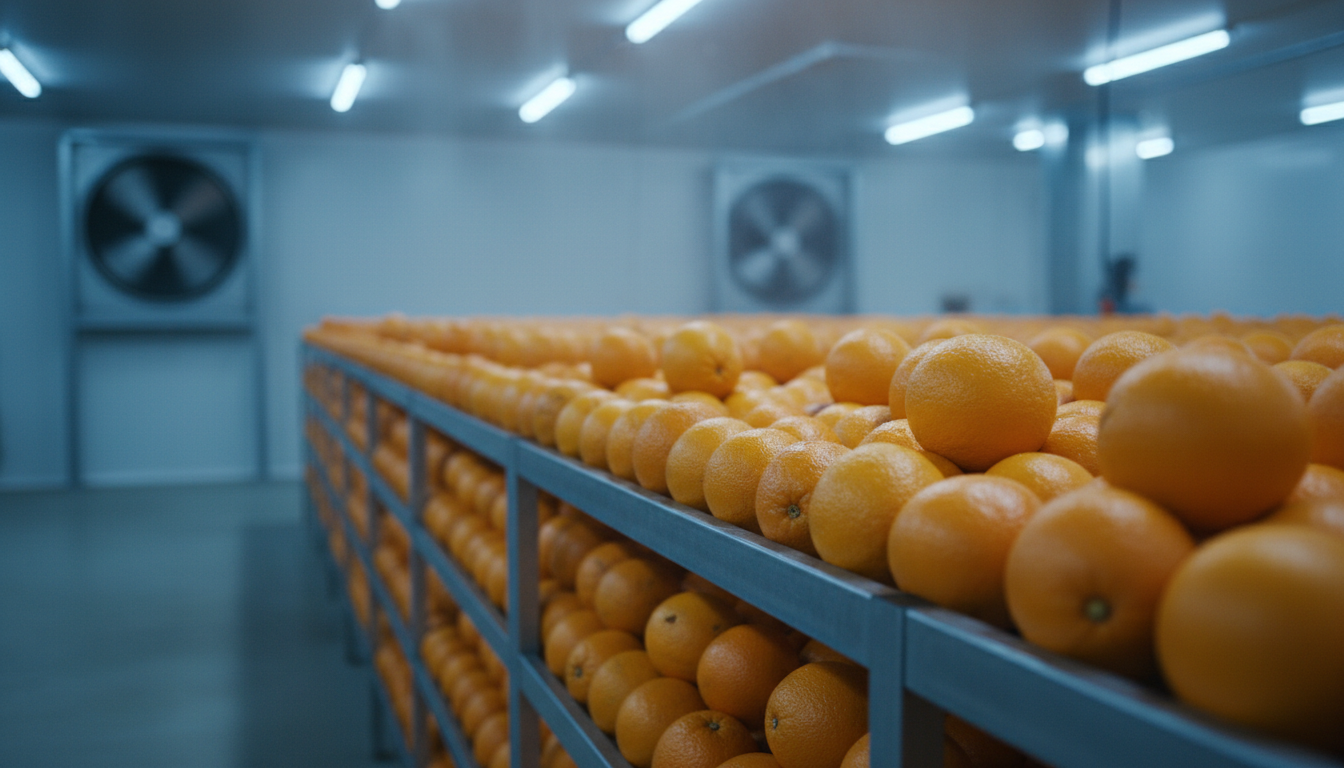
Central Valley Cold Storage (CVCS) addresses these challenges through an off-grid, technologically advanced infrastructure designed to provide growers with granular control over their inventory. By decoupling from the traditional grid, we ensure that the citrus cold chain remains unbroken, preventing the temperature fluctuations that trigger premature senescence or chilling injury.
The Science of Degreening
Early in the harvest season, particularly for Navel oranges and certain lemon varieties, the fruit may reach internal maturity (the desired Brix-to-acid ratio) while the rind remains green. This greening is due to high chlorophyll content, which often persists in the Central Valley’s climate if nighttime temperatures haven’t dropped sufficiently to trigger the breakdown of chlorophyll and the expression of carotenoids. To meet consumer expectations for “bright orange” or “vivid yellow” fruit, degreening is essential.
Degreening is a delicate physiological manipulation where the fruit is exposed to low concentrations of ethylene gas (typically 1-5 ppm) under specific environmental conditions. This is not “ripening” in the way one ripens a banana; rather, it is the stimulation of the enzymes (chlorophyllase) responsible for pigment change. The success of this process depends on three critical factors available at our facility:
- Precise Temperature Control: Degreening is most effective between 68°F and 78°F. Temperatures above this range can inhibit color development and promote the growth of pathogens like Diplodia stem-end rot. Temperatures below this range significantly slow the metabolic response.
- Humidity Management: Ethylene exposure can be dehydrating. Maintaining a relative humidity (RH) of 90-95% is mandatory during degreening to prevent “button” (calyx) desiccation and subsequent fruit drop or decay.
- Air Exchange and CO2 Monitoring: As citrus respires during degreening, it produces carbon dioxide. If CO2 levels rise above 0.1%, the degreening effect of ethylene is neutralized. Our citrus cold storage services include high-rate air exchange to ensure CO2 is flushed while maintaining the thermal envelope.
By utilizing our individually settable bays, growers can dedicate specific zones to the degreening process, ensuring that the ethylene environment for one lot does not affect long-term storage lots nearby. This precision allows for a seamless transition from the degreening room to the cooling chamber without unnecessary transport stress.
Preventing Rind Pitting and Decay
Once the desired color is achieved, or if the fruit arrives color-break ready, the focus shifts to long-term preservation. The citrus rind is the fruit’s primary defense, yet it is highly susceptible to physiological disorders when stored outside its narrow “Goldilocks” zone. The two most prominent threats are rind pitting (oleocellosis) and chilling injury.
Rind pitting often occurs due to moisture loss. When the Vapor Pressure Deficit (VPD) between the fruit and the surrounding air is too high, water is pulled from the flavedo (the outer colored layer). This results in the collapse of oil glands, creating unsightly brown lesions. To combat this, CVCS maintains a constant humidity level of 90% or higher. Our off-grid power systems are vital here; they prevent the “cycle resets” common in grid-tied facilities that often cause humidity drops and temperature spikes.
Chilling injury (CI) is a more complex threat. While many believe colder is always better, citrus is a subtropical crop. If stored below their threshold, the fruit experiences cellular collapse. For example, Lemons are particularly sensitive and should generally be stored at 45-50°F. Navels are hardier but still risk CI if held below 38°F for extended periods. The symptoms of CI—pitting, water-soaked spots, and increased susceptibility to Penicillium molds—often only appear after the fruit is moved to room temperature, leading to high rejection rates at the retail level.
Optimized Storage Parameters by Variety
The following table outlines the technical requirements for the primary citrus varieties grown in the Central Valley. Maintaining these specific parameters is the difference between a premium product and a total loss.
| Citrus Variety | Ideal Storage Temp | Humidity | Storage Duration |
|---|---|---|---|
| Navel Oranges | 38-42°F | 90-95% | 8-12 Weeks |
| Lemons | 45-50°F | 85-90% | 4-6 Months |
| Mandarins | 38-40°F | 90-95% | 2-4 Weeks |
By adhering to these varietal-specific standards, CVCS allows growers to “bank” their fruit, waiting for market windows that offer the highest return on investment rather than being forced to sell immediately upon harvest due to lack of quality storage.
Madera: The Hub for Citrus Logistics
Geography is destiny in the agricultural supply chain. Located in Madera, CVCS sits at the nexus of the Central Valley’s citrus production. Proximity to the groves reduces “field heat” accumulation. Every hour fruit sits in the California sun post-harvest significantly reduces its potential storage life. By offering a centralized, high-capacity citrus cold storage solution in the heart of the valley, we minimize the transit time from the packing house to the cooling environment.
Our facility’s unique selling proposition is the level of customization available to the grower. Most commercial cold storage facilities operate on a “one-size-fits-all” temperature set point. This is catastrophic for a grower who needs 48°F for Lemons while their neighbor needs 38°F for Navels. At CVCS, our bays are individually settable. This means the thermal and atmospheric environment is tailored to the specific physiological needs of the cargo, not the convenience of the facility operator.
Furthermore, our off-grid capability provides a layer of risk mitigation that is increasingly necessary in California. With the rising frequency of Public Safety Power Shutoffs (PSPS) and grid instability, the citrus cold chain is under constant threat. A four-hour power outage in a facility holding thousands of bins of Mandarins can lead to a temperature rise that triggers condensation on the fruit rind. This “sweating” is a precursor to fungal rot. CVCS eliminates this risk, providing a stable, autonomous environment that protects your investment regardless of external grid conditions.
Frequently Asked Questions
Q: What is chilling injury in citrus?
A: Chilling injury (CI) is a physiological disorder that occurs when citrus is stored below its variety-specific temperature threshold (typically below 38-45°F). It manifests as rind lesions, pitting, and internal browning. It is often a “latent” injury, meaning it becomes visible only after the fruit is moved into warmer retail environments.
Q: How does CVCS help with degreening?
A: Our facility features individually settable bays that allow growers to create the exact heat, humidity, and ethylene environment needed to reach peak color. We provide the precise 68-78°F range required for effective chlorophyll degradation while maintaining the 90%+ humidity necessary to prevent rind desiccation during the process.
Q: Why is humidity as important as temperature?
A: Citrus fruit is mostly water. If the storage air is dry, the fruit will lose moisture through its pores. This not only reduces the saleable weight but also causes the rind to become brittle and prone to “pitting” and “peteca,” which are major grade defects.
The transition from the tree to the table is a perilous journey for a citrus fruit. It requires a partner who understands the biological nuances of the crop. At Central Valley Cold Storage, we provide the technical infrastructure and physiological expertise to ensure that your harvest maintains its quality from the first bin to the final consumer.
Reserve Citrus Storage Capacity