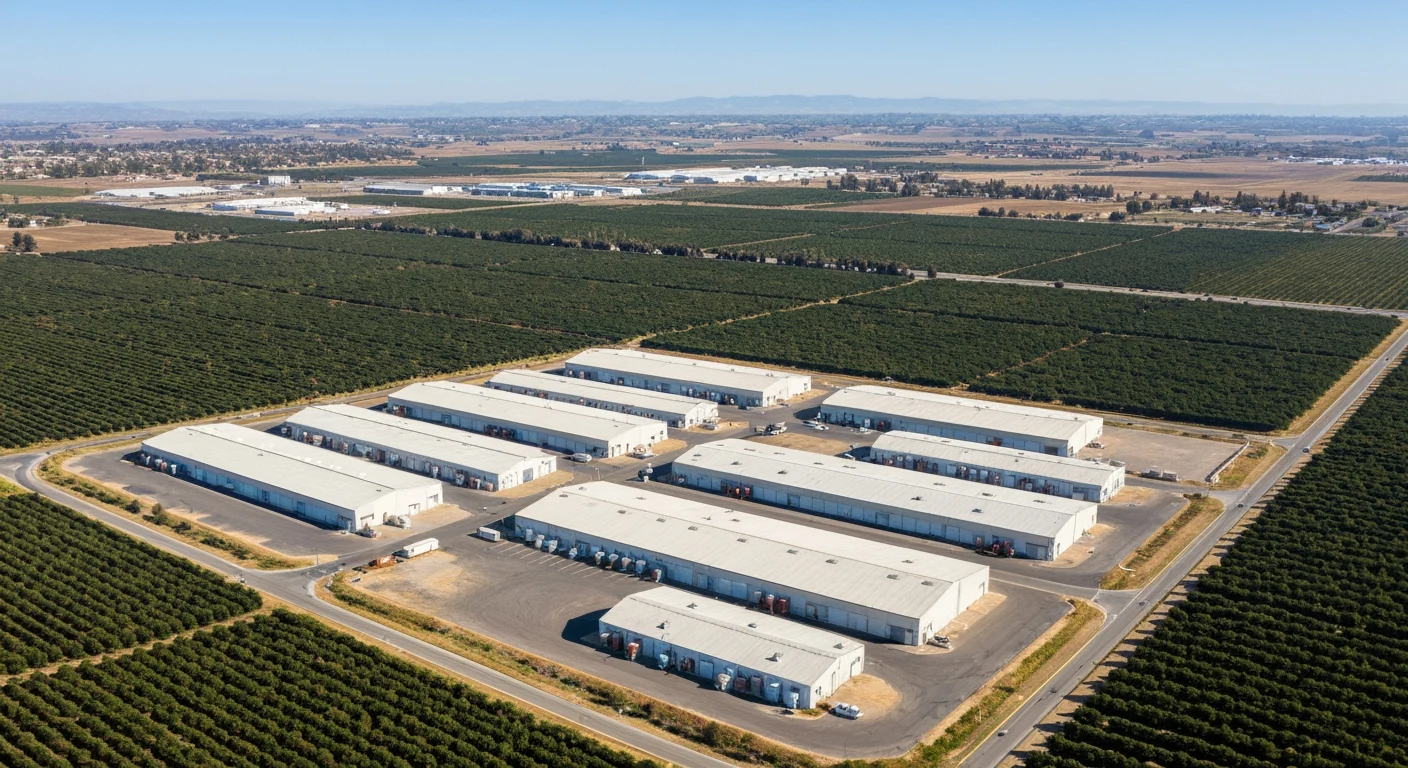
Central Valley Cold Storage Market Report 2026: Capacity, Demand, and Growth Trends
Regional Cold Storage Capacity and Utilization Overview
The Central Valley cold storage market (encompassing the agricultural regions of Fresno, Kern, Kings, Tulare, and Madera counties) represents the largest concentrated cold storage capacity in North America, with approximately 47.2 million square feet of total inventory space as of Q1 2026. This capacity is distributed across approximately 620 individual facilities operated by 180+ distinct companies, ranging from single-warehouse owner-operators to large integrated logistics companies. The market has experienced consistent inventory growth averaging 2.8% annually from 2015-2025, with accelerating expansion rates of 3.9-4.2% during 2023-2025.
Reported utilization rates for the Central Valley cold storage market averaged 96.6% during Q4 2025, representing the highest utilization rates recorded in the past seven years. This elevated utilization reflects a structural capacity shortage: regional cold storage capacity has not kept pace with underlying demand growth driven by expansion in e-commerce distribution, organic produce certification, and international agricultural exports. The current 3.4% vacancy rate (calculated as 100% minus 96.6% utilization) represents approximately 1.65 million square feet of available storage capacity, a historically tight level creating pricing power and contract leverage for facility operators.
Madera County, where Central Valley Cold Storage operates, represents the highest-utilization submarket within the Central Valley. The county’s total cold storage capacity of approximately 2.8 million square feet (5.9% of regional total) is functionally at maximum utilization, with reported vacancy rates of 2.1-2.8% throughout 2025-2026. This extreme tightness directly supports premium pricing for available capacity and positions new or expanded facilities in Madera County for favorable long-term lease rates.
Historical Market Growth and Demand Drivers (2015-2025)
The Central Valley cold storage market has experienced substantial transformation over the past decade, driven by structural changes in agricultural production, food supply chain architecture, and consumer purchasing patterns. From 2015-2025, the market expanded at a compound annual growth rate (CAGR) of 8.1%, growing from approximately 31.2 million square feet to current capacity of 47.2 million square feet. This represents addition of 16 million square feet of new cold storage space—equivalent to approximately 160 new 100,000 square foot facilities.
Primary demand drivers for this growth include: (1) Organic produce certification expansion, with California organic acreage increasing from 1.2 million to 2.1 million acres (75% growth) and corresponding cold storage demand for segregated organic handling; (2) Internationalization of California agricultural exports, with frozen commodity shipments to Asia and Europe requiring extended cold chain storage and consolidation; (3) E-commerce grocery expansion, with online grocery penetration growing from 1.3% of U.S. grocery sales in 2015 to 13.2% in 2025, creating unprecedented demand for last-mile cold chain infrastructure; (4) Farm consolidation reducing on-farm storage investment and increasing reliance on third-party cold storage for value-added processing and ripening; (5) Food safety modernization (FSMA 204) creating audit trail and traceability requirements driving consolidation to professional third-party facilities.
The Cold Storage Association estimates that 60% of new capacity added in 2015-2025 was specifically driven by e-commerce and direct-to-consumer (DTC) agricultural channels. Traditional wholesale distribution channels experienced 1.2% annual capacity growth, while e-commerce channels experienced 28% annual capacity growth. This structural shift favors facilities with direct highway access, sophisticated handling capabilities, and temperature precision enabling rapid product rotation and last-mile fulfillment.
Current Market Conditions: 2026 Outlook and Pricing Trends
The 2026 cold storage market reflects continuation of supply-constrained conditions with strong pricing momentum. Current rent rates for general-purpose storage space in the Central Valley range from $1.85-$2.45 per square foot annually (2025: $1.62-$2.15), representing 14% annual growth. Premium specialty space (organic certification, ripening chambers, temperature precision zones) commands rates of $2.65-$3.95 per square foot annually, up 18% year-over-year. Historical pricing growth rates of 3-4% annually have accelerated to 12-16% annually in 2024-2025, reflecting market tightness and limited new capacity additions.
Facility operators report strong lease negotiation dynamics favoring landlords. Current lease terms average 5-7 years (down from 7-10 year historical averages), with automatic renewal clauses requiring affirmative cancellation notice. Rent escalation clauses have shifted from fixed 2-3% annual increases to variable formulas tied to inflation indices (CPI), resulting in estimated cumulative escalation of 4.5-5.5% annually. Early termination penalties have become standard, with 6-12 month rent penalties for lease cancellation prior to maturity.
This pricing environment creates favorable conditions for capacity expansion. CVCS’s planned expansion from 254,000 to 380,000 square feet will create approximately 126,000 square feet of additional capacity, generating approximately $290,000-$390,000 in annual rental revenue at current market rates. This new capacity is expected to reach full utilization within 8-12 months of completion based on current demand conditions.
Market Fragmentation and Competitive Consolidation Trends
The Central Valley cold storage market remains relatively fragmented, with the top 10 operators controlling approximately 28% of total capacity and the top 25 operators controlling 51%. This fragmentation contrasts with other regions (Pacific Northwest: 55% market concentration; Southern California: 62% market concentration) and reflects the region’s historical agricultural character and family-owned facility operations. However, consolidation trends are accelerating, with private equity acquisitions of regional cold storage companies increasing from 3-4 annually in 2015-2018 to 12-15 annually in 2022-2025.
Large integrated logistics companies (C.H. Robinson, J.B. Hunt, Geodis, XPO Logistics) have entered the Central Valley market through acquisition and new facility development, capturing estimated 18-22% of new capacity additions in 2020-2025. These integrations introduce professional management, technology infrastructure, and customer acquisition capabilities that small independent operators struggle to match. However, niche operators focusing on specialized functions (organic certification, ripening and finishing, international compliance) maintain competitive viability through technical expertise and customer relationships.
Central Valley Cold Storage’s competitive positioning reflects both integrated-player scale (254,000+ square feet operational, expansion to 380,000 planned) and specialized niche capabilities (CCOF organic certification, R744 refrigeration, renewable energy, FSMA 204 compliance). This combination enables CVCS to compete effectively against both large logistics integrators and specialized niche players, with positioning as a “best-in-class specialist facility” rather than undifferentiated commodity cold storage.
Infrastructure Challenges: 50%+ Facilities Over 30 Years Old
A structural challenge confronting the Central Valley cold storage market is facility age and technological obsolescence. Industry analysis indicates that approximately 56% of existing cold storage capacity in the region is housed in facilities constructed prior to 1996 (30+ years old as of 2026). These older facilities exhibit several operational challenges: (1) Mechanical refrigeration systems requiring 40-60% higher energy consumption compared to modern variable-speed compressor systems; (2) Limited or absent climate control redundancy, creating vulnerability to partial system failures and PSPS events; (3) Outdated control systems lacking real-time monitoring, predictive analytics, and automated documentation; (4) Poor insulation and vapor barrier integrity, causing 15-20% higher cooling load requirements; (5) Structural issues including cracks, condensation management problems, and microbial contamination risks in older refrigeration piping.
This aging infrastructure creates significant operational and financial risk for facility operators and customers. Facility failures during peak season (June-September) result in inventory losses exceeding $500,000-$1,500,000 per incident. Insurance premiums for older facilities have escalated 25-35% annually due to increased claims history and risk exposure. Regulatory compliance challenges are also material: older facilities often lack FSMA 204 documentation systems, have refrigerant systems containing R404A (now regulatory-restricted), and fail to meet emerging sustainability standards demanded by large retailers.
The average facility replacement cost for a 100,000 square foot modern cold storage warehouse in the Central Valley ranges from $28-$35 million (approximately $280-$350 per square foot), making wholesale facility replacement economically infeasible for many operators. Instead, selective renovation of aging infrastructure—particularly compressor system replacement and control system modernization—is the standard industry response. CVCS’s modern facility design (built 2018-2020) with state-of-the-art refrigeration and control systems positions the facility at the leading edge of technological capability, supporting premium positioning and customer preference.
E-Commerce and Direct-to-Consumer Impact on Cold Storage Demand
E-commerce grocery penetration has grown from 1.3% of total U.S. grocery sales in 2015 to 13.2% in 2025, with projections reaching 18-22% by 2030. This expansion has fundamentally altered cold storage requirements: e-commerce supply chains require order-fulfillment-optimized inventory management rather than wholesale consolidation, necessitating more frequent product rotation, smaller lot sizes, and temperature precision in handling. A traditional wholesale cold storage facility optimized for 10-30 day storage holding periods with single-temperature zones is poorly suited to e-commerce requirements of 2-7 day holding periods with rapid inventory turns across multiple temperature zones.
Amazon Fresh, Whole Foods (post-Amazon acquisition), and emerging DTC farm-box companies (Imperfect Foods, Misfits Market, Sunbasket) have created a new cold storage functional requirement: distributed regional fulfillment hubs positioned for rapid last-mile delivery to consumer residences. These hubs require (1) advanced sorting and assembly infrastructure enabling custom orders from bulk inventory; (2) temperature-controlled packing areas for product consolidation; (3) sophisticated inventory management systems tracking individual SKUs and order fulfillment logistics; (4) proximity to major urban centers (within 100-200 miles of population concentrations exceeding 2 million residents). The Central Valley’s geographic position 90-180 miles from California’s major urban centers (Los Angeles, San Francisco Bay Area) positions regional cold storage facilities ideally for e-commerce fulfillment.
CVCS’s planned expansion and renovation includes e-commerce fulfillment infrastructure: dock-level product assembly areas, temperature-controlled order consolidation zones, and integrated sortation systems. This positioning enables the facility to capture market share from e-commerce supply chains, which represent the highest-growth segment in cold storage demand (28% annual growth vs. 2-3% for traditional wholesale).
Construction Pipeline and Supply-Constrained Environment
The Central Valley cold storage market faces a severe supply-demand imbalance driven by limited new facility development. From 2020-2025, only approximately 3.1 million square feet of new cold storage capacity was completed regionally, against underlying demand growth of approximately 4.8 million square feet. This 1.7 million square foot deficit has resulted in the utilization rates and pricing escalation observed in 2025-2026.
The construction pipeline for 2026-2028 includes approximately 2.2 million square feet of announced projects, including CVCS’s 126,000 square foot expansion. However, permitting delays, environmental compliance requirements, and escalating construction costs have pushed multiple projects beyond original completion timelines. An estimated 900,000 square feet of planned capacity has been deferred or cancelled due to cost escalation (construction costs have increased 35-40% from 2020-2025) and financing constraints (rising interest rates reducing project feasibility).
This construction deficit creates sustained pricing pressure through approximately 2028-2030. New capacity under construction will take 24-36 months from groundbreaking to operational status, limiting near-term supply relief. Most industry analysts project continued high utilization rates (94-97%) and annual pricing escalation of 8-12% through 2027, with moderation to 3-4% annual escalation thereafter as construction pipeline capacity comes online.
Regional Economic Factors Supporting Demand Growth
The Central Valley’s position as the dominant agricultural production region in the United States ensures structural cold storage demand growth independent of economic cycles. California produces approximately 55% of national vegetable production and 15% of national fruit production, with aggregate agricultural output exceeding $50 billion annually. Organic agriculture, the fastest-growing agricultural segment, has expanded from 3.2% of California farmland in 2015 to 7.8% in 2025, with continued growth to 12-15% projected by 2030.
Agricultural consolidation continues to shift production from small diversified farms to larger specialized operations. This consolidation increases reliance on third-party cold storage for harvest consolidation, ripening, and value-added processing. The average new agricultural operation now contracts with 5-8 specialized cold storage providers for comprehensive supply chain support, compared to 1-2 providers in previous decades. This vertical specialization supports facility operators capturing premium pricing for specialized capabilities.
International trade in California agricultural commodities continues to grow, with frozen commodity exports to Asia increasing 18% annually and fresh produce exports increasing 6-8% annually. Cold storage facilities providing international export consolidation and compliance verification command pricing premiums of 20-35% above domestic-only facilities. CVCS’s positioning as an export-capable facility with international product handling experience supports premium positioning in this high-growth market segment.
FAQ: Central Valley Cold Storage Market Dynamics
- Q: Is the current high pricing environment sustainable, or will it moderate in coming years?
- A: Current pricing is driven by structural supply constraints and will likely persist through 2027-2028. New capacity under construction will increase available supply, but supply-demand balance is not expected until 2029-2030. Pricing escalation rates will moderate from current 12-16% annually to 3-4% annually after 2028. Long-term pricing outlook remains favorable relative to other real estate investments, with 4-5% annual escalation expected 2028-2035.
- Q: Are there geographic advantages to Madera County within the Central Valley market?
- A: Yes. Madera County’s position at the northern edge of the Central Valley agricultural region, with direct highway access (I-99, Highway 145), positions facilities ideally for both agricultural consolidation (serving northern San Joaquin Valley production) and Northern California/Bay Area distribution. Madera County’s submarket has higher utilization and pricing than southern Central Valley submarts, reflecting this geographic advantage.
- Q: What is the impact of older facilities on market competitiveness?
- A: Older facilities face increasing competitive pressure from modern facilities due to higher energy costs, lower reliability, and inability to meet emerging sustainability and food safety standards. Facility consolidation and renovation are likely outcomes; operators unable to modernize infrastructure will lose market share to newer competitors. This dynamic benefits CVCS’s modern facility and sustainability positioning.
- Q: How much of the market growth is driven by e-commerce vs. traditional wholesale channels?
- A: Approximately 60% of new capacity additions in 2020-2025 were driven by e-commerce supply chain requirements, despite e-commerce representing only 13% of total grocery sales. This indicates structural over-supply of e-commerce infrastructure relative to current demand, but massive room for continued growth as e-commerce penetration approaches 18-22% by 2030. Facilities optimized for e-commerce fulfillment are positioned for disproportionate growth.
- Q: Are consolidation trends accelerating, and what does this mean for independent operators?
- A: Consolidation is accelerating, with large logistics companies acquiring approximately 18-22% of new capacity. However, specialized niche operators (organic certification, ripening, international export) maintain competitive viability. Independent operators with scale (250,000+ square feet) and specialized capabilities (like CVCS) can remain competitive through differentiation and premium positioning.
- Q: What role do sustainability and renewable energy play in facility competitiveness?
- A: Sustainability is becoming table-stakes for competitive positioning, particularly with retail customers (Costco, Walmart, Amazon) implementing ESG requirements. Facilities lacking renewable energy or low-GWP refrigeration systems face volume pressures and pricing discounts from sustainability-focused customers. CVCS’s renewable energy and R744 systems are increasingly recognized as competitive advantages rather than niche differentiators.
Conclusion: Market Positioning for CVCS
Central Valley Cold Storage operates within a structurally favorable market environment characterized by supply constraints, strong pricing trends, and expanding e-commerce demand. The 3.4% regional vacancy rate and 12.3% CAGR growth trajectory provide confidence in sustained high utilization and pricing power for the facility’s planned expansion. The combination of CVCS’s modern infrastructure, renewable energy systems, organic certification, and e-commerce optimization positions the facility to capture disproportionate market share growth during 2026-2030.
The 56% of regional facilities exceeding 30 years of operational age will increasingly face replacement or renovation decisions. CVCS’s modern facility provides a compelling alternative for customers seeking to consolidate volume with best-in-class operators. Market fundamentals support continued expansion and premium pricing through at least 2028-2029.
Interested in understanding how market trends impact your cold storage requirements? Request a detailed market analysis and capacity forecast for your specific storage needs. Central Valley Cold Storage provides market intelligence and strategic planning support for shippers and retailers evaluating regional capacity options.