2026 Cold Storage Update. The Central Valley cold storage and 3PL market has continued its 2024–2026 expansion driven by California’s tree-nut, table-grape, and stone-fruit harvest growth and renewed export demand. Capacity has tightened in Fresno, Madera, and Tulare counties as the dairy and citrus channels rebuild. For Central Valley growers, packers, shippers, and food-service operators, the logistics dynamic for 2026 favors operators with multi-temp capacity, expedited cross-dock services, and integrated first-mile pickup programs. The remainder of this article — originally published in an earlier cycle and updated for the 2026 market — covers the underlying operational and service detail.
In the world of high-value perishables, the interval between the moment a blueberry is harvested and the moment it reaches its physiological “stasis” temperature is the single most critical factor determining market success. As a post-harvest physiologist, I view the blueberry not merely as a fruit, but as a living, respiring biological system The Complete Guide to Cold Storage Benefits for Ca….. From the second it is detached from the bush, it begins a countdown toward senescence. In the heat of California’s Central Valley—where blueberry acreage has surged by over 200% in the last decade—managing this biological clock requires more than just a cold room; it requires precision thermodynamics.
The Race Against Botrytis
The most formidable adversary in the export of blueberries is Botrytis cinerea, commonly known as gray mold. This fungus thrives in the micro-climates created within berry clamshells. The relationship between temperature and fungal growth is non-linear; for every few degrees of temperature increase, the rate of Botrytis development accelerates significantly. This is due to the Q10 coefficient—a measure of the rate of change of a biological or chemical system as a consequence of increasing the temperature by 10°C.
For blueberries, the respiration rate at 68°F (20°C) is roughly five to eight times higher than it is at 32°F (0°C). This high respiration produces not only heat but also moisture and carbon dioxide. If berries are placed in a standard “room cooling” environment, the center of the pallet remains warm for hours, if not days. This “warm core” creates a localized high-humidity environment—a literal incubator for mold spores. When the fruit eventually cools, the moisture in the air condenses on the surface of the berry (a phenomenon known as “sweating”), providing the free water necessary for Botrytis spores to germinate.
Effective blueberry cold storage for export requires reaching the 32°F (0°C) threshold as quickly as possible to arrest this process. In my observations of Central Valley operations, facilities that utilize rapid pre-cooling protocols see a marked decrease in “leakers” and fungal decay upon arrival at international ports. Speed is not just a matter of efficiency; it is the biological prerequisite for life extension in soft fruit.
Thermodynamics of Forced-Air Cooling
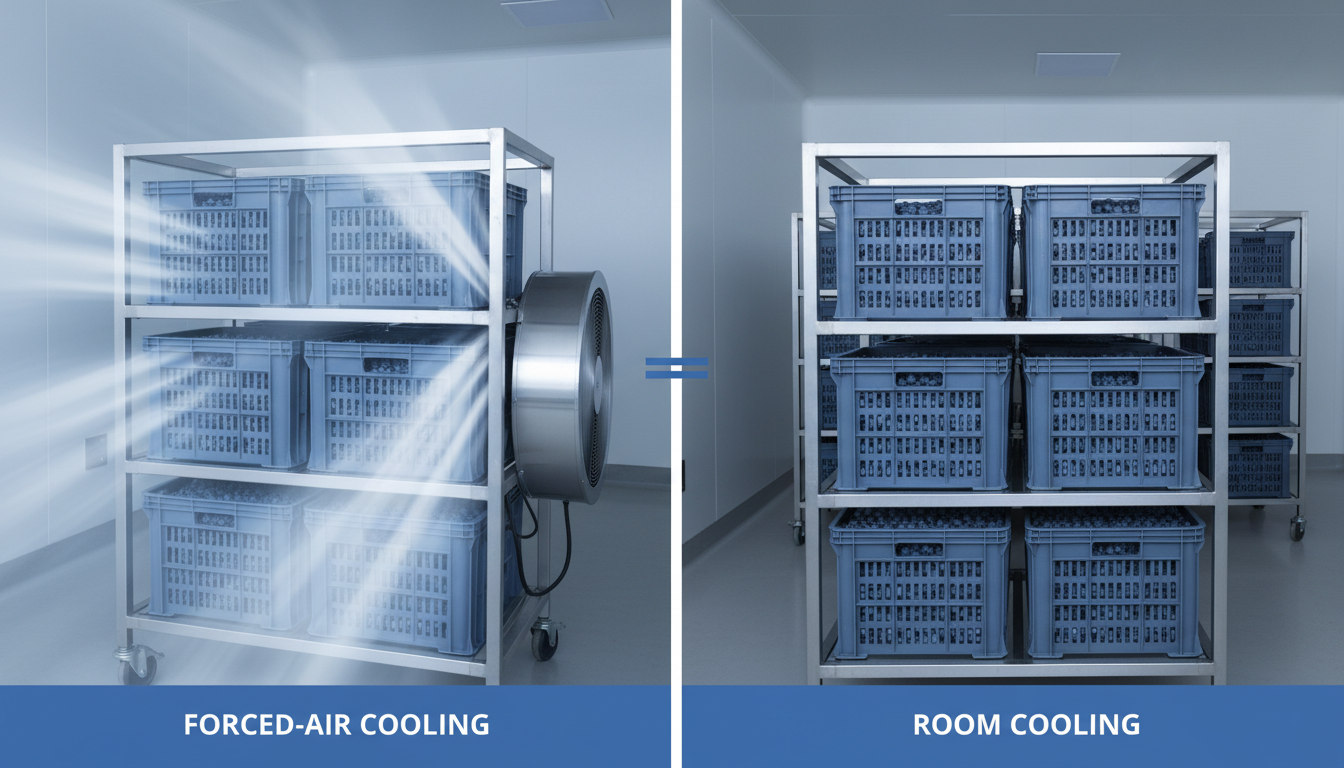
To understand why forced-air cooling is superior to room cooling, we must examine the physics of heat transfer. Room cooling relies on natural convection and radiation. Chilled air circulates around the perimeter of a pallet, but because air follows the path of least resistance, it rarely penetrates the interior of the corrugated boxes or the individual plastic clamshells. The air inside the packaging remains stagnant, acting as an insulator rather than a coolant.
Forced-air cooling (FAC) fundamentally changes this dynamic by introducing a pressure differential. By positioning pallets against a specialized fan system and sealing the gaps, we create a “tunnel” where air is pulled or pushed directly through the product. This utilizes forced convection, which is significantly more efficient at removing heat from the fruit’s surface. In a forced-air system, the “Seven-Eighths Cooling Time”—the time required to remove 87.5% of the temperature difference between the fruit and the coolant—is achieved in a fraction of the time required by room cooling.
Consider the data in the following comparison table, which highlights the stark differences in performance between these methodologies:
| Method | Cooling Time | Moisture Loss | Export Suitability |
|---|---|---|---|
| Forced-Air | 1-2 Hours | Minimal | High |
| Room Cooling | 12-24 Hours | Moderate | Low |
| Hydro-cooling | N/A | High | Not Recommended |
A critical technical nuance in forced-air cooling for blueberries is the management of the Vapor Pressure Deficit (VPD). While we want to cool the fruit quickly, we must also ensure we do not desiccate it. Because blueberries have a high surface-area-to-volume ratio, they are prone to water loss, which manifests as shriveling and loss of “bloom”—the natural waxy coating that consumers equate with freshness. High-quality blueberry cold storage facilities in Madera optimize their FAC tunnels to maintain high relative humidity while moving high volumes of air, ensuring that heat is removed while internal moisture is retained.
Export Protocols for High-Value Berries
The stakes for international export are significantly higher than for domestic transit. A blueberry destined for a grocery store in San Francisco may only need to survive three days of logistics. A blueberry destined for Shanghai or Rotterdam must survive 14 to 21 days in a shipping container. At Central Valley Cold Storage, the protocols for these “high-value” shipments are rigorous, focusing on Export Readiness to ensure the fruit can withstand the rigors of ocean freight.
The protocol begins with the “Pull-Down” phase. To meet export standards, the fruit must be cooled to an internal temperature of 32°F within 2-4 hours of arrival at the facility. This rapid pull-down ensures that the metabolic rate is minimized before the fruit is loaded into a refrigerated container (reefer). If the fruit is loaded at even 40°F, the reefer’s cooling system—which is designed to maintain temperature rather than lower it—may struggle to reach the set point, leading to a “hot load” and inevitable spoilage.
Furthermore, Mastering the Produce Cold Chain involves understanding the impact of ethylene. While blueberries are categorized as low-ethylene producers, they are moderately sensitive to it. Rapid cooling slows the fruit’s sensitivity to ethylene and its own production of the gas, further preserving the firm texture required by international buyers. In the Central Valley, the logistical hub of Madera has become essential because it allows for the immediate transition from field to forced-air tunnel, shaving critical hours off the “field-heat-to-stasis” timeline.
The 200% increase in blueberry acreage in the Central Valley has necessitated an evolution in infrastructure. It is no longer sufficient to have “cold space.” Modern export requires “velocity of cooling.” For the post-harvest physiologist, the goal is clear: utilize the principles of thermodynamics to put the fruit into a state of suspended animation. Forced-air cooling is the only viable method to achieve this without the moisture-related risks of hydro-cooling or the sluggishness of room cooling.
The Importance of the “Bloom” and Physical Integrity
Beyond the internal temperature, the physical aesthetics of the blueberry are paramount for export. The epicuticular wax, or “bloom,” serves as a natural barrier against moisture loss and pathogens. One of the hidden dangers of slow room cooling is the potential for the fruit to stay at a “dew point” temperature for too long, causing moisture to condense and strip away this wax. Forced-air cooling, by rapidly moving past the dew point and stabilizing the temperature, preserves the bloom, ensuring the fruit arrives with the “frosty” blue appearance that commands premium prices in overseas markets.
Strategic Advantage in Madera
Centering these operations in Madera provides a strategic geographical advantage. As the gateway to both the Port of Oakland and the logistics hubs of Southern California, Madera-based pre-cooling allows for a seamless cold chain. By integrating rapid forced-air cooling immediately after harvest, growers can ensure their blueberries are “vessel-ready” the same day they are picked. This efficiency is the difference between a successful export season and a series of insurance claims for “arrivals with decay.”
Frequently Asked Questions
- Q: Why is forced-air cooling best for blueberries?
A: It removes field heat rapidly, reducing the metabolic rate and preventing the growth of Botrytis (gray mold). This speed is essential for maintaining the firm texture required for long-distance transport. - Q: Can’t I just use a very cold room to cool my berries?
A: Standard room cooling is too slow. It can take 12-24 hours for the center of a pallet to reach the target temperature, during which time the berries are respiring heavily and losing shelf life. - Q: Does forced-air cooling dry out the fruit?
A: When managed correctly at a professional facility, the speed of cooling actually reduces overall moisture loss compared to the long, drawn-out process of room cooling, as it quickly closes the vapor pressure deficit.
In conclusion, the science is definitive: for the blueberry exporter, time is the enemy and temperature is the weapon. Forced-air cooling remains the gold standard for anyone serious about international trade. By leveraging rapid pre-cooling, we ensure that the quality of the Central Valley harvest is preserved from the field to the global table.
Ready to secure your cold chain?
Inquire about Pre-Cooling Services
Related Articles
- The Complete Guide to Cold Storage Benefits for California Agriculture
- Ethylene Management: Preventing Cross-Contamination in Mixed Cold Storage
- The Physics of Pre-Cooling: Why Madera Proximity Adds Shelf-Life