In the San Joaquin Valley, we often say that the sun provides the sugar, but the cold provides the profit. My grandfather used to walk the rows of our Flame Seedless blocks, tasting for Brix and checking for color, but he always knew that the moment the shears snapped the rachis, a race began—a race against the very biology of the fruit itself. Today, as both a multi-generational grower and a post-harvest physiologist, I look at our vineyards through a lens of cellular kinetics and thermodynamics. We aren’t just shipping fruit; we are managing the biological decay of a living organism.
The table grape is a marvel of evolutionary engineering, designed to attract avian seed dispersers with its high sugar content and vibrant colors. However, from a commercial perspective, its physiology presents a unique challenge. Unlike the tomato or the banana, the table grape is non-climacteric. It does not possess a “second wind” of ripening once removed from the vine. There is no starch reserve to convert to sugar, no ethylene-triggered surge to improve flavor. The moment it is harvested, its quality is at its absolute peak, and from that second forward, the “senescence clock” begins to tick. To manage this, we must master the science of table grape respiration rates.
The Respiration Race
To understand why a grape loses its “snap” or why the stems turn a brittle brown, we must look at the respiration cycle. Respiration is the process by which the grape consumes its own stored energy—primarily glucose and organic acids—to maintain cellular integrity. Because the grape is no longer receiving water or nutrients from the parent vine, it is essentially “breathing” away its shelf life.
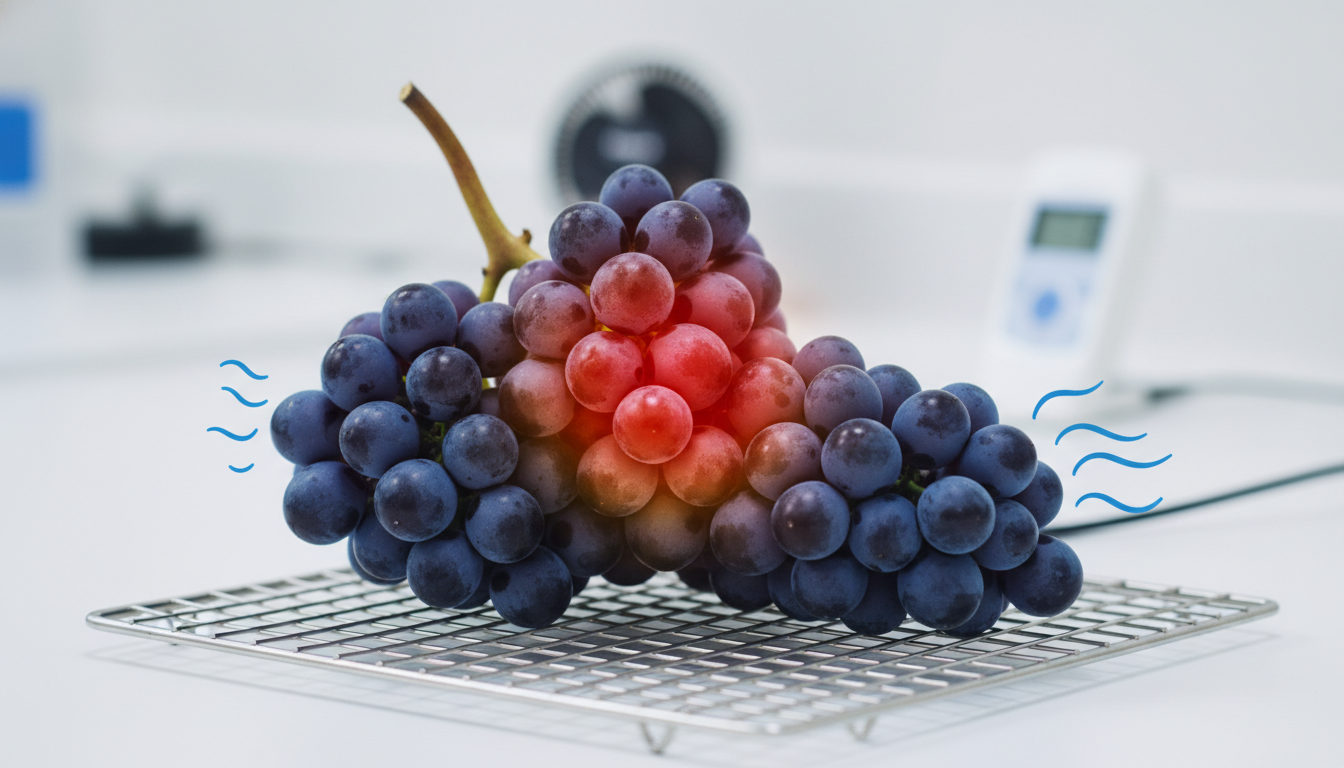
The rate of this consumption is governed by temperature. At the cellular level, enzymes facilitate the oxidation of sugars into carbon dioxide, water, and heat. This metabolic heat is a grower’s worst enemy. If a pallet of grapes is left in the Central Valley sun at 90°F, the internal temperature of the berries continues to rise not just because of the ambient air, but because the fruit is generating its own internal heat through accelerated respiration. This creates a feedback loop: higher heat leads to higher respiration, which leads to more heat, resulting in rapid tissue breakdown and flavor loss.
One of the most critical factors in table grape physiology is their high surface-to-volume ratio. Compared to a dense fruit like a Granny Smith apple, a cluster of grapes exposes a massive amount of surface area to the environment. This makes them extremely susceptible to water loss through transpiration. When a grape respires, it loses moisture. When that moisture loss exceeds roughly 2-3% of its harvest weight, we see the first signs of stem browning and berry softening. By the time it reaches 5%, the fruit is often unmarketable. Our goal at our state-of-the-art post-harvest science facility is to intervene before the first percentage point is lost.
Thermodynamics of Pre-Cooling
The thermodynamics of cooling a table grape is a study in precision. We utilize forced-air cooling to pull field heat out of the center of the corrugated cartons. The objective is to achieve a “seven-eighths cooling time,” which is the time required to remove 87.5% of the temperature difference between the initial field temperature and the cooling medium (the air). In our Central Valley operations, we aim for a target temperature of 32°F (0°C).
Why 32°F? This is the thermal “sweet spot” where we can suppress table grape respiration rates to their absolute minimum without reaching the freezing point of the berry juice (which, due to its high sugar content, is typically around 28°F to 30°F). The impact of this temperature drop is not linear; it is exponential. According to the Q10 law of biological reactions, for every 10-degree Celsius (18°F) drop in temperature, the rate of respiration decreases by a factor of two to three.
When we bring a harvest in from a 100°F field and plunge it to 32°F, we aren’t just cooling the skin; we are slowing the molecular vibrations within the cells. This preserves the turgidity—that characteristic “pop” when you bite into a fresh grape—and protects the Brix-to-acid ratio that defines the variety’s flavor profile. Without immediate thermal intervention, the grape would exhaust its malic and tartaric acids, leaving the fruit tasting flat and overly sweet, lacking the complex acidity required for a premium eating experience.
Halting the Senescence Clock
Senescence is the final stage of a plant’s life cycle, characterized by the breakdown of cell walls and the loss of chlorophyll. In table grapes, we see this most prominently in the rachis (the stem). The rachis is actually more metabolically active than the berries themselves. It respires at a rate significantly higher than the fruit, which is why you often see brown, brittle stems on grapes that still look relatively plump. To the retail buyer, a brown stem is the first sign of “old” fruit, even if the berries are still edible.
By utilizing precise thermal management at CVCS, we effectively put the fruit into a state of suspended animation. We are not just preventing rot; we are preserving the physiological youth of the cluster. This is where our research into The Science of Rehab Storage: Rehydrating Produce for Market becomes vital. While cooling stops the clock, our facility also manages the Vapor Pressure Deficit (VPD). By maintaining a high relative humidity (above 95%) alongside the 32°F temperature, we ensure that the air does not “wick” moisture away from the stems. This dual approach—thermal suppression and moisture equilibrium—is the only way to ensure 5-star retail placement after weeks of transit.
The following data illustrates the direct correlation between temperature management and the biological longevity of the fruit:
| Temperature | Respiration Rate (CO2 mg/kg-hr) | Relative Shelf Life |
|---|---|---|
| 32°F | 2-4 | 100% |
| 40°F | 6-10 | 60% |
| 70°F | 30-50 | < 5% |
As the data shows, a grape stored at 70°F respires nearly ten times faster than one stored at 32°F. In practical terms, one hour at 70°F costs the grower nearly a full day of potential shelf life. This is why our “pick-to-cool” window is so narrow. In the Central Valley, leaving a trailer of harvested fruit on the edge of the field for four hours in the afternoon sun is effectively discarding several days of retail viability.
The Role of Modern Infrastructure
For generations, we relied on simple cold storage—essentially big refrigerators. But modern post-harvest physiology requires more. Our facility utilizes advanced sensors to monitor not just ambient air, but internal pulp temperatures across various pallet positions. We account for the “heat of respiration,” ensuring that the cooling system has the “BTU-heft” to overcome the biological heat load of 20+ tons of fruit entering the facility simultaneously.
Furthermore, we must manage the atmospheric composition. While table grapes are generally tolerant of a wide range of oxygen and CO2 levels, precise control can further inhibit the growth of Botrytis cinerea (gray mold), which is the primary cause of post-harvest decay. Thermal control is our first line of defense; if the temperature stays at 32°F, the metabolic activity of the mold spores is also suppressed, preventing the spread of infection through the “nesting” effect in the carton.
The Grower’s Perspective: Why It Matters
As a grower, I know that my reputation is only as good as the fruit that the consumer pulls out of their refrigerator three weeks after I’ve shipped it. If that grape is soft, if the stem is a desiccated husk, or if the flavor has gone “stale,” I’ve lost a customer. The science of table grape respiration rates is what allows us to bridge the gap between the San Joaquin Valley and a dinner table in New York City or a fruit stall in Seoul.
We are no longer in the era of “good enough” cooling. The global supply chain demands a product that looks and tastes as if it were harvested hours ago. Achieving this requires a deep respect for the thermodynamics of the grape and an investment in the technology required to master it. We are fighting a battle against the second law of thermodynamics—entropy—and our only weapon is a precisely calibrated cooling curve.
Frequently Asked Questions
Q: How quickly must grapes be cooled?
A: To maximize shelf life and maintain the “picked-today” quality, grapes should ideally reach their target storage temperature of 32°F within 6-12 hours of harvest. Any delay in this “pull-down” period directly results in a proportional loss of turgidity and stem health.
Q: Does sugar content (Brix) affect respiration?
A: Yes. Higher sugar levels generally mean higher osmotic pressure within the cells, which can slightly influence the freezing point and the metabolic rate. However, regardless of Brix, the primary driver of respiration remains the ambient pulp temperature.
Are you ready to optimize your harvest for maximum longevity? At our facility, we combine decades of farming heritage with the latest in post-harvest science to ensure your fruit stands the test of time and travel.