By: Sustainable Infrastructure Consultant
In the high-stakes world of industrial cold storage, the margin for error is measured in fractions of a degree. For Procurement Directors and Enterprise RFP leads, the primary challenge is no longer just finding square footage—it is securing an energy profile that guarantees thermal stability against an increasingly volatile public grid. As extreme weather events and aging infrastructure lead to more frequent “brownouts” and “blackouts,” the conversation has shifted from simple energy procurement to sophisticated energy resilience.
The solution emerging at the forefront of the industry is the industrial battery microgrid. This is not merely a backup generator; it is a fundamental reconfiguration of how a facility interacts with power. By integrating high-capacity battery storage with onsite generation, facilities can maintain a perfectly flat temperature line, regardless of external grid conditions. This approach stores excess solar energy during the day to power industrial compressors throughout the night, ensuring zero thermal fluctuation and providing what many consultants now call a “thermal insurance policy.”
Beyond the Solar Panel
For the past decade, solar arrays have been the face of “green” industrial initiatives. However, for a facility operating 24/7, solar panels alone are an incomplete solution. The limitation of solar-only installations is their inherent intermittency. In cold storage, the highest thermal loads often occur when the sun is setting or during the humid evening hours when ambient temperatures remain high but solar production has ceased. Relying solely on the grid during these hours exposes the facility to peak-demand pricing and potential instability.
The industrial battery microgrid goes beyond the solar panel by decoupling the timing of energy generation from the timing of energy consumption. This is the “brain” of the modern warehouse. In a microgrid setup, the battery acts as a buffer. It smooths out the “spikes” in solar production caused by passing clouds and, more importantly, it provides the instantaneous discharge capacity required to start heavy-duty industrial compressors. Without this storage component, the facility remains tethered to the utility’s reliability—or lack thereof.
From a procurement perspective, the microgrid transforms energy from a variable operating expense into a fixed infrastructure asset. While the public utility continues to raise rates to cover aging infrastructure repairs, an off-grid or grid-interactive microgrid allows the operator to lock in their energy costs for decades. With industrial-scale battery costs having decreased by approximately 80% since 2010, the “green premium” has vanished, replaced by a “reliability dividend.”
Storing the Sun for the Night Shift
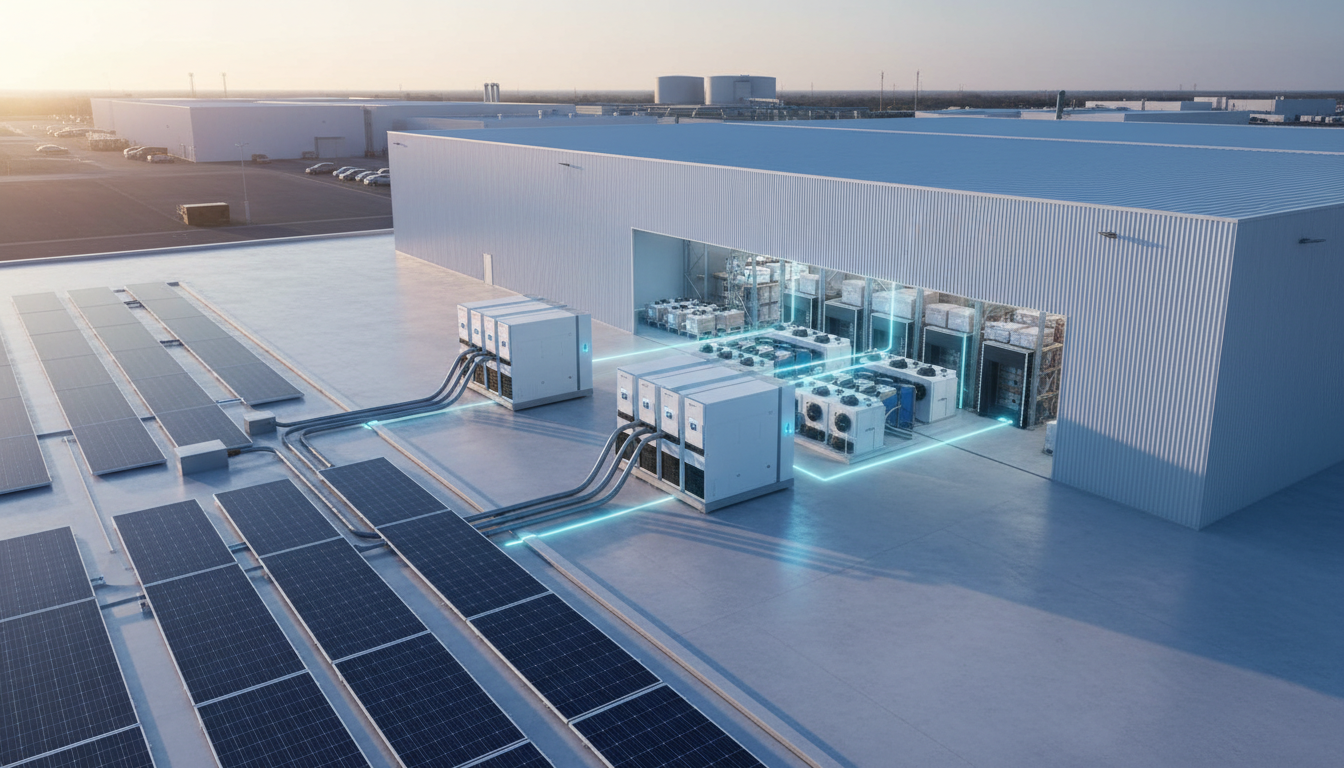
The physics of cold storage is relentless. Compressors do not sleep, and neither can the power supply. The integration of high-capacity battery storage allows facilities like Central Valley Cold Storage (CVCS) to maintain their status as the largest battery-powered facility in the U.S. These systems are designed to capture the massive influx of energy produced by a megawatt-scale solar array during the middle of the day—often more than the facility can use in real-time—and store it for the “night shift.”
This process, known as energy arbitrage, is the secret to 100% uptime. During the day, the solar array powers the facility while simultaneously charging the battery bank. As the sun sets, the microgrid controller seamlessly switches the source of power from the solar panels to the batteries. This transition is invisible to the refrigeration system. There is no voltage sag, no frequency deviation, and most importantly, no interruption in the cooling cycle.
For an RFP director, this level of autonomy is the ultimate risk mitigation strategy. If the public grid fails at 2:00 AM, a standard facility faces a race against time, relying on diesel generators that may or may not start. A battery-equipped microgrid facility, however, has already been running on its stored energy for hours. It simply continues to do so, unaffected by the external chaos. This is not just sustainability; it is operational hardening.
Eliminating Thermal Fluctuations
In the pharmaceutical and high-end food sectors, “Product Integrity” is the most critical KPI. Standard grid power is prone to “micro-outages” and frequency shifts that can cause industrial VFDs (Variable Frequency Drives) to trip. When a compressor trips, the system must undergo a restart sequence, leading to “cycling” that can cause minor but measurable thermal fluctuations. Over time, these fluctuations can degrade the shelf life of sensitive products and increase the rate of mechanical wear on the refrigeration equipment.
An industrial battery microgrid acts as a power quality filter. Because the power is being drawn from a DC battery source and converted via high-precision inverters, the “cleanliness” of the electricity is superior to that of the utility grid. This results in:
- Steady-State Operation: Compressors run at optimal speeds without the need to over-compensate for power sags.
- Reduced Mechanical Stress: Fewer emergency shutdowns and restarts extend the lifespan of the ammonia or CO2 refrigeration systems.
- Precise Climate Control: The ability to maintain a “flat line” temperature profile that meets the most stringent USDA and FDA requirements.
By eliminating these fluctuations, the facility effectively de-risks the cargo of its tenants. When evaluating a cold storage provider, procurement directors are increasingly looking for this “microgrid advantage” as a differentiator that guarantees the safety of their high-value inventory.
The Economic Logic of Reliability
The decision to implement an industrial battery microgrid is as much a financial one as it is technical. To understand the value proposition, one must compare the traditional utility model against the integrated microgrid model. The following table highlights the performance metrics that matter most to enterprise-level stakeholders:
| Energy Source | Reliability | Cost Stability |
|---|---|---|
| Public Utility | Vulnerable (Weather/Grid Load) | Low (Subject to Rate Hikes) |
| Solar-Only | Daytime Only | High (Fixed Generation Cost) |
| Solar + Battery | 24/7 (Off-grid Capable) | High (Locked-in ROI) |
For a procurement director, the “Low” cost stability of the public utility is a significant liability. Energy is often the second largest expense in cold storage after labor. By moving to a solar-plus-battery microgrid, the facility effectively hedges against future inflation. While the initial capital expenditure (CAPEX) is higher, the total cost of ownership (TCO) over a 20-year period is significantly lower, especially when factoring in the avoidance of “Demand Charges”—the heavy fees utilities charge for peak power usage.
Technical Specifications and Redundancy
When reviewing an RFP for a battery-integrated facility, it is essential to look at the “Duration” and “Depth of Discharge” (DoD) of the battery array. A high-quality industrial battery microgrid is not just a few Tesla Powerwalls strapped together; it is a containerized solution using Lithium-Iron-Phosphate (LFP) or Flow Battery technology, designed for thousands of deep cycles.
These systems often feature N+1 redundancy. If one battery module or one inverter fails, the system continues to operate at full capacity. This level of redundancy is what allows for 100% uptime. Furthermore, the Software-as-a-Service (SaaS) layer of the microgrid provides real-time monitoring and predictive analytics. Facility managers can see exactly how many hours of reserve power are available at any given moment, allowing for intelligent load shedding if an extended grid outage is anticipated.
This technical sophistication is why the “Largest battery powered facility in the U.S.” is becoming the benchmark for the industry. It proves that the technology has scaled beyond the pilot phase and is now a viable, robust solution for the most demanding industrial applications.
The Future of Industrial Infrastructure
As we look toward the future of the supply chain, the role of the “warehouse” is changing. It is no longer a passive box; it is an active participant in the energy ecosystem. Facilities equipped with an industrial battery microgrid can even provide services back to the grid during times of extreme stress, creating new revenue streams through demand response programs. However, for the cold storage operator, the primary goal remains the same: Protecting the cold chain.
The integration of Solar-Plus-Battery Microgrids: Ensuring 100% Uptime in Cold Storage is the definitive answer to the challenges of modern energy procurement. It provides the reliability of a private power plant with the sustainability of renewable energy, all while protecting the bottom line from the volatility of the energy market.
Frequently Asked Questions
Q: What happens on cloudy days?
A: Our battery array is sized to provide multiple days of reserve power, ensuring continuous operation. Even on overcast days, solar panels continue to produce energy (albeit at a reduced rate), and the microgrid controller manages the discharge of stored energy to ensure the compressors never skip a beat.
Q: Does a microgrid replace the utility connection entirely?
A: It can, but most industrial facilities choose a “grid-interactive” model. This allows the facility to remain connected to the utility for emergency backup or to sell excess energy back to the grid, while primarily operating on its own generated and stored power.
Q: How does this impact the facility’s ESG goals?
A: An industrial battery microgrid is the single most effective way to reduce Scope 2 emissions. By generating and storing carbon-free energy onsite, facilities can often achieve near-zero emission status for their energy consumption, directly contributing to the ESG mandates of enterprise clients.
For procurement professionals, the choice is clear. In a world of uncertainty, the microgrid offers the one thing the public utility cannot: a guarantee of thermal continuity. It is the secret to reliability in the modern industrial landscape.
Secure Your Cold Chain Reliability
Ready to move beyond grid dependency? Discover how our industry-leading microgrid technology protects your assets and your bottom line.