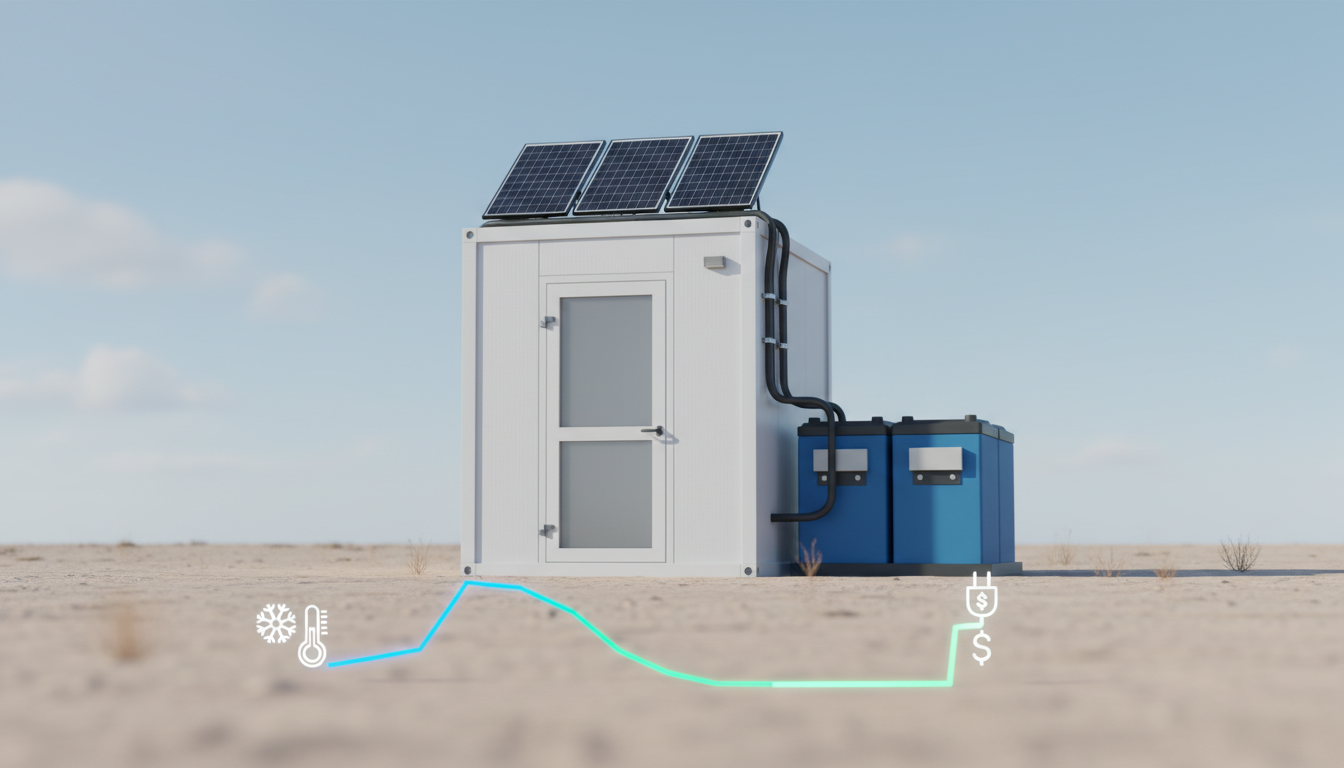
`In the high-stakes world of industrial cold storage, energy is more than a utility—it is the lifeblood of the operation. For facilities managing millions of dollars in perishable agricultural assets, the traditional reliance on the centralized power grid has shifted from a convenience to a systemic risk How Off-Grid Cold Storage Reduces Food Waste in Ca….. As a sustainable infrastructure consultant, I have observed a paradigm shift in how enterprise logistics firms view energy procurement. We are moving away from the “pay-as-you-go” volatility of utility rates toward a model defined by the Levelized Cost of Energy (LCOE). Nowhere is this more evident than at Central Valley Cold Storage (CVCS), the largest off-grid solar-plus-battery facility of its kind in the United States.
The Volatility of the California Grid
To understand the value of an off-grid system, one must first analyze the instability of the alternative. The California power grid is currently grappling with a “perfect storm” of aging infrastructure, wildfire mitigation costs, and a rapidly changing generation mix. Over the last five years, industrial electricity rates in California have surged by approximately 45%. For a facility operating massive compressor racks 24/7, these increases represent a direct erosion of profit margins that cannot always be passed on to clients.
Beyond the simple cost per kilowatt-hour (kWh), the reliability of the grid has become a critical concern. Public Safety Power Shutoffs (PSPS) and localized brownouts are now a recurring reality in the Central Valley The Complete Guide to Cold Storage Benefits for Ca….. In a cold storage context, even a momentary loss of power can be catastrophic. While thermal inertia allows a warehouse to maintain temperature for a short window, the mechanical stress placed on industrial compressors during frequent restarts—and the risk of “slugging” or electronic failure due to “dirty” grid power—creates a maintenance nightmare.
By moving off-grid, CVCS effectively insulates itself from these external shocks. The off-grid industrial energy costs are no longer subject to the whims of the California Public Utilities Commission (CPUC) or the operational failures of investor-owned utilities. Instead, the cost of energy is “locked in” at the moment of system commissioning, providing a level of price certainty that is virtually impossible to achieve on the grid.
Designing the 1200kW Microgrid
Engineering an off-grid system for an industrial load is a feat of precision. Unlike residential solar, which can rely on the grid as a “buffer,” an off-grid industrial microgrid must be perfectly balanced to handle high inrush currents and sustained baseloads. The 1200kW microgrid at CVCS was designed with a philosophy of redundancy and resilience.
The system comprises three primary pillars:
- High-Efficiency PV Array: Oversized to ensure that even on overcast days, the facility generates enough power to both run the compressors and charge the battery banks.
- Lithium-Iron Phosphate (LFP) Battery Storage: Chosen for its safety profile and cycle life, the BESS (Battery Energy Storage System) acts as the “heartbeat” of the facility, smoothing out the intermittency of solar and providing 100% uptime through the night.
- Advanced Microgrid Controllers: These are the “brains” of the operation, utilizing predictive algorithms to manage load shedding and prioritize cooling cycles based on real-time atmospheric data and battery State of Charge (SoC).
When discussing off-grid industrial energy costs, the technical design directly influences the LCOE. A poorly designed system with inadequate storage would require frequent use of backup diesel generators—the most expensive form of energy. By right-sizing the 1200kW microgrid, CVCS minimizes “curtailment” (wasted energy) and maximizes the utilization of every photon captured, driving the LCOE down over the 25-year lifespan of the hardware.
The ROI of Energy Autonomy
The Levelized Cost of Energy (LCOE) is calculated by dividing the total lifetime costs of an energy system (CAPEX + OPEX) by its total energy production. In the context of The Economics of Off-Grid, the math for a facility like CVCS is compelling. While the upfront investment in solar panels and high-capacity batteries is significant, the operational costs are remarkably low, consisting mostly of routine cleaning and inverter inspections.
Compare this to the grid: every year, the utility “tax” increases. When we project the 10-year and 20-year costs, the off-grid model creates a “fixed-cost logistics model.” This allows CVCS to offer enterprise clients long-term storage contracts with guaranteed rates—a massive competitive advantage in an industry where energy surcharges are the norm. Furthermore, the elimination of “demand charges”—those aggressive fees utilities levy for using power during peak periods—removes one of the largest hidden costs in industrial refrigeration.
| Energy Source | 2024 Rate | 2030 Proj. Rate | Stability |
|---|---|---|---|
| Utility Grid | $0.22/kWh | $0.38/kWh | Low (PSPS Risk) |
| CVCS Off-Grid | Fixed LCOE | Fixed LCOE | 100% (Battery) |
| Diesel Backup | $0.55/kWh | Variable | Emergency Only |
As indicated in the table above, the gap between grid rates and off-grid LCOE is expected to widen significantly by 2030. For a facility that consumes millions of kWh annually, a difference of $0.10 or $0.15 per kWh translates into millions of dollars in cumulative savings. This is the essence of energy autonomy: transforming a liability into a strategic asset.
Technical Deep Dive: Resilience and Risk Mitigation
In my role as a consultant, I often remind clients that “cheapest” is not always “best” if it compromises reliability. However, in the case of Solar-Plus-Battery Microgrids, the more resilient solution is also becoming the more economical one. The off-grid system at CVCS provides “clean” power—consistent voltage and frequency that are not subject to the surges or sags of a stressed public grid. This extends the lifespan of the refrigeration equipment, further reducing the total cost of ownership (TCO) for the facility.
Moreover, the integration of off-grid industrial energy costs into the corporate ESG (Environmental, Social, and Governance) framework cannot be ignored. Enterprise clients are increasingly under pressure to decarbonize their supply chains. By storing goods in a 100% solar-powered facility, they are effectively reducing their Scope 3 emissions, making CVCS an essential partner for future-looking brands.
Frequently Asked Questions
Q: How does off-grid power benefit cold storage?
A: It ensures 100% uptime regardless of the public grid and locks in long-term energy costs, protecting the facility from rate hikes and PSPS events.
Q: Is an off-grid system more expensive than the grid?
A: While the initial capital expenditure is higher, the Levelized Cost of Energy (LCOE) over a 10-to-20-year period is typically lower than projected grid rates, especially in regions with high utility volatility like California.
Q: What happens if there is a week of cloudy weather?
A: Industrial microgrids like the one at CVCS are designed with significant battery autonomy and oversized solar arrays. Even in low-light conditions, the system generates power, and redundant backup systems (such as ultra-efficient generators) are in place to ensure the cold chain is never broken.
Conclusion: The Future of Industrial Infrastructure
The success of Central Valley Cold Storage serves as a blueprint for the future of industrial infrastructure. We are entering an era where energy independence is a prerequisite for operational excellence. By focusing on the Levelized Cost of Energy rather than the monthly utility bill, forward-thinking operators can achieve a level of financial and operational stability that was previously thought impossible.
For the agricultural sector, which forms the backbone of the global food supply, this shift is more than a trend—it is a necessity. The ability to guarantee 100% uptime while fixing energy costs for decades provides a “truth source” for the industry, proving that sustainability and profitability are not just compatible, but mutually reinforcing.
Ready to see how we’ve redefined industrial energy? See Our Energy Profile
“`