The Fragility of the Public Grid: A Systemic Risk to Agricultural Portfolios
For the modern agricultural enterprise, the traditional reliance on the public utility grid has transitioned from a standard operational procedure to a significant liability. In the California Central Valley, where multi-million dollar inventories of almonds, pistachios, and cold-stored produce represent the lifeblood of the regional economy, the stability of the power supply is no longer a localized concern—it is a fiduciary one The Complete Guide to Cold Storage Benefits for Ca….. Data indicates that California grid outages have increased by a staggering 40% over the last 24 months, driven by aging infrastructure, extreme weather events, and the increasing frequency of Public Safety Power Shutoffs (PSPS).
When an enterprise manages a high-value agricultural portfolio, the “cost of doing business” now includes the very real possibility of catastrophic inventory loss. Traditional mitigation strategies, such as diesel backup generators, are increasingly viewed as inadequate. Generators are prone to mechanical failure, require complex fuel logistics during regional emergencies, and do not address the micro-fluctuations in voltage that can degrade sensitive cooling equipment. To truly secure an asset, the industry is moving toward a new paradigm: Thermal Insurance.
From a consultant’s perspective, the grid is a single point of failure. Whether it is a wildfire-induced blackout or a mid-summer brownout due to peak demand, the public utility cannot guarantee the 100% uptime required for sensitive biological assets. For stakeholders, the shift from grid-dependence to energy autonomy is not merely a sustainability goal; it is a strategic hedge against the volatility of an increasingly unstable energy market.
Defining Thermal Insurance: The New Standard in Energy Autonomy
Thermal Insurance is not a policy purchased from an underwriter; it is an operational strategy that guarantees 100% uptime through energy autonomy. In technical terms, it is the operational guarantee of temperature stasis achieved via onsite energy generation and storage The Economics of Thermal Insurance: Protecting $10….. By decoupling a facility from the public grid, operators can maintain a “flat-line” temperature profile, effectively insuring the inventory against the thermal spikes that occur during power transitions or utility failures.
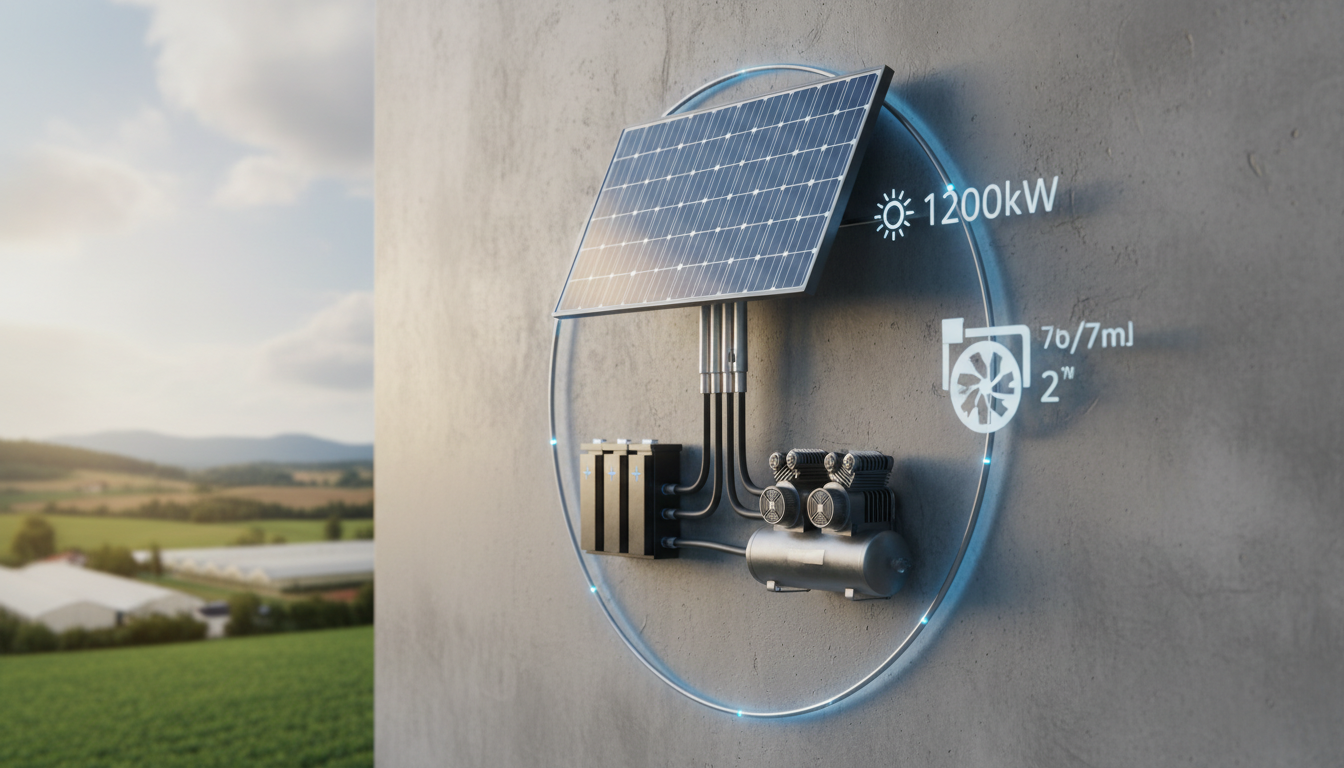
The gold standard for this model is found at Central Valley Cold Storage (CVCS), which currently stands as the largest off-grid solar + battery facility in the United States. Utilizing a massive 1200kW solar array paired with industrial-scale battery storage, the facility operates in a state of permanent “islanding.” This means the cooling systems are powered by a consistent, controlled flow of energy that is entirely independent of the external environment.
The Mechanics of Thermal Stasis
Traditional grid-dependent facilities often experience what we call “The Thermal Sawtooth.” This occurs when the utility power fluctuates or when the facility switches to backup power, causing the refrigeration compressors to cycle inefficiently. These fluctuations, even if they stay within a “safe” range, accelerate the degradation of the product. Thermal Insurance, as implemented via an off-grid microgrid, eliminates this volatility. The precision of battery-stored energy allows for a level of load-following that standard utility power cannot match.
When comparing a standard facility to a microgrid-backed facility, the technical advantages become clear:
| Feature | Public Grid Dependent | CVCS Off-Grid Microgrid |
|---|---|---|
| Power Uptime | 98.2% (Est.) | 100% |
| Temp Fluctuation | +/- 3.5°F | +/- 0.5°F |
| PSPS Risk | High | Zero |
As evidenced in our technical analysis, 24/7 Thermal Stability: Comparing Microgrids vs. Standard Utility Grids, the microgrid architecture provides a level of thermodynamic inertia that protects the cellular integrity of stored assets. For an enterprise, this is the difference between delivering a premium product and managing a secondary-market salvage operation.
The Financial Impact of Stasis: Preventing ‘Shrink’ and Protecting Margins
In the world of high-value agriculture, “shrink” is the enemy of the balance sheet. Shrinkage isn’t just about physical loss; it’s about the loss of quality, weight, and shelf-life that occurs when a product is subjected to temperature variance. Thermal Insurance acts as a financial hedge by ensuring that the product leaving the facility is in the exact same condition as the product that entered it.
Eliminating the Invisible Loss
Most facility managers account for catastrophic loss—the total failure of a cooling system. However, many overlook the “invisible loss” caused by +/- 3.5°F fluctuations. These cycles cause moisture migration within the product. In the almond industry, for example, moisture control is critical. A fluctuation that leads to even a 1% increase in moisture can trigger mold growth or enzymatic changes that devalue the entire lot. By maintaining a +/- 0.5°F environment, Thermal Insurance preserves the weight and grade of the commodity, directly impacting the Net Present Value (NPV) of the portfolio.
OPEX Predictability and CAPEX Justification
Beyond product integrity, Thermal Insurance addresses the volatility of energy pricing. California’s utility rates for industrial customers have seen double-digit increases, compounded by “Time-of-Use” (TOU) charges that penalize facilities for cooling during the hottest parts of the day. An off-grid microgrid transforms energy from a variable OPEX (operating expense) into a fixed CAPEX (capital expenditure).
For an enterprise-level agricultural firm, this allows for precise long-term financial modeling. You are no longer at the mercy of the California Public Utilities Commission (CPUC) rate hikes. Instead, the 1200kW solar array and battery system function as a pre-paid energy contract for the next 25 years. This level of fiscal certainty is a core component of modern sustainable infrastructure consulting.
Strategic Implementation: Why Enterprise RFPs Must Prioritize Autonomy
As we move into a future defined by climate uncertainty and grid instability, the criteria for selecting cold storage partners or building new facilities must evolve. Enterprise RFPs (Request for Proposals) should no longer treat power as a given utility; it must be treated as a mission-critical component of the facility’s engineering.
- Redundancy is Not Autonomy: An RFP that asks for “backup power” is asking for a reactive solution. An RFP that demands “energy autonomy” is seeking a proactive Thermal Insurance strategy.
- Data-Driven Compliance: Modern portfolios require granular data. Off-grid microgrids provide digital breadcrumbs of every watt generated and every degree maintained, allowing for 100% transparency in the cold chain.
- ESG Integration: Implementing off-grid solar + battery solutions isn’t just about risk mitigation; it is a powerful driver for Environmental, Social, and Governance (ESG) reporting, significantly reducing the Scope 2 emissions of the enterprise.
The Central Valley Cold Storage model proves that the technology for 100% autonomous agricultural storage is not a “future” concept—it is a current reality. For those managing multi-million dollar portfolios, the question is no longer whether you can afford to implement Thermal Insurance, but whether you can afford the risk of remaining on the grid.
Frequently Asked Questions
Q: What is Thermal Insurance?
A: It is the operational guarantee of temperature stasis achieved via onsite energy generation and storage, ensuring that inventory is never exposed to the risks of grid failure or fluctuations.
Q: How does Thermal Insurance differ from a standard insurance policy?
A: A standard insurance policy pays you after your product has been damaged or lost. Thermal Insurance is a preventative infrastructure strategy that ensures the damage never occurs in the first place by maintaining 100% uptime.
Q: Is off-grid power feasible for large-scale industrial facilities?
A: Yes. As demonstrated by the 1200kW solar array and battery storage system at Central Valley Cold Storage, large-scale industrial loads can be fully supported through autonomous microgrids.
Secure Your Portfolio Today
Ready to move beyond grid-dependence? Learn the technical specifications and financial modeling behind the nation’s most resilient cold storage infrastructure.