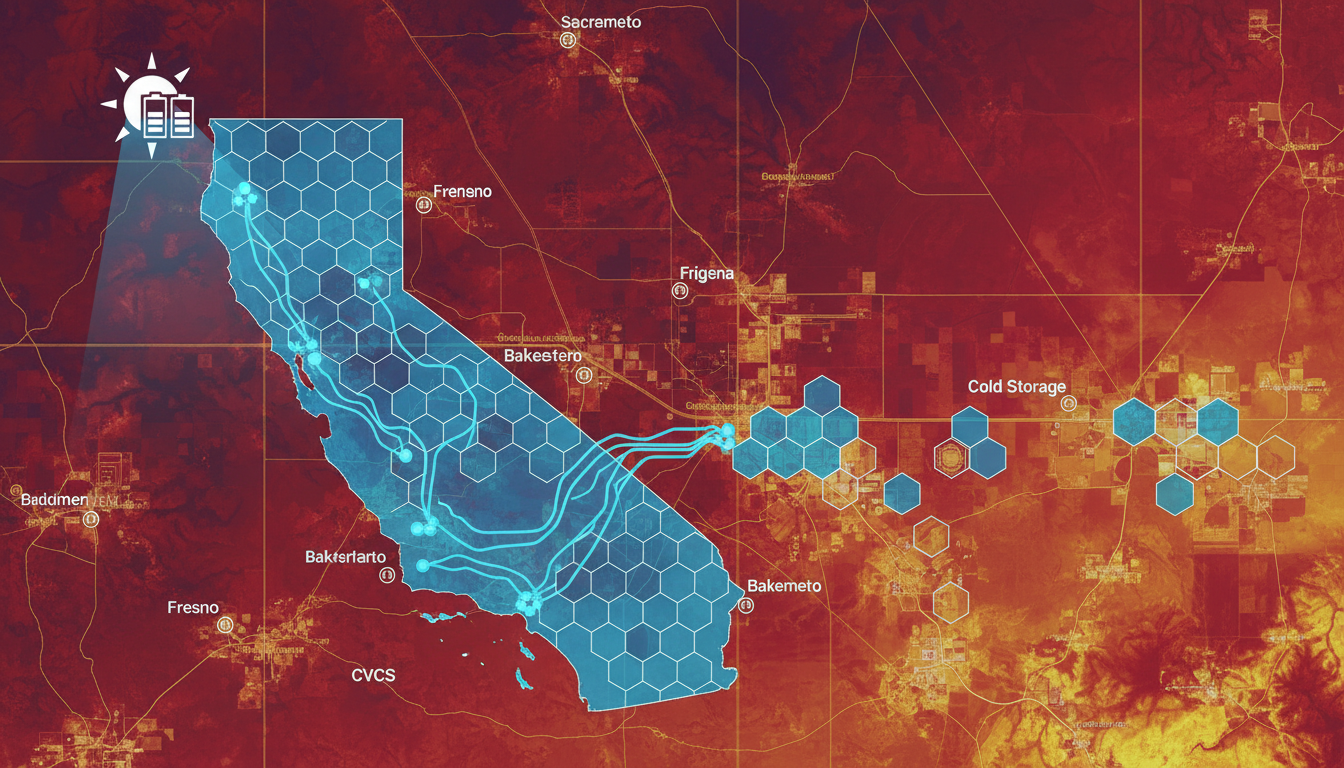
At the center of this transition is a fundamental decoupling of energy consumption from utility price fluctuations. By leveraging onsite solar and battery microgrids, facilities like Central Valley Cold Storage (CVCS) are redefining the “Levelized Cost of Energy” (LCOE) for the refrigeration sector Agricultural Cold Storage at Madera Airport Indust….. This article explores the fiscal architecture of off-grid cold storage and why the largest off-grid solar + battery facility in the U.S. represents the new gold standard for procurement directors seeking price certainty and 100% uptime.
The Hidden Costs of the Grid
For decades, procurement directors viewed the grid as a reliable, albeit expensive, constant. However, the last five years have shattered that illusion. California’s grid-tied industrial facilities are currently grappling with a “triple threat” of economic pressures: escalating base rates, punitive peak demand charges, and the constant specter of Public Safety Power Shutoffs (PSPS). Since 2020, industrial rates have spiked by margins that outpace inflation, with some regions seeing annual increases of 6% to 10%, or even 20% in extreme localized cycles.
The “hidden” cost of the grid isn’t just the price per kilowatt-hour (kWh); it’s the structural inefficiency of the billing model. Peak demand charges—often ranging from $15 to $30 per kW—can account for up to 50% of a facility’s monthly bill. These charges are triggered by the highest period of usage, effectively punishing cold storage operations for doing exactly what they are designed to do: maintain thermal stability during the hottest parts of the day. When you layer on the cost of diesel backup generator maintenance and the carbon penalties associated with them, the traditional grid-tied model reveals itself as a high-volatility, low-margin trap.
Levelized Cost of Energy (LCOE) Breakdown
To truly understand the economics of off-grid cold storage, we must pivot from a “Price-Per-Month” mindset to a “Levelized Cost of Energy” (LCOE) framework. LCOE calculates the average net present cost of electricity generation for a generating plant over its lifetime. In an off-grid microgrid scenario, the LCOE is front-loaded into infrastructure capital, which effectively “locks in” the energy price for 20 to 25 years.
When we compare a grid-tied facility to an off-grid microgrid like CVCS, the divergence in long-term cost-benefit is staggering. While the grid-tied facility is subject to the whims of regulatory filings and utility infrastructure failures, the off-grid facility operates on a fixed-cost basis. This allows for long-term contract stability that is impossible to achieve when your primary input cost is controlled by a third-party utility. By bypassing the transmission and distribution fees that make up a massive portion of a California utility bill, off-grid industrial energy costs are slashed by approximately 50% over the lifecycle of the facility.
| Cost Driver | Grid-Tied Facility | CVCS Off-Grid Microgrid |
|---|---|---|
| Peak Demand Charge | $15-$30/kW | $0 |
| Reliability Risk | High (PSPS Events) | Zero (Isolated) |
| Energy Price Inflation | 6-10% annually | Fixed Infrastructure Cost |
The table above highlights the structural advantage of the microgrid. For a procurement director, the $0 peak demand charge is the most significant differentiator. It removes the need for complex load-shedding strategies that can risk internal temperature fluctuations. Instead, the facility utilizes its battery array to buffer the massive energy requirements of industrial compressors, ensuring that the cost of cooling at 2:00 PM on a Tuesday in July is identical to the cost at midnight in December.
Mitigating Spoilage Liability
Beyond the monthly invoice, the most critical economic factor in cold storage is risk mitigation. In the Central Valley, a PSPS event or a grid failure isn’t just an inconvenience; it is a multi-million dollar liability. For high-value commodities like almonds, citrus, or frozen proteins, a loss of power for even a few hours can trigger a catastrophic breach of the cold chain. The spoilage liability for a single 100,000-square-foot facility can exceed $5 million in inventory value, not to mention the irreparable damage to brand reputation and retail partnerships.
Traditional facilities rely on backup diesel generators, which are notoriously fickle and subject to strict South Coast Air Quality Management District (SCAQMD) or similar regional air board regulations. These generators often fail to kick in instantaneously, and their fuel supply is vulnerable during large-scale disasters. In contrast, an off-grid microgrid offers 100% uptime. Because the system is physically isolated from the municipal grid, it is immune to the cascading failures of the California ISO. This resilience transforms energy from a source of anxiety into a competitive advantage. When the grid goes down across the Central Valley, an off-grid facility remains a “cold island,” providing uninterrupted service and protecting the assets of its clients.
The Future of Cold Storage: Off-Grid Resilience and Sustainable Infrastructure
As we look toward the next decade of supply chain evolution, the integration of energy production and storage with logistics is inevitable. We are moving toward a model where the warehouse is the power plant. This synergy is the core of The Future of Cold Storage: Off-Grid Resilience and Sustainable Infrastructure. By generating power exactly where it is consumed, we eliminate the 5-10% energy loss that occurs during transmission over long distances. For enterprise-level procurement, this represents the ultimate form of vertical integration.
Furthermore, the environmental, social, and governance (ESG) implications are profound. For many of our partners, reducing the carbon footprint of their cold chain is no longer optional—it is a mandate from shareholders and consumers alike. An off-grid solar + battery facility provides a verifiable, 100% renewable energy source that bypasses the “greenwashed” mix of the state grid. This allows our clients to claim zero-emissions storage, a value proposition that is increasingly commanding a premium in the marketplace.
The CVCS Advantage: Scaling the Largest Off-Grid Microgrid
Central Valley Cold Storage (CVCS) isn’t just a proof of concept; it is the largest off-grid solar + battery facility in the United States. This scale is vital because it provides the thermal mass and energy storage capacity necessary to handle the most demanding industrial loads. For procurement directors, this scale translates to reliability. We have engineered a system that accounts for “worst-case” meteorological scenarios, ensuring that even during consecutive days of low solar irradiance, our battery arrays have the depth of discharge required to maintain strict temperature setpoints.
This infrastructure allows us to offer our partners something the grid cannot: long-term price certainty. When we remove the variable of utility rate hikes, we can offer multi-year contracts with fixed storage rates. This allows for more accurate budgeting and protects our clients’ margins from the 20% annual fluctuations that have become common in the California energy market.
Conclusion: Energy as a Strategic Asset
For the Enterprise Procurement Director, the decision to move toward off-grid cold storage is a transition from a defensive posture to an offensive one. You are no longer at the mercy of a utility’s infrastructure failures or a regulator’s rate approvals. Instead, you are leveraging a fixed-cost infrastructure that guarantees 100% uptime and significantly lower TCO.
The economics are clear: when you factor in the elimination of peak demand charges, the mitigation of spoilage risk, and the long-term hedge against energy inflation, the off-grid microgrid is the only logical path forward for industrial refrigeration in California. It is time to treat energy not as a bill to be paid, but as a strategic asset to be managed.
Frequently Asked Questions
Q: How does off-grid power affect storage rates?
A: It allows for long-term fixed-rate contracts by removing utility price volatility. Because our primary input cost (energy) is stabilized through onsite infrastructure, we can pass that certainty on to our clients, protecting them from the 6-10% annual rate hikes typical of grid-tied providers.
Q: Is 100% uptime actually achievable without a grid connection?
A: Yes. By over-provisioning solar generation and utilizing large-scale battery storage, off-grid facilities are specifically designed to operate independently 24/7. In fact, they are often more reliable than grid-tied facilities because they are not vulnerable to Public Safety Power Shutoffs (PSPS) or regional grid failures.
Ready to stabilize your cold chain costs?
Discover how our off-grid infrastructure can reduce your operational risks and provide long-term price certainty in the California market.