Temperature Monitoring and Documentation: A Practical Guide to Cold Storage FSMA Compliance
Definition: Temperature monitoring and documentation in cold storage operations is the continuous, automated measurement of storage environment conditions and the systematic recording of all temperature and humidity data, deviations, and corrective actions. This infrastructure is essential for FSMA 204 compliance, food safety certification (SQF, BRCGS, PRIMUS), and regulatory audits. Effective systems integrate IoT sensors, centralized data logging, automated alert protocols, and documentation procedures that prove storage conditions were maintained within specified ranges throughout product holding periods.
The Critical Role of Temperature Data in Food Safety and Compliance
Temperature is the primary control variable in cold storage. Product quality, safety, and shelf life are directly dependent on maintaining target storage temperatures throughout the holding period. A temperature deviation of 10°F for 8-12 hours can result in measurable quality degradation (texture changes, oil separation in nuts, ripening acceleration in fruit). A 24+ hour deviation can render product unsuitable for intended use.
Beyond quality management, temperature data is the primary evidence demonstrating that a facility maintained conditions necessary to prevent microbial growth and foodborne pathogen proliferation. In contamination trace-back scenarios, regulatory agencies ask: “What was the temperature in the storage zone where this lot was held?” If the facility cannot produce continuous temperature records covering the entire holding period, the facility has inadequate documentation and faces regulatory questions about product safety.
Modern food safety frameworks (FSMA 204, SQF, BRCGS, PRIMUS) explicitly require automated temperature monitoring with continuous data logging. Manual daily or weekly temperature checks are no longer acceptable for compliance. Regulatory auditors expect facilities to produce minute-by-minute or hour-by-hour temperature records spanning every moment of product storage.
IoT Sensor Networks: The Foundation of Automated Temperature Monitoring
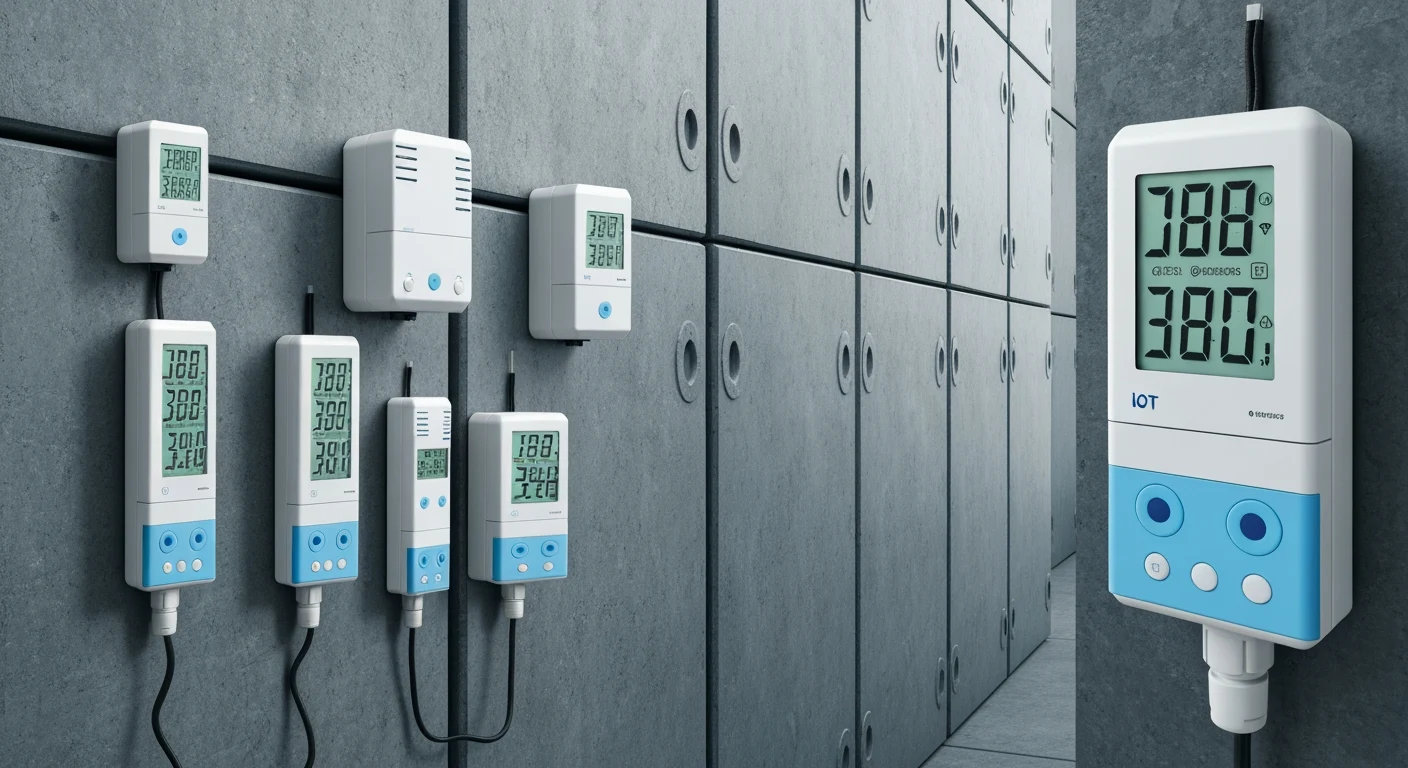
Automated temperature monitoring begins with Internet of Things (IoT) sensors distributed throughout the cold storage facility. These sensors continuously measure temperature and humidity and transmit data to a centralized database at regular intervals (typically 15 minutes to 1 hour depending on facility size and risk profile).
Sensor Types and Placement: Cold storage facilities typically employ multiple sensor types distributed across different zones: thermometers measuring return-air temperature (temperature of air returning to the evaporator after circulating through the storage zone), product-contact sensors measuring temperature of actual stored product, and humidity sensors measuring relative humidity in storage zones. Sensors should be placed at multiple heights and locations within each storage zone, not merely at entrance/exit points.
Sensor Accuracy and Calibration: Sensors must be calibrated regularly (typically quarterly) to ensure accuracy. Calibration involves comparing sensor readings against a known-accurate reference (calibrated reference thermometer or certified calibration equipment). FSMA 204 compliance requires that facilities document calibration procedures and results. A sensor drifting outside acceptable accuracy range must be replaced. Documentation of calibration and sensor replacement is essential audit evidence.
Sensor Redundancy and Backup Systems: Single-point failures in monitoring systems create compliance risk. If a primary sensor fails, the facility loses temperature data during the failure period. To address this, professional facilities employ redundant sensors in each zone, ensuring that if one sensor fails, backup sensors continue monitoring. Redundancy is particularly critical for high-risk temperature zones (sub-zero storage, organic storage) where temperature deviations create significant liability.
CVCS Sensor Infrastructure: CVCS maintains redundant IoT sensor networks throughout our facility. Each storage zone has multiple temperature sensors (primary and backup) plus humidity sensors, all reporting to a centralized monitoring system. Sensor calibration is conducted quarterly with documented results maintained for audit purposes. The system is designed to ensure that complete temperature data is available for every moment of product storage.
Data Logging Intervals and Compliance Requirements
The frequency at which temperature data is recorded (logging interval) is specified by regulatory and certification standards, though the standards are evolving toward greater data granularity.
FDA and FSMA 204 Guidance: FDA guidance suggests temperature data logging at intervals allowing detection of temperature deviations “in a timely manner.” For cold storage, this is typically interpreted as hourly or more frequent logging. Facilities logging only daily temperatures face FDA questions about whether less-frequent deviations would be detected.
SQF and BRCGS Standards: SQF and BRCGS standards require continuous automated monitoring with data logging at intervals appropriate to detect deviations from target range. Both standards accept hourly logging as compliant for standard cold storage zones. Sub-zero and ultra-low-temperature zones may require more frequent logging (15-30 minute intervals).
Industry Best Practices: Leading cold storage operators log temperature data at 15-30 minute intervals, providing granular data that clearly shows temperature variation within days and hours. This level of granularity is advantageous in audits—it demonstrates that deviations, if any, occurred and were identified and corrected quickly.
CVCS Data Logging Intervals: CVCS logs temperature and humidity data at 15-minute intervals in all storage zones. This granular logging provides clear evidence of storage condition maintenance and rapid deviation detection. 15-minute data intervals also enable CVCS to identify patterns (time-of-day variations, seasonal fluctuations) that inform facility optimization efforts.
Temperature Deviation Protocols: Detection, Investigation, and Documentation
Temperature deviations—periods when stored product temperature exceeds or falls below target range—are inevitable in real-world operations. Equipment failures, power outages, or unexpected operational demands can cause deviations. What matters for compliance is that facilities detect deviations quickly, investigate root causes, document findings, and implement corrective actions.
Automated Alert Systems: Modern facilities employ automated alert systems triggering alarms when temperature deviates from target range. These alerts notify facility staff (via email, SMS, or on-site alarm) that a deviation has occurred, enabling immediate investigation and response. Alerts should be configured with appropriate thresholds—deviation of 0.5°F might trigger an alert in sub-zero zones (high sensitivity), while 1-2°F deviation might be acceptable in moderate-temperature zones (lower sensitivity).
Deviation Investigation Procedures: When a deviation is detected, facility staff should follow documented procedures: (1) identify the affected storage zone and product, (2) determine the cause of the deviation (equipment malfunction, power outage, door left open, etc.), (3) assess the duration and magnitude of the deviation, (4) estimate impact on stored product quality and safety, (5) document findings, (6) implement corrective actions if necessary.
Corrective Actions and Product Assessment: For minor deviations (1-2°F for 1-2 hours), corrective action may be as simple as verifying system recovery and confirming that product remains suitable for intended use. For significant deviations (5-10°F for 6+ hours), assessment may involve: temperature checks on actual product to verify that deviation did not penetrate to product interior, quality assessment (checking product for signs of degradation), and determination of whether product can continue storage or must be redirected to alternative use (processing, animal feed, etc.).
Documentation Standards: Deviation investigations must be documented with: date/time of deviation, duration and magnitude (how many degrees of variation, for how long), root cause determination, assessment of product impact, corrective actions implemented, and signature of staff conducting investigation and documentation. This documentation is retained for audit purposes and provides evidence that the facility responded appropriately to deviations.
CVCS Deviation Protocols: CVCS maintains automated alert systems configured to notify management of any temperature deviation exceeding zone-specific thresholds. Upon alert, facility staff immediately investigate the deviation, document findings and corrective actions, and assess product impact. All deviation documentation is retained and available for customer audits. This systematic approach ensures that deviations are rare, detected immediately when they occur, and managed with documented procedures.
Integration with FSMA 204 Traceability Systems
Temperature data must be integrated with product traceability systems so that specific lots can be linked to documented storage conditions. FSMA 204 compliance requires that when a lot is traced backward, the facility can provide not only receiving date and product identity but also the complete temperature history of the storage zone where that lot was held.
Lot-to-Zone Mapping: Facilities must maintain documentation linking each stored lot to its physical storage location (zone, section, shelf) and the corresponding temperature monitoring data for that zone. This mapping allows FSMA 204 trace-back to include temperature documentation showing that the lot was held at compliant temperatures throughout its storage period.
Data Retrieval and Reporting: Traceability systems should enable rapid retrieval of temperature data for specific lots. Given a recall scenario, facility staff should be able to search by lot identifier, determine storage location, and retrieve temperature data for the time period the lot was stored—all within hours. This capability demonstrates FSMA 204 readiness to regulators.
CVCS Integration Capabilities: CVCS’s warehouse management system (WMS) links lot identifiers to storage zones and integrates with temperature monitoring systems. When a lot is searched in the WMS, the system can retrieve: product identity and quantity, storage zone and location, storage start/end dates, and corresponding temperature data for those dates. This integration provides complete traceability spanning product identity and storage conditions.
Alarm Management and Power Outage Response Protocols
Cold storage facilities depend on continuous power to maintain temperature control. Power outages create immediate product safety risks. Facilities must have procedures addressing outage response and power restoration verification.
Backup Power Systems: Professional facilities employ backup power (generators or battery systems) to maintain critical refrigeration systems during grid outages. FSMA 204 and SQF standards require documentation that facilities maintain power-outage preparedness. For facilities without backup power, this represents a significant compliance gap—product cannot be stored safely without continuous temperature control during outages.
Renewable Energy and Outage Resilience: CVCS’s on-site 1200kW solar system provides partial offset of facility energy consumption, and on-site battery storage provides backup power during outages. This renewable energy infrastructure ensures that even during grid outages, critical systems maintain temperature control for several hours, protecting stored inventory and enabling orderly response to extended outages.
Power Outage Notification and Response: Facilities should document procedures for notifying management during power outages, monitoring temperature recovery after power restoration, and assessing product impact. Outage documentation should include: duration of the outage, temperature loss during the outage, recovery time to target temperature, product assessment, and any corrective actions. This documentation demonstrates that the facility responded appropriately to outages.
Temperature Logging Software and Data Management Systems
Temperature data logging requires software systems capable of receiving data from IoT sensors, storing data in accessible databases, alerting staff to deviations, and generating audit-ready reports.
Essential Software Features: Professional systems should include: real-time data display (showing current temperature in each zone), alert generation and notification (email, SMS, on-site alarms for deviations), historical data retrieval (ability to retrieve data for specific time periods), graphical data visualization (charts showing temperature trends over time), report generation (automated reports for audits), and data security and backup (protecting data from loss or corruption).
Integration with Facility Systems: Temperature logging software should integrate with facility management systems, allowing staff to correlate temperature data with operational events. For example, if temperature spiked during a specific time period, integration with access logs might show that a door was propped open. Integration reduces time required to investigate deviations and supports rapid root-cause determination.
Data Retention and Archive: Facilities must retain temperature data for 5+ years (per FSMA 204 requirements). This requires robust data archival systems protecting against loss or corruption. Facilities should maintain both primary data storage (typically cloud-based systems for accessibility) and archive storage (protected backup copies).
CVCS Data Management Infrastructure: CVCS employs professional temperature logging software with real-time alerts, 15-minute data granularity, automated reporting, and integration with our warehouse management system. Temperature data is stored in redundant systems with 5+ year retention, exceeding regulatory requirements. This infrastructure enables immediate deviation response and audit documentation.
Documentation Standards for Temperature Audits and Inspections
Regulatory agencies and certification auditors will request temperature documentation to verify compliance. Facilities should maintain documentation organized and accessible to auditors.
Documentation Package Contents: A complete temperature documentation package should include: sensor calibration records (verification that sensors are accurate), alert configuration and testing (confirmation that alarm systems function properly), deviation log and investigation records (documented responses to deviations), power outage documentation (if applicable), product traceability with temperature data (linking lots to storage conditions), and routine temperature summary reports (showing normal operating conditions over time).
Audit Preparation and Responsiveness: Facilities should maintain documentation organized by audit category (sensor maintenance, deviation management, traceability, etc.) enabling rapid response to auditor requests. During audits, auditors typically request temperature data for specific time periods or lots. Facilities providing data within hours (rather than days) demonstrate organized systems and build auditor confidence.
CVCS Audit Readiness: CVCS maintains temperature documentation organized by zone and time period, enabling rapid retrieval for auditor requests. Our systems are designed to provide auditors with complete temperature records, deviation documentation, and product traceability within hours of inquiry. This responsiveness supports successful audit completion.
Remote Monitoring and 24/7 Operational Visibility
Modern cold storage facilities provide remote monitoring capabilities enabling facility staff and customers to view real-time temperature data from anywhere. This visibility supports operational transparency and enables rapid response to deviations.
Dashboard Access and Real-Time Alerts: Professional systems provide staff and authorized customers with web-based or mobile app access to real-time temperature displays. Staff working off-site can monitor conditions continuously. Customers can verify that their stored product is maintained at target temperatures without requiring on-site visits.
Customer Transparency and Service Differentiation: For cold storage providers, offering customers real-time temperature visibility is a service differentiator. Customers value ability to verify storage conditions independently, and real-time access builds customer confidence in facility operations. This transparency also supports sales conversations—prospective customers are impressed by demonstrating 24/7 monitoring and real-time visibility.
Operational Risk Management: Real-time monitoring enables rapid identification of emerging problems. A sensor showing gradual temperature drift (not yet exceeding alarm thresholds) can be identified days before it becomes a compliance issue. Early identification enables preventive maintenance before deviations occur.
CVCS Remote Monitoring Capabilities: CVCS provides authorized customers with web-based and mobile app access to real-time temperature data for their stored product. Customers can verify conditions 24/7 without on-site visits. This transparency supports customer confidence and differentiates CVCS from competitors lacking real-time visibility capabilities.
Continuous Improvement and Optimization Through Data Analysis
Temperature data, when analyzed systematically, reveals patterns that support facility optimization. Facilities can identify: zones with temperature stability issues, time-of-day patterns indicating potential problems, seasonal variations, and equipment performance trends.
Data Analytics and Pattern Recognition: Quarterly analysis of temperature data can identify trends enabling equipment maintenance optimization. For example, analysis might reveal that a particular zone shows increasing temperature deviation in afternoon hours, suggesting equipment efficiency degradation that warrants maintenance before failure occurs.
Equipment Maintenance and Efficiency: Systematic temperature data analysis supports preventive maintenance scheduling. Equipment showing gradual performance degradation (evidenced by narrowing temperature margins or increasing deviation frequency) can be serviced before failure. This proactive maintenance prevents costly equipment failures and product loss.
Energy Efficiency Optimization: Temperature data analysis can reveal opportunities for energy efficiency improvements. For example, analysis might show that sub-zero zones maintain temperatures 5°F colder than necessary, representing wasted energy. Adjusting setpoints to necessary minimums reduces energy consumption without compromising product quality.
Call to Action: Temperature Compliance Partnership
Temperature monitoring and documentation are foundational to FSMA 204 compliance and food safety certification. CVCS’s automated IoT sensor networks, 15-minute data logging intervals, automated alert systems, integrated traceability, and comprehensive documentation procedures establish the infrastructure required for regulatory compliance and customer confidence.
Whether you’re evaluating cold storage vendors, preparing for FSMA 204 compliance, or conducting supplier audits, request detailed documentation of temperature monitoring infrastructure. Facilities with professional automated systems and comprehensive documentation are operationally superior to facilities relying on manual temperature checks.
Request a detailed temperature monitoring system review demonstrating CVCS’s compliance infrastructure and 24/7 operational visibility capabilities.