The Pharmaceutical Cold Chain in California
California is home to some of the world’s largest pharmaceutical and biotechnology companies, with significant operations in the Bay Area, San Diego, and increasingly in the Central Valley corridor. The state’s position as a global life sciences hub creates substantial demand for GDP (Good Distribution Practice)-compliant cold storage capable of maintaining tight temperature bands — particularly the 2–8°C range required for vaccines, biologics, and many small-molecule drugs.
While purpose-built pharmaceutical warehouses exist at major distribution hubs, there is growing demand for regional cold storage options that support clinical trial logistics, distributor staging, and emergency inventory buffers in the Central Valley — particularly as Valley-based specialty pharmacies and healthcare networks expand.
GDP Compliance: What It Requires of Cold Storage Facilities
Good Distribution Practice guidelines (WHO GDP, EU GDP Directive 2013/C 68/01, and USP <1079> for the US market) establish the minimum standards for temperature-controlled pharmaceutical storage and distribution. Key requirements include:
Temperature mapping: GDP-compliant facilities must complete validated temperature mapping studies of all storage zones. Mapping must be performed under both summer and winter conditions (or year-round in climates with significant seasonal variation like California’s Central Valley) to identify hot spots and cold spots within the storage area.
Continuous monitoring: Temperature must be continuously recorded with calibrated, validated monitoring equipment. Alarm thresholds must be set within the acceptable range, and monitoring data must be retained for a minimum period (typically 5 years for pharmaceutical applications).
Qualified Personnel: GDP requires that staff handling pharmaceutical cold storage receive documented training on temperature excursion handling, emergency procedures, and cold chain principles.
Deviation management: All temperature excursions must be documented, assessed for product impact using validated risk models, and reported to the product owner. The facility must have documented SOPs for excursion response including emergency notification protocols.
2–8°C Storage: The Critical Pharmaceutical Band
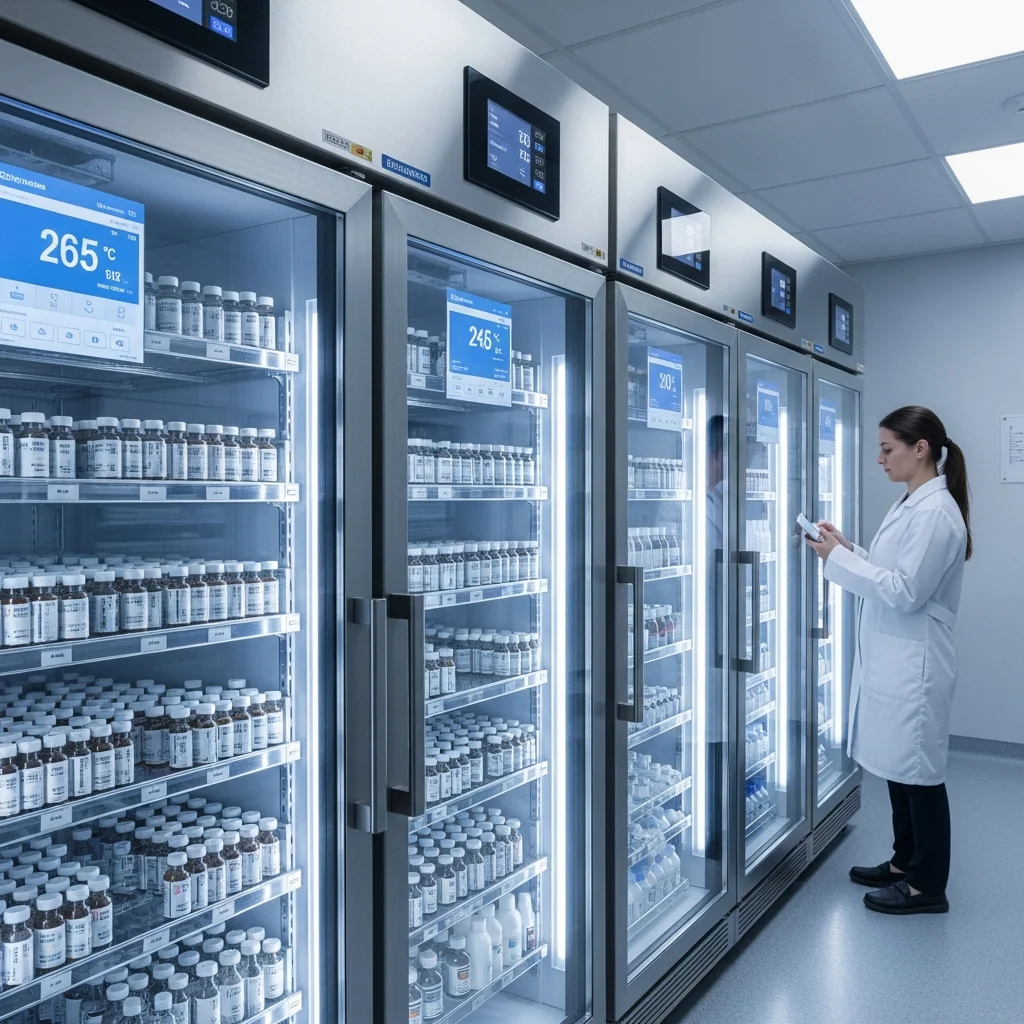
The 2–8°C range is the most common pharmaceutical cold storage specification and covers the majority of vaccines, many monoclonal antibodies, and most biologics. Maintaining this range in a commercial cold storage environment — rather than a purpose-built pharmaceutical vault — requires precise refrigeration control and excellent insulation to prevent temperature excursions during door openings, power transitions, and ambient temperature swings.
California’s hot summer temperatures (Central Valley summers regularly exceed 105°F) create particularly demanding conditions for 2–8°C maintenance. Facilities must be engineered with sufficient redundant refrigeration capacity to maintain setpoints even during peak summer demand when ambient temperatures impose the maximum thermal load on the building envelope.
Frozen Pharmaceutical Storage: -20°C and -80°C Applications
A smaller but growing segment of pharmaceutical cold storage requires deep freeze conditions. mRNA vaccines and certain biologics require -20°C to -80°C storage — conditions that are well outside the range of conventional cold storage facilities but that specialized freezer warehouses can accommodate. The COVID-19 vaccine rollout demonstrated both the importance of and the logistical complexity of -80°C pharmaceutical cold chain at scale.
For pharmaceutical shippers evaluating cold storage options in the Central Valley, it is worth clarifying whether 2–8°C controlled temperature storage or deep freeze storage is required — these are served by entirely different facility types and regulatory frameworks.
Practical Considerations for Pharmaceutical Cold Storage Users
Pharmaceutical shippers evaluating Central Valley cold storage for staging, distribution support, or emergency inventory should request: temperature mapping validation documentation, monitoring system calibration records, emergency power specifications (generator capacity and transfer time), and GDP audit history. A facility that can produce clean audit documentation on short notice is demonstrating the operational discipline that pharmaceutical storage demands.