In the high-stakes arena of global agricultural commerce, California stands as a titan, exporting over $20 billion in agricultural products annually. However, the journey from a Central Valley orchard to a supermarket in Seoul or a boutique grocer in London is not merely a logistical challenge; it is a forensic biological race against time. For the post-harvest physiologist, Export Readiness is defined by the ability to arrest the natural senescence of a living organism while navigating a gauntlet of international phytosanitary regulations.
The moment a fruit or vegetable is severed from its parent plant, its internal clock begins a countdown to decay. As a living tissue, the commodity continues to respire, consuming its own stored sugars and releasing heat and moisture. To ensure that California’s bounty arrives at its destination with its organoleptic qualities intact, we must employ a rigorous, data-driven approach to cold chain management. This involves a three-pronged strategy: the rapid extraction of field heat, the maintenance of precise thermal and atmospheric stasis, and the utilization of sustainable, non-reactive refrigeration technologies.
The Biological Clock: Respiration and Decay
From a physiological perspective, the post-harvest lifespan of produce is inversely proportional to its respiration rate. Respiration is the oxidative breakdown of starches, sugars, and organic acids into simpler molecules, releasing energy in the form of heat (vital heat). The rate of this process is governed by the Q10 temperature coefficient—a principle stating that for every 10°C (18°F) increase in temperature, the rate of biological chemical reactions doubles or even triples.
Achieving Export Readiness begins with the critical window of pre-cooling. For highly metabolic commodities like berries or leafy greens, removing field heat within the first four hours of harvest is non-negotiable. If a pallet of blueberries sits on a loading dock at 80°F for several hours, it may lose several days of potential shelf life before it even reaches the cold storage facility. This rapid cooling reduces the metabolic rate, effectively putting the produce into a state of suspended animation.
The Critical Four-Hour Window
The “Four-Hour Rule” is a benchmark in forensic post-harvest science. During this window, the primary objective is to reach the “7/8ths cooling time,” where 87.5% of the temperature difference between the initial field temperature and the target storage temperature is removed. Failure to achieve this leads to accelerated “shrink”—a term used to describe weight loss and physical degradation. For specialists focused on Blueberry Pre-Cooling, this phase is the single most important factor in determining whether a shipment will survive a trans-Pacific voyage.
Ethylene Management: The Silent Catalyst
Beyond simple respiration, the presence of ethylene (C2H4) poses a significant threat to Export Readiness. Ethylene is a naturally occurring phytohormone that triggers ripening and, eventually, senescence. In a closed cold chain environment, even trace amounts of ethylene can lead to premature softening, bitterness, and discoloration. A forensic approach to Ethylene Management involves not only scrubbing the air of this hormone but also ensuring that ethylene-producing commodities (like apples) are never co-mingled with ethylene-sensitive ones (like kiwifruit or leafy greens).
Phytosanitary Readiness: Beyond Temperature
While temperature management preserves the physical integrity of the produce, Export Readiness is also dictated by compliance with the stringent phytosanitary standards set by USDA APHIS and international governing bodies. Exporting to markets like Japan, Australia, or the European Union requires more than just high-quality fruit; it requires documented proof of pest mitigation and chemical purity.
This is where the choice of refrigeration technology becomes a strategic asset. Traditional synthetic refrigerants carry the risk of chemical leakage, which can result in the “tainting” of organic produce. At CVCS, we utilize 100% sustainable input CO2 refrigeration (R744). CO2 is a natural refrigerant that is non-toxic, non-flammable, and leaves zero chemical residues. For organic exporters, this is a critical differentiator, ensuring that the “organic” label remains untarnished from the packing house to the international port of entry.
The Digital Forensic Trail: Goose Monitoring
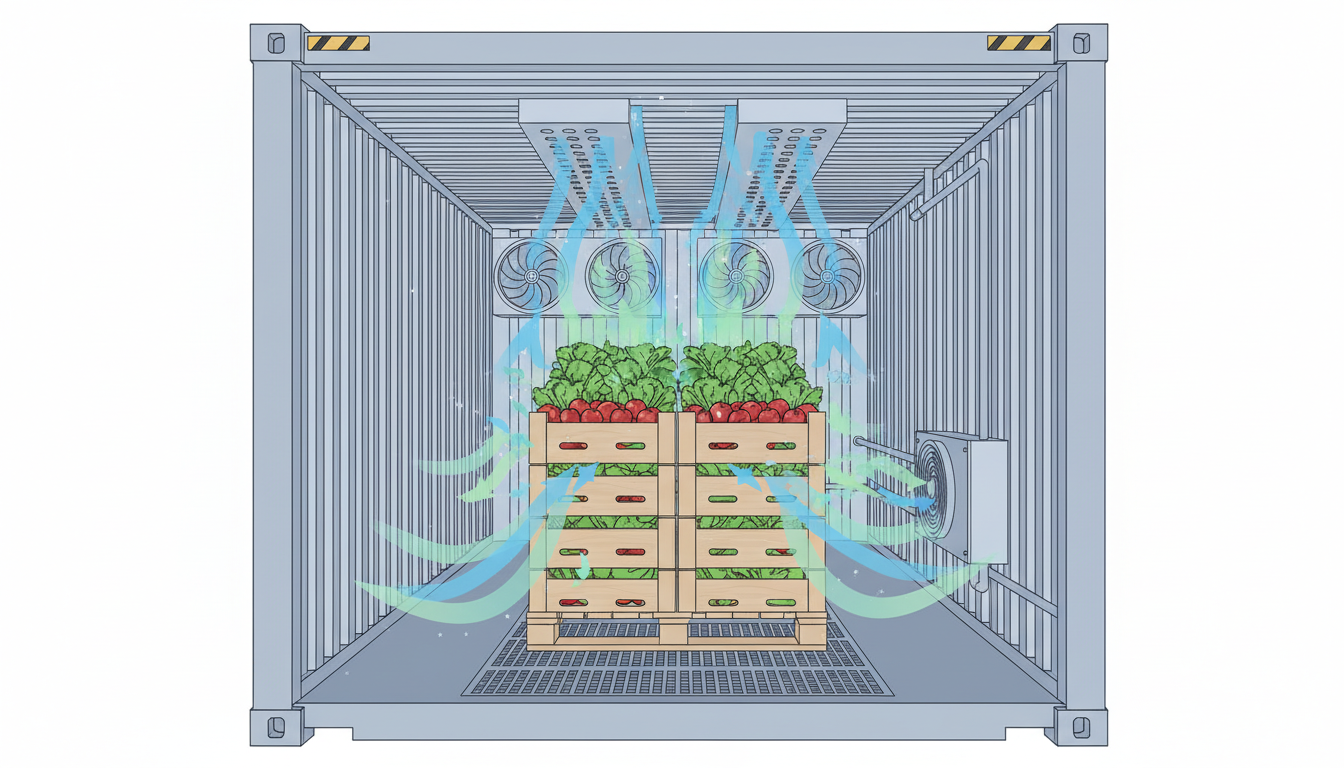
Modern export markets demand radical transparency. It is no longer enough to claim that a shipment remained at 32°F; the exporter must prove it. Through real-time Goose monitoring systems, every pallet is tracked for temperature fluctuations, humidity levels, and GPS location. This forensic data log serves as a “birth certificate” for the shipment, providing the documentation required to pass through customs and phytosanitary inspections without delay. If a deviation occurs, the system provides immediate alerts, allowing for corrective action before the threshold for permanent physiological damage is crossed.
Meeting International Protocols
Different nations have specific cold-treatment protocols to eradicate pests like the Mediterranean fruit fly without the use of methyl bromide fumigation. These protocols often require the produce to be held at specific, ultra-low temperatures (often just above freezing) for a set number of days during transit. Achieving this requires a refrigeration system with high thermal mass and precision, such as our CO2-based systems, which can maintain a variance of less than 0.5°F.
The Role of Humidity in Turgidity Preservation
One of the most overlooked aspects of the cold chain is the Vapor Pressure Deficit (VPD). While temperature controls the rate of chemical decay, humidity controls the rate of physical moisture loss. Produce is largely composed of water (often 80-95%), and the loss of even 3-5% of that water results in a visible loss of turgidity—the internal pressure that keeps a grape crisp or a leaf firm.
In a forensic analysis of “shrink,” we often find that the refrigeration system itself is the culprit. Standard cooling units often strip moisture from the air as it passes over the evaporator coils. To maintain Export Readiness, the relative humidity (RH) must be matched to the specific commodity’s needs. For table grapes, this means maintaining a staggering 95% RH to prevent stem browning and berry shatter.
The Science of Transpiration
Transpiration is the movement of water vapor from the internal tissues of the produce to the surrounding atmosphere. This is driven by the difference in vapor pressure between the produce and the air. By utilizing high-efficiency CO2 refrigeration systems with oversized evaporators, we can maintain high humidity levels without the need for supplemental misting, which can introduce pathogens. This preserves the “bloom” on blueberries and the structural integrity of grape clusters, ensuring they arrive in overseas markets with the same “fresh-picked” appearance they had in California.
Commodity-Specific Storage Requirements
To assist exporters in their planning, the following table outlines the optimal forensic parameters for three of California’s key export commodities. Maintaining these precise setpoints is the hallmark of a professional cold chain.
| Commodity | Optimal Temp | Humidity | Max Storage |
|---|---|---|---|
| Almonds | 34°F | 50% | 2 Years |
| Table Grapes | 31°F | 95% | 4-6 Months |
| Blueberries | 32°F | 90-95% | 2-4 Weeks |
Conclusion: The Synergy of Science and Sustainability
Achieving 100% export compliance is a multidisciplinary endeavor. It requires the biological insight of a physiologist, the precision of a thermodynamic engineer, and the transparency of a data scientist. As California continue to lead the world in agricultural output, the adoption of CO2 refrigeration and advanced real-time monitoring is not just a trend—it is a necessity for anyone serious about global market penetration.
By focusing on the rapid removal of field heat, the mitigation of ethylene, and the strict management of vapor pressure, we can extend the reach of California’s farms to the furthest corners of the globe. The result is less food waste, higher returns for growers, and a superior product for the global consumer.
Frequently Asked Questions
Q: How does CO2 refrigeration benefit organic produce?
A: CO2 refrigeration utilizes R744, a natural refrigerant. Unlike synthetic HFCs or HCFCs, R744 is a natural part of the atmosphere and poses no risk of chemical taint to the produce. This ensures that the shipment meets all international organic certification standards while providing superior cooling efficiency.
Q: Why is the 4-hour pre-cooling window so critical?
A: After harvest, produce enters a state of high metabolic activity. For every hour it remains at field temperature, the internal respiration consumes the sugars and moisture that define quality. Pre-cooling within four hours “locks in” the shelf life required for long-distance export.
Q: What is “Goose Monitoring”?
A: Goose monitoring is our proprietary real-time data tracking system. It provides continuous visibility into temperature, humidity, and location, ensuring that any cold chain deviations are identified and corrected immediately, which is essential for phytosanitary documentation.
Are you ready to optimize your international shipping strategy?
Ensure your cargo meets the highest standards of global quality. Request an Export Readiness Audit today and let our team of post-harvest specialists secure your cold chain.