Winning the First Mile in Madera
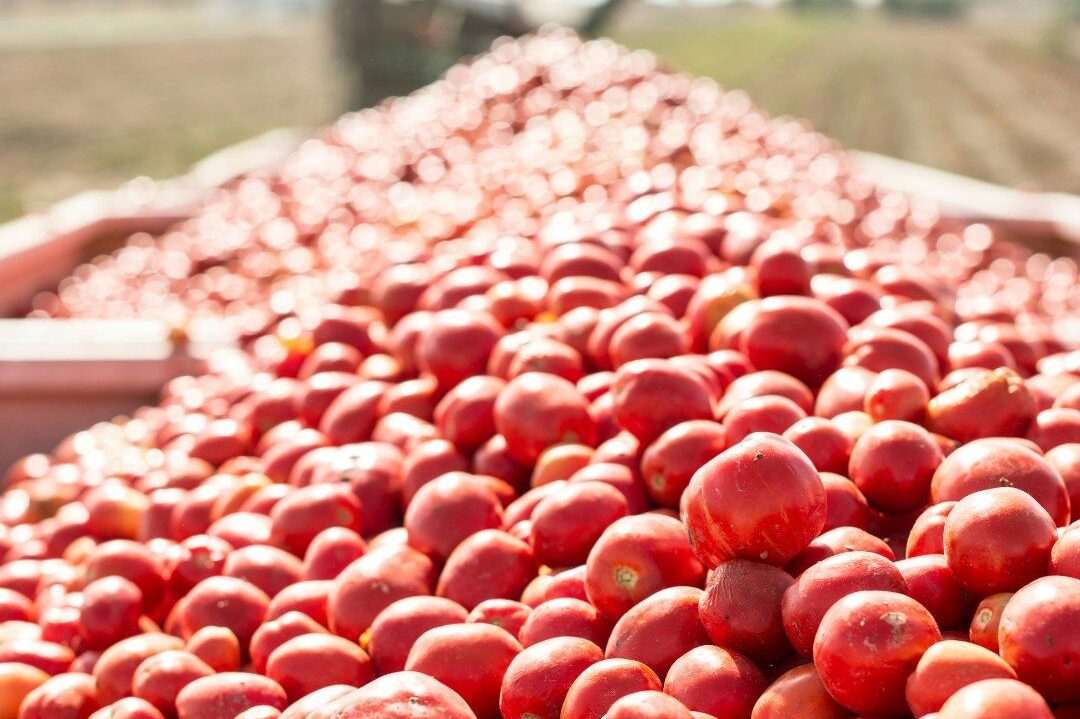
For the Central Valley produce grower, the “First Mile” is more than a distance on a map; it is a race against biology. In Madera County, where the agricultural output exceeds $2 billion annually, the efficiency of this first mile—the journey from the orchard or field to the initial cooling point—determines the profitability of an entire season. As a sustainable infrastructure consultant, I have spent years analyzing the friction points in supply chains. In our region, the most significant friction isn’t at the port or the retail shelf; it is the thermal inertia and logistical cost incurred between harvest and the first pallet drop.
Operational transparency requires us to look at the numbers. Every hour a harvested bin of almonds, pistachios, or fresh stone fruit sits in the valley sun, its shelf life is truncated. Traditional logistics models have often forced growers to bypass local options in favor of large-scale hubs in Fresno or distant port-adjacent facilities. However, the rise of specialized first-mile cold storage in Madera is shifting the paradigm, allowing growers to lock in freshness and reduce overhead before the product ever touches a long-haul truck.
The Cost of Thermal Inertia in Transit
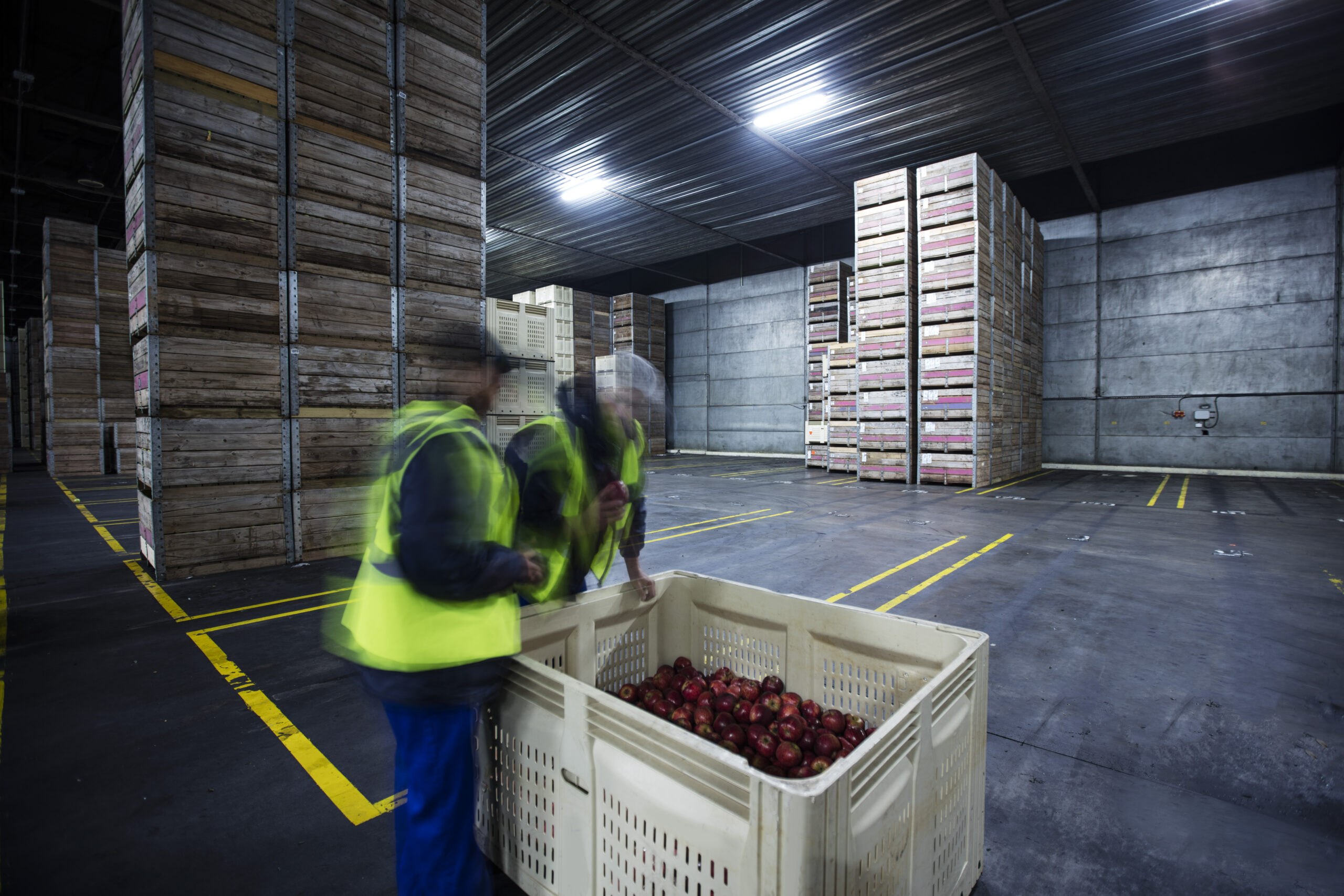
In the world of post-harvest physiology, “field heat” is the enemy. When a crop is harvested, it continues to respire, consuming its own sugars and moisture. This respiration rate is directly tied to temperature. In the high-heat environment of Madera County, delaying the cooling process by even a few hours can result in “shrink”—a reduction in weight and quality that directly eats into the grower’s margin.
When we talk about thermal inertia, we are referring to the energy required to bring a product down to its optimal storage temperature. If a truck carries warm product for two to four hours toward a distant hub, the core temperature remains high, leading to internal degradation. By utilizing first-mile cold storage within the Madera Airport Industrial Park, growers can effectively “stop the clock.”
The strategic advantage of this proximity cannot be overstated. By reducing the time between harvest and pre-cooling to under 30 minutes, growers can reduce respiration loss to negligible levels. This preservation of cell structure not only improves the appearance and taste of the produce but also ensures that the product is robust enough to handle the rigors of international export. The “first mile” should be a sprint to a cold cell, not a slow crawl through highway traffic.
The Impact of Road Vibration
Beyond heat, the physical logistics of the first mile introduce mechanical stress. Long hauls on secondary roads and crowded freeways subject produce to constant vibration. When fruit is warm, it is more susceptible to bruising and skin breaks. Cooling the product locally in Madera firms up the cellular structure of the produce, making it more resilient to the “transit shock” it will inevitably face during the subsequent miles to the distribution center or port.
Reducing Diesel Surcharges with Local Hubs
Logistics is, at its heart, a fuel and labor game. For Madera growers, the traditional trek to distant cooling hubs represents a significant drain on resources. With diesel prices remaining volatile and California’s stringent emissions regulations increasing the cost of fleet maintenance, every unnecessary mile is a liability. Operational transparency means acknowledging that long-haul trucking should be reserved for the “last mile” or the “middle mile,” not the initial stage of the cold chain.
By leveraging local storage at Central Valley Cold Storage (CVCS), growers can optimize their fleet utilization. Instead of committing a driver and a rig to a four-hour round trip to a distant facility, that same truck can make multiple “shuttle” runs between the field and the local Madera hub. This increases the efficiency of harvest crews, as bins are emptied and returned to the field faster, keeping the harvest machinery moving.
The following table illustrates the stark difference between utilizing distant hubs versus local Madera-based infrastructure:
| Metric | Distant Hub (Fresno/Ports) | CVCS (Madera Local) |
|---|---|---|
| Average Haul Time | 2-4 Hours | < 30 Minutes |
| Respiration Loss | Moderate | Negligible |
| Fuel Cost | High | Minimum |
| Driver Hours (HOS) Impact | Significant | Minimal |
From a consultant’s perspective, the reduction in fuel costs is only the tip of the iceberg. The real savings come from the optimization of “Hours of Service” (HOS). When drivers spend less time idling in traffic or on long transits to drop off product, they are available for more critical movements. Furthermore, reducing the distance traveled by heavy trucks on local Madera roads decreases the carbon footprint of the operation—a metric that is becoming increasingly important for growers seeking sustainable certifications and premium market pricing.
Madera: The New Cold Chain Capital
Madera is no longer just a pass-through on Highway 99. It has evolved into the geographic heart of the Central Valley’s agricultural logistics network. With over $2 billion in annual agricultural value, the county demands infrastructure that matches its output. The development of high-capacity first-mile cold storage facilities in the Madera Airport Industrial Park has transformed the region into a strategic nexus for growers across the valley.
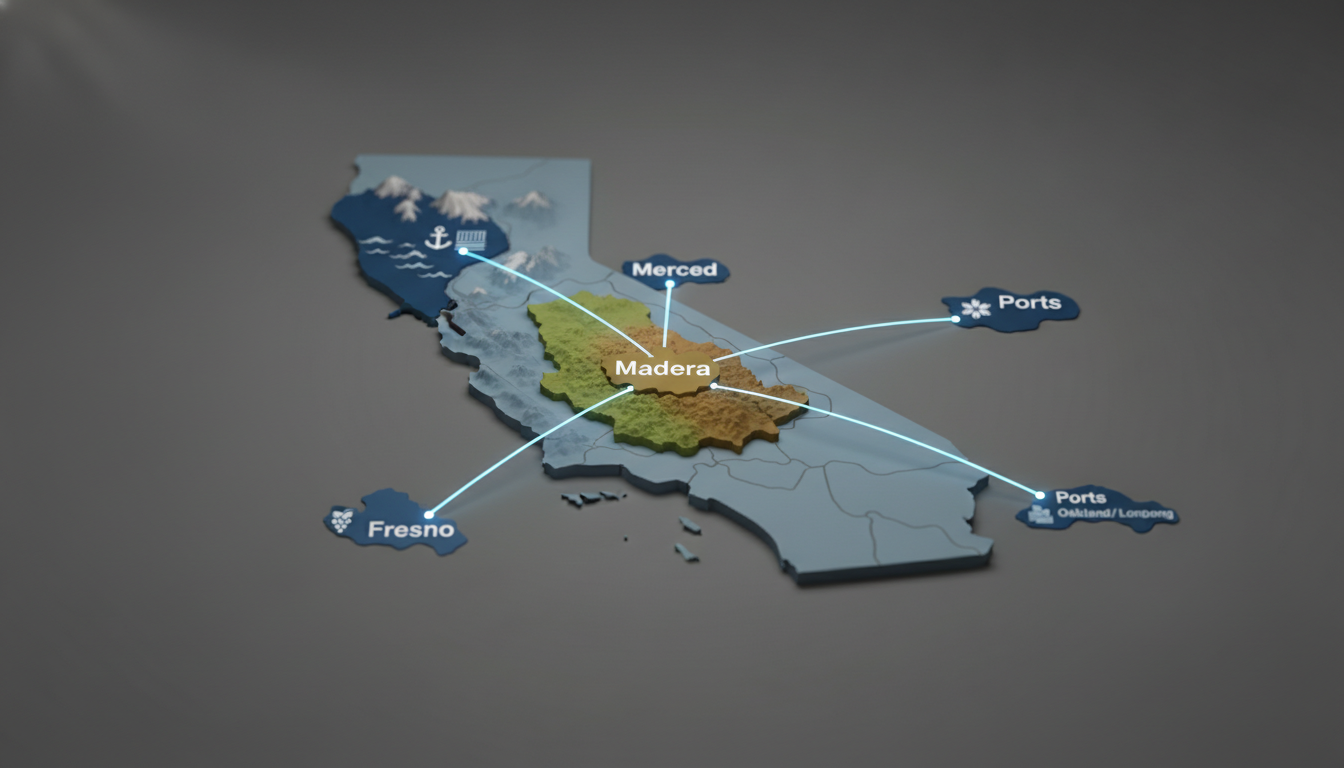
This geographic advantage allows for unparalleled market flexibility. In a volatile market, the ability to hold product locally while waiting for a price peak is invaluable. When produce is stored in a distant port hub, the grower loses a degree of control. The product is already “committed” to that destination’s logistics flow. However, by keeping the product in Madera, the grower retains the ability to pivot—shipping North to Sacramento/Bay Area, South to Los Angeles, or West to the ports, depending on where the demand is highest at that specific moment.
This flexibility is a core component of The Strategic Advantage of First-Mile Cold Storage in Madera, CA. It empowers the grower to become a price maker rather than a price taker. By stabilizing the product immediately after harvest, the grower ensures that the quality remains “export-grade” for a longer duration, providing a wider window for sales and distribution.
Infrastructure and Access
The Madera Airport Industrial Park is uniquely positioned to handle the volume of the modern harvest. With easy access to major arterials, it bypasses the congestion often found in larger metropolitan hubs. This ease of access translates to faster turn times for trucks. In the logistics world, time is the only commodity you can’t buy back. For a grower during peak season, every minute saved at the loading dock is a minute that can be reinvested into harvest speed and field efficiency.
The Sustainable Shift
As a Sustainable Infrastructure Consultant, I look at the long-term viability of these models. The centralization of cooling near the point of harvest is inherently more sustainable. It reduces the total “food miles” and minimizes the energy required to cool product that has already begun to overheat during a long transit. It is a cleaner, leaner, and more transparent way to do business in the Central Valley.
Key Takeaways for Madera Growers
- Proximity is Profit: Minimizing the distance between the orchard and the cooling point is the most effective way to reduce “shrink” and preserve crop value.
- Logistical Efficiency: Local storage reduces fuel consumption and optimizes driver hours, allowing for more “shuttle” runs and faster harvests.
- Strategic Flexibility: Storing product in Madera allows growers to respond to market fluctuations and choose the most profitable distribution route.
- Infrastructure Advantage: CVCS provides the necessary technology and location to serve as the anchor for a grower’s first-mile strategy.
Frequently Asked Questions
Q: Where is CVCS located?
A: We are situated in the Madera Airport Industrial Park, perfectly positioned for valley-wide access and quick turnarounds for local growers.
Q: Does first-mile storage help with export?
A: Yes, absolutely. It stabilizes the product’s core temperature and moisture levels immediately, ensuring it is in peak condition before the strenuous and long journey to international markets.
Q: How does local cooling impact my bottom line during a heatwave?
A: During extreme heat, respiration rates skyrocket. Having a cooling facility within 30 minutes of the field can be the difference between a premium grade and a “processor” grade crop.
The “First Mile” doesn’t have to be a source of stress. With the right logistics strategy and a focus on local, high-efficiency cold storage, Madera County growers can protect their investments, reduce their overhead, and ensure that their world-class produce reaches the consumer in the exact condition it was intended. It is time to stop the clock on spoilage and start the engine on profitability.
Ready to optimize your harvest logistics?
Ensure your crop’s quality is locked in from the very first mile. Contact our team today to discuss your storage needs and see how our Madera facility can support your operations.