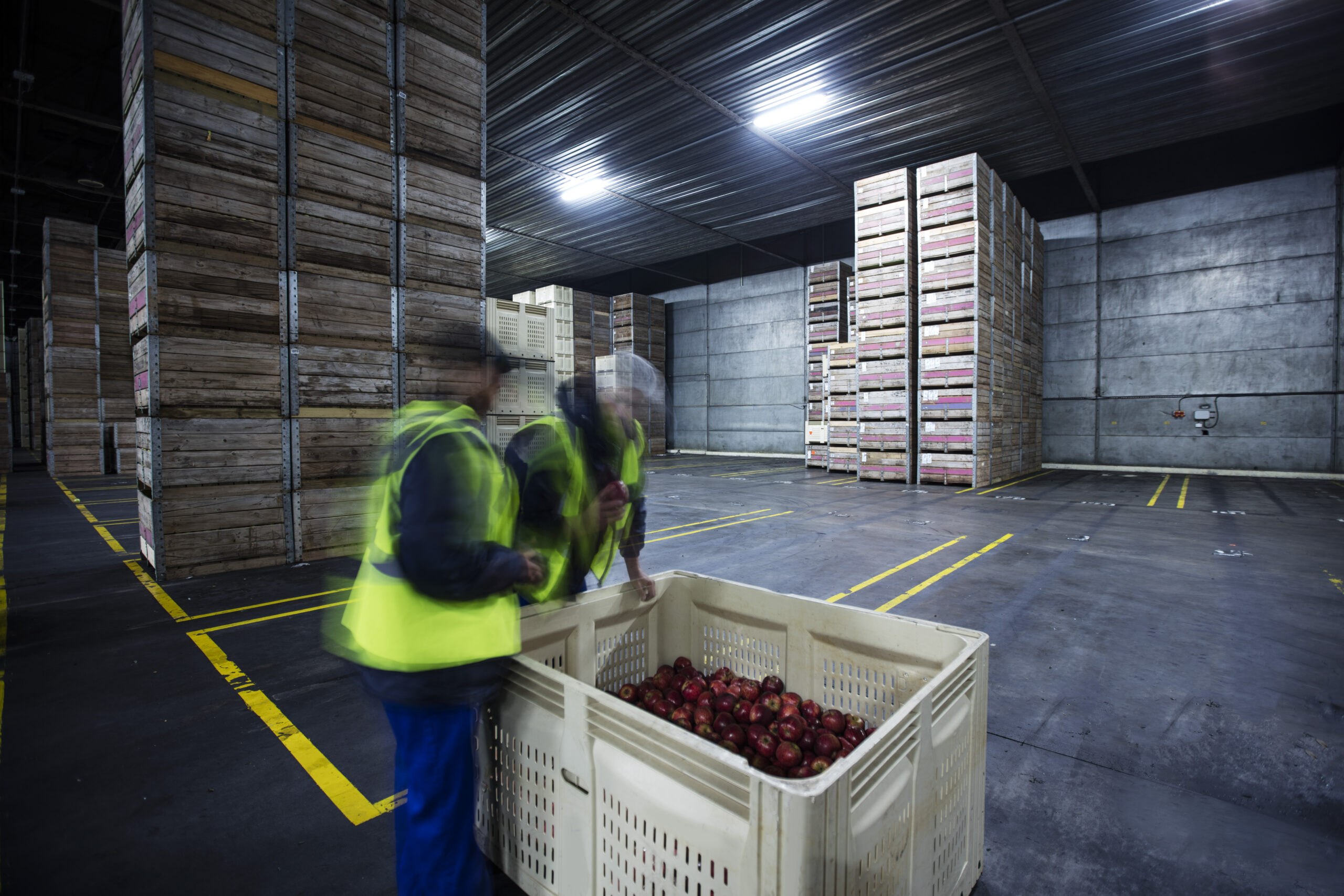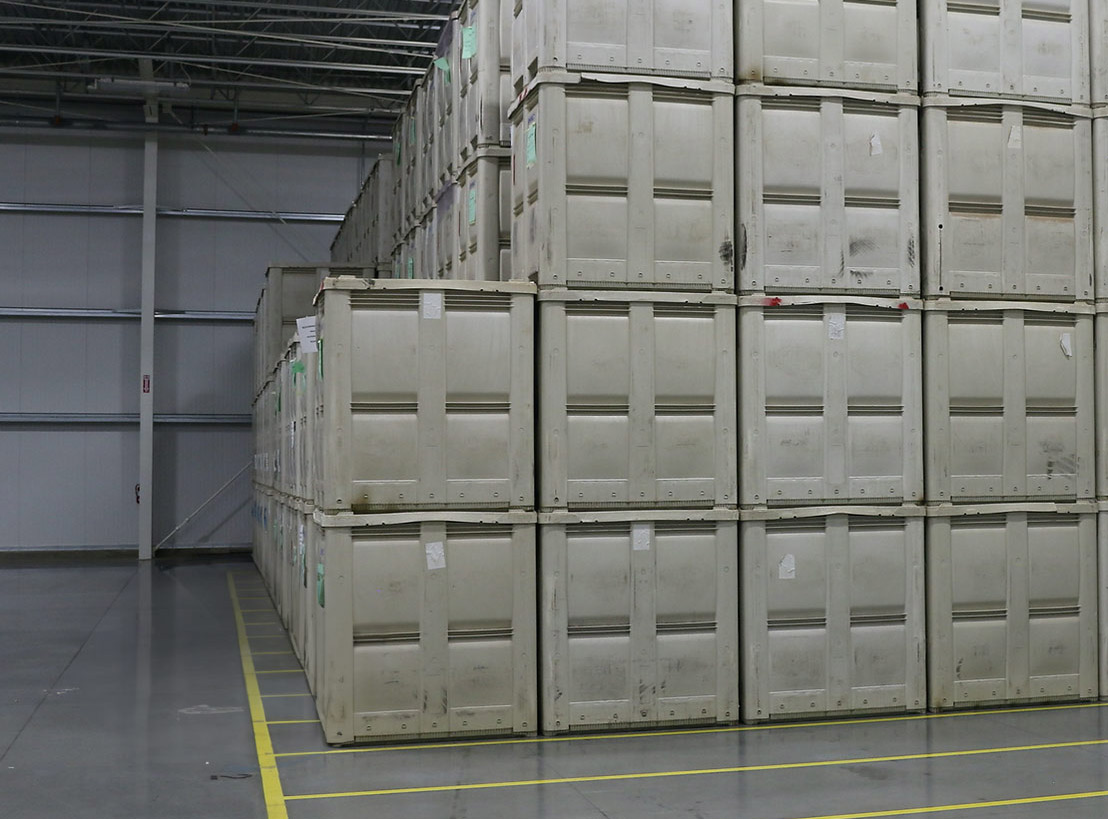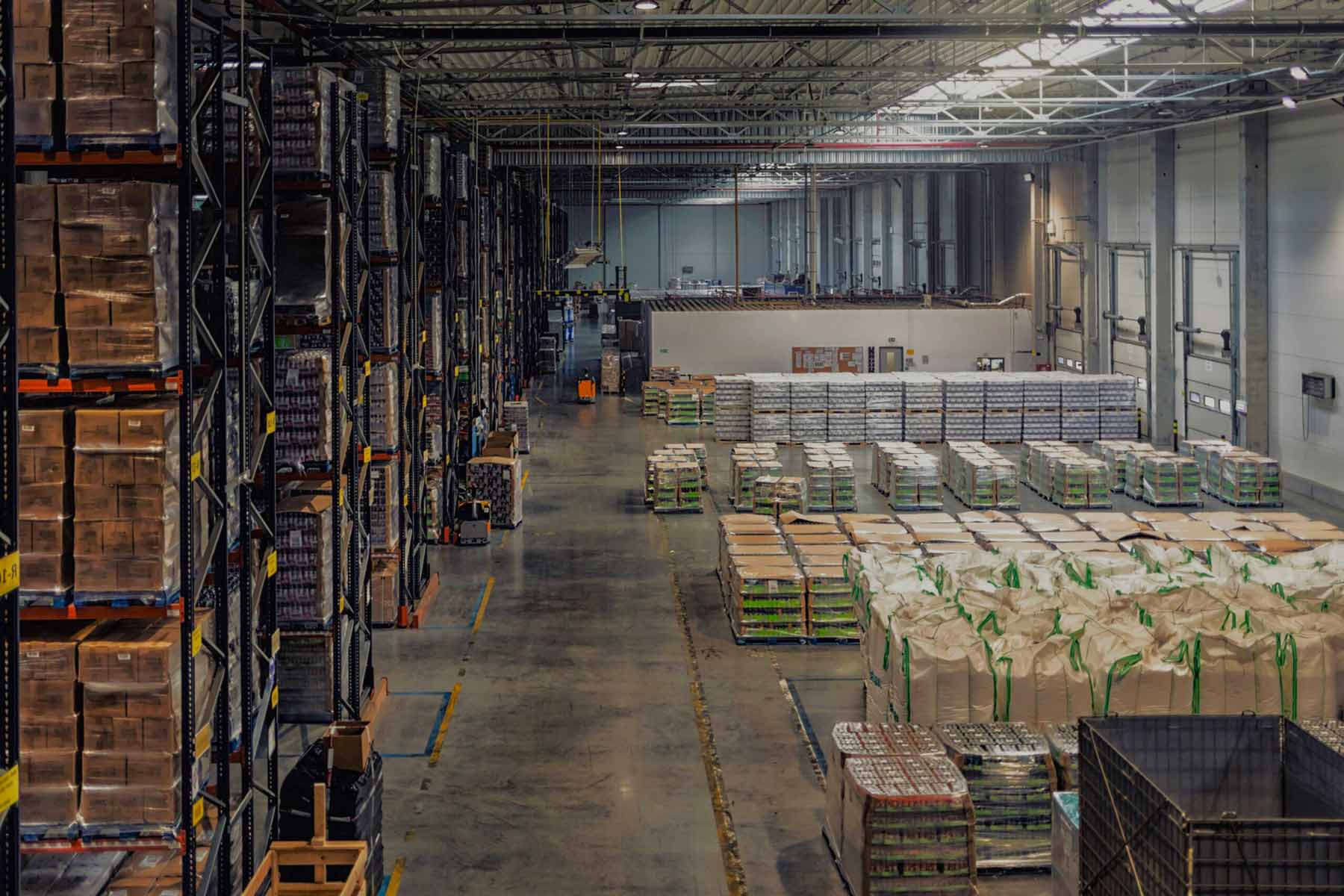
The transition toward Madera is driven by data. As freight rates fluctuate and California’s regulatory environment for trucking becomes increasingly complex, the need for source-adjacent facilities has moved from a “luxury” to a “necessity.” Madera offers a unique intersection of available land, immediate highway access, and, most importantly, a geographic location that shaves critical miles off the journey to the Port of Oakland The Complete Guide to Cold Storage Benefits for Ca….. This article examines the technical and logistical advantages of the Madera Airport Industrial Park and why it has become the preferred choice for sophisticated exporters and logistics providers like Central Valley Cold Storage (CVCS).
The Geography of Central Valley Logistics
Geographic positioning is the most immutable asset in logistics. Madera California sits at the precise “elbow” of the state, providing a balanced reach to both Northern and Southern California markets. However, its true value lies in its proximity to the source. Madera County’s agricultural value exceeded $2B in 2022, a figure that underscores the sheer volume of commodities—ranging from almonds and walnuts to grapes and dairy—that require immediate logistical intervention once they leave the field.
The Madera Airport Industrial Park is situated with tactical precision. By positioning a facility in this zone, logistics providers are placing themselves within a 20-mile radius of some of the world’s most productive walnut and almond blocks Ethylene Management: Preventing Cross-Contaminatio….. In the logistics of perishables, every minute spent in transit from the field to a temperature-controlled environment is a degradation of shelf life. By utilizing a source-adjacent location, exporters can achieve “flash-cooling” or rapid stabilization of goods far faster than if they were forced to navigate the urban corridors of larger metropolitan areas.
Proximity to the ‘Golden State’ Highway
The industrial park offers nearly instantaneous access to Highway 99, the primary artery of the Central Valley. Unlike hubs located deep within city limits, the Madera Airport Industrial Park allows for “gate-to-highway” transitions in under five minutes. For a logistics technologist, this means a significant reduction in idling time and fuel consumption, as well as a more predictable schedule for drayage drivers who are often operating on razor-thin margins and strict Hours of Service (HOS) regulations.
Avoiding the ‘Fresno Bottleneck’
For decades, Fresno was the default destination for Valley freight. However, as the city has grown, so too has its traffic complexity. The interchange of Highway 99, Highway 41, and Highway 180 has become a notorious point of failure for logistics schedules. Heavy commuter traffic, combined with ongoing infrastructure projects, creates a “bottleneck” that can add 30 to 60 minutes of dwell time for trucks moving through the city.
When we analyze the “cost per mile,” we must also factor in the “cost per minute.” Madera California provides a bypass to this congestion. By staging operations at the Madera Airport Industrial Park, carriers can head north toward the Port of Oakland or south toward Los Angeles without ever having to engage with Fresno’s inner-city traffic. This congestion-free environment is critical for maximizing a driver’s HOS. Under current ELD (Electronic Logging Device) mandates, a 45-minute delay in traffic isn’t just an inconvenience; it can be the difference between a driver completing a round-trip to the Port of Oakland or being forced to stop for a mandatory rest period 30 miles short of their destination.
The Efficiency of Source-Adjacent Pre-Cooling
Another technical advantage of the Madera location is the ability to offer source-adjacent pre-cooling. For agricultural exporters, the “heat load” of a product coming out of the field must be removed as quickly as possible. Transporting “hot” product 40 or 50 miles to a distant hub in Fresno increases the risk of spoilage and requires the truck’s reefer unit to work harder, consuming more diesel. Madera’s proximity to the orchards allows for a shorter “field-to-fridge” duration, preserving the cold chain’s integrity from the very first mile.
Strategic Access to Port Corridors
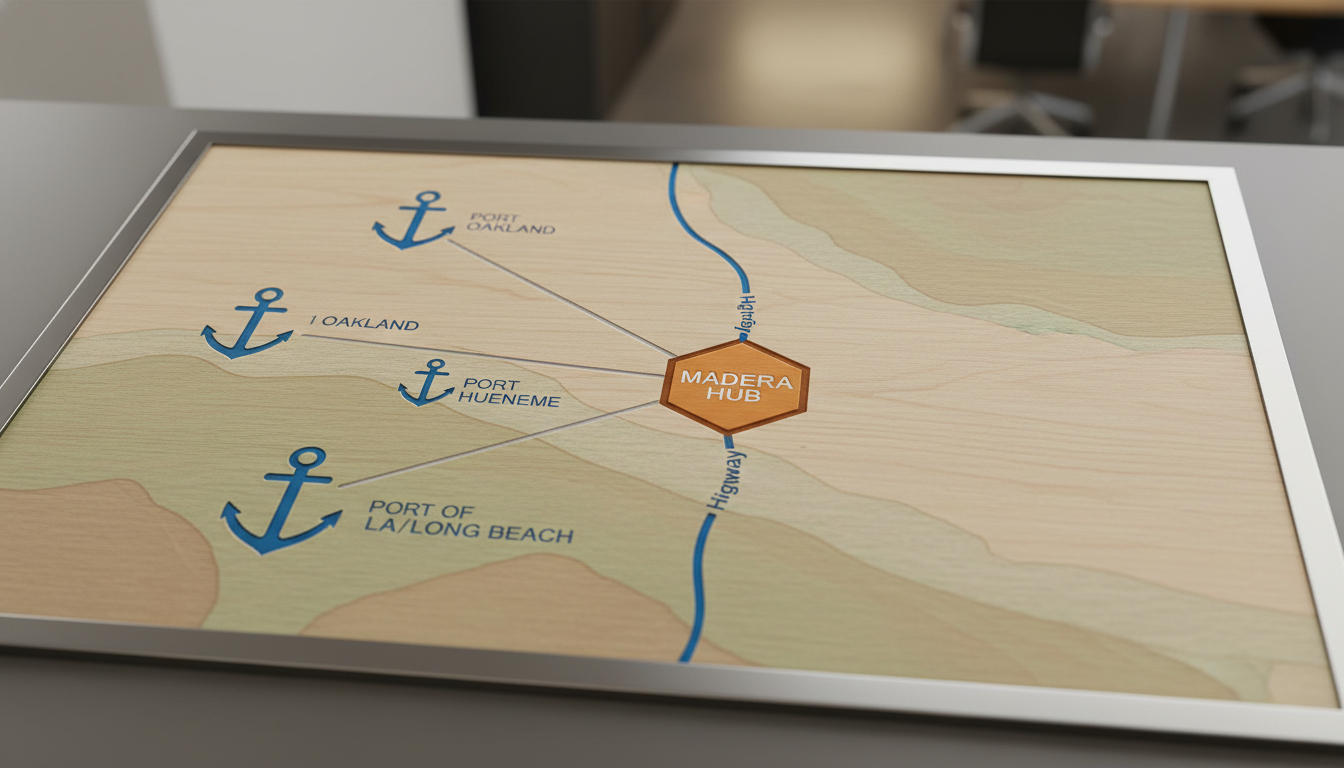
While the proximity to fields is vital, the proximity to ports is what defines an export hub. The Madera Airport Industrial Park is uniquely positioned to serve the Port of Oakland, which remains the primary exit point for California’s agricultural exports to the Pacific Rim. As the data below illustrates, Madera offers a significant mileage advantage over Fresno-based hubs when heading north.
| Route | Dist from Madera | Dist from Fresno Hub |
|---|---|---|
| Port of Oakland | 145 Miles | 170 Miles |
| Port of LA/LB | 250 Miles | 225 Miles |
| Major Walnut Blocks | 20 Miles | 60 Miles |
A 25-mile difference might seem marginal in a single trip, but in the context of high-volume logistics, the numbers are staggering. For an exporter moving 1,000 containers a year, a 50-mile round-trip savings translates to 50,000 fewer miles on the road. This results in direct savings on fuel, reduced wear and tear on equipment, and a smaller carbon footprint—a metric that is becoming increasingly important for corporate ESG (Environmental, Social, and Governance) reporting.
Optimizing the Oakland Drayage Run
The 145-mile distance from Madera to the Port of Oakland is a “sweet spot” for drayage. It allows for a driver to comfortably complete a full turn—picking up a loaded container, delivering it to the port, picking up an empty, and returning to the Madera Airport Industrial Park—well within their legal driving window, even with potential delays at the port terminal. This reliability makes Madera-based facilities like CVCS a preferred partner for carriers who prioritize driver retention and safety.
The Future of Industrial Infrastructure in Madera
The development of the Madera Airport Industrial Park is a response to the “land grab” in more traditional logistics hubs. As space in the Inland Empire and the Bay Area becomes prohibitively expensive, the Central Valley—and Madera in particular—is seeing a surge in “Class A” industrial development. These modern facilities are built with the latest in logistics technology, including high-bay racking, advanced Warehouse Management Systems (WMS), and energy-efficient cooling technologies.
Furthermore, Madera California offers a business-friendly environment that encourages industrial growth. The local government recognizes the importance of logistics to the regional economy, leading to faster permitting and infrastructure support compared to the bureaucratic hurdles found in larger California cities. This agility allows logistics providers to scale their operations in tandem with the growth of the agricultural sector, ensuring that there is always “surge capacity” during peak harvest seasons.
Technological Integration at CVCS
Within the Madera Airport Industrial Park, Central Valley Cold Storage (CVCS) leverages its location to integrate advanced logistics tech. From real-time temperature monitoring to automated inventory tracking, the goal is to provide a seamless “black box” solution for exporters. When a walnut grower in Madera County sends their crop to our facility, they aren’t just getting a cold room; they are getting a strategic outpost that is 25 miles closer to their global customers than any facility in Fresno.
Frequently Asked Questions
Q: Is Madera closer to the Port of Oakland than Fresno?
A: Yes, by approximately 25 miles, reducing round-trip drayage costs significantly and helping drivers stay within their Hours of Service (HOS) limits.
Q: What makes the Madera Airport Industrial Park better than other Valley locations?
A: It offers a “congestion-free” alternative to the Fresno hubs. With direct access to Highway 99 and proximity to Highway 152, it provides a faster route to both the Port of Oakland and the Silicon Valley markets without the urban traffic delays associated with larger cities.
Conclusion: The Strategic Shift to Madera
In conclusion, the migration of logistics power toward Madera California is a logical evolution of the California supply chain. By minimizing the distance to the source of the product and reducing the distance to the primary export port, the Madera Airport Industrial Park offers a dual-sided efficiency that is unmatched in the Central Valley. For logistics specialists, the data is clear: avoiding the Fresno bottleneck and utilizing source-adjacent facilities is the most effective way to protect margins and ensure the integrity of California’s agricultural bounty.
As we look toward the future of global trade, the “first mile” will continue to be the area where the greatest efficiencies are won or lost. Madera is no longer just a stop along the highway; it is the logistics epicenter of the Valley.
Ready to optimize your supply chain and bypass the congestion of traditional hubs?
Schedule a Facility Tour in Madera to see how our strategic location can transform your first-mile logistics.