The solution lies in shifting the paradigm from energy as a volatile operational expense (OpEx) to energy as a predictable capital investment (CapEx). The primary tool for this transition is the Levelized Cost of Energy (LCOE). By leveraging off-grid solar and battery storage, industrial operators can lock in energy prices for decades, effectively insulating themselves from a utility market that has shown no signs of stabilization.
The Hidden Tax of Utility Volatility
California industrial electricity rates are currently among the highest in the United States, and the trajectory is steeply upward. For a large-scale cold storage facility, the “sticker price” per kilowatt-hour (kWh) is only the beginning of the story. The true cost of grid dependence is buried in a complex web of demand charges, Time-of-Use (TOU) windows, and regulatory riders that compensate for wildfire mitigation and grid modernization.
In the Central Valley, these costs are exacerbated by the “Duck Curve” phenomenon. As the sun sets and solar generation drops, but cooling demand remains high due to thermal inertia in massive warehouses, utilities spike rates to their daily maximums. This creates a “hidden tax” on cold storage operators who cannot simply turn off their compressors when prices peak. For an enterprise partner, this volatility makes multi-year budgeting nearly impossible. When a utility announces a 12% rate hike—common in recent years—a facility’s bottom line is immediately compromised without any change in operational efficiency.
Furthermore, the physical reliability of the grid in rural and industrial corridors is increasingly in question. Public Safety Power Shutoffs (PSPS) and aging transmission infrastructure pose a literal threat to the integrity of frozen and chilled inventory. In this context, the Levelized Cost of Energy (LCOE) becomes more than a financial metric; it becomes a measure of operational resilience.
Calculating LCOE for Industrial Refrigeration
To understand the advantage of the Central Valley Cold Storage (CVCS) model, one must understand the mathematics of LCOE. Simply put, LCOE is the total cost of building and operating an energy-generating asset over its entire life cycle, divided by the total energy it produces.
For an off-grid solar-plus-battery microgrid, the calculation includes:
- Initial Capital Expenditure: The procurement and installation of high-efficiency photovoltaic (PV) panels and Tier-1 Battery Energy Storage Systems (BESS).
- Operations and Maintenance (O&M): Cleaning of panels (critical in the Central Valley dust environment), inverter replacements, and software monitoring.
- Financing Costs: The cost of capital over a 20- or 25-year horizon.
- System Degradation: Accounting for the slight decrease in panel and battery efficiency over time.
Unlike a utility bill, which is subject to the whims of the California Public Utilities Commission (CPUC), the LCOE of an off-grid system is “baked in” from day one. At CVCS, we have pioneered the use of the largest off-grid solar facility in the U.S. to create a fixed-cost energy environment. By removing the utility from the equation, we eliminate the transmission and distribution (T&D) charges that often make up 30-40% of a standard industrial energy bill.
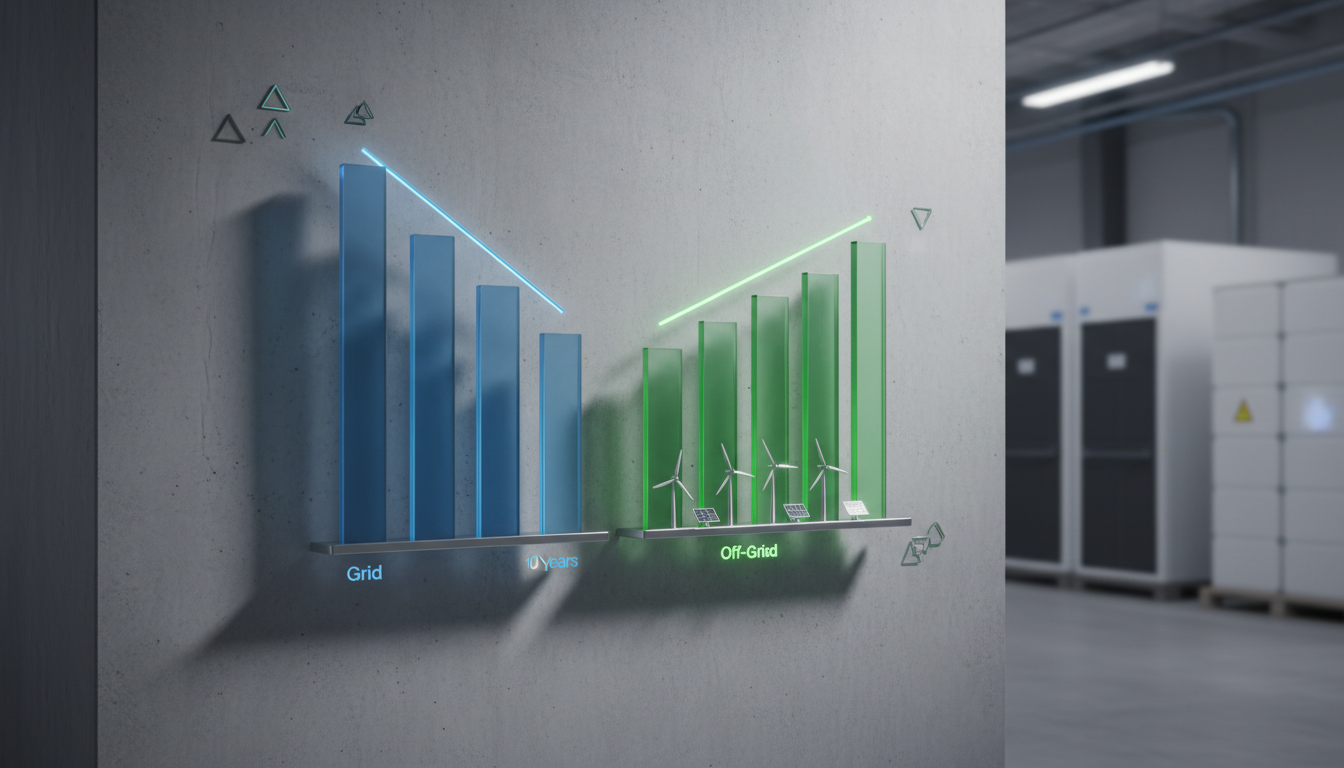
The following table illustrates the divergence between traditional utility procurement and the fixed LCOE model over a 10-year horizon, assuming a conservative 7% annual utility rate increase (a figure many analysts consider low given recent trends).
| Year | Projected Utility Rate (per kWh) | Off-Grid Fixed LCOE (per kWh) | Cost Variance (Benefit) |
|---|---|---|---|
| Year 1 | $0.18 | $0.11 | -38.9% |
| Year 3 | $0.20 | $0.11 | -45.0% |
| Year 5 | $0.24 | $0.11 | -54.2% |
| Year 7 | $0.27 | $0.11 | -59.3% |
| Year 10 | $0.33 | $0.11 | -66.7% |
As the data demonstrates, the gap between grid-connected costs and LCOE-based costs widens every year. By Year 10, the grid-connected facility is paying three times the energy cost of the off-grid facility. This delta is not just a saving; it is a competitive moat that allows CVCS and its partners to offer more aggressive pricing to their own customers while maintaining superior margins.
The CFO’s Roadmap to Energy Certainty
For a Chief Financial Officer, the transition to an LCOE-focused strategy is about risk mitigation. In a standard grid-connected model, the energy bill is a “naked” exposure to the energy market. By utilizing off-grid solar and battery storage, the CFO effectively hedges that exposure for the next two decades.
1. Treating Energy as a Fixed Asset
When energy is produced on-site through a microgrid, it can be treated as a depreciable asset. This allows for significant tax advantages, including the Investment Tax Credit (ITC) and accelerated depreciation (MACRS). This changes the conversation from “how much do we owe the utility?” to “how much value does our energy infrastructure add to our balance sheet?”
2. Eliminating Demand Charge Uncertainty
In industrial refrigeration, the highest costs are often incurred during “startup” periods or during the hottest parts of the day when compressors are running at maximum capacity. Utilities charge massive premiums for these “peak demand” moments. An off-grid system, sized for the peak load and supported by a robust BESS, eliminates these charges entirely. The Levelized Cost of Energy remains the same whether the sun is shining or the facility is drawing from the batteries at 2:00 AM.
3. Long-Term Price Lock
At CVCS, we provide a 20-year price lock. In an inflationary environment, the value of a fixed cost cannot be overstated. While labor, packaging, and logistics costs rise, the energy cost remains a flat line on the graph. This certainty allows for more accurate long-term contract negotiations with food producers and retailers who require stable storage pricing.
4. Decarbonization and ESG Compliance
Beyond the financial metrics, LCOE-driven infrastructure fulfills the increasingly stringent ESG (Environmental, Social, and Governance) requirements of global retailers. By operating on 100% renewable off-grid power, industrial users can report zero Scope 2 emissions. This is not just “greenwashing”; it is a verifiable reduction in the carbon intensity of the food supply chain, which carries tangible value in today’s marketplace.
The CVCS Advantage
Central Valley Cold Storage (CVCS) is not just a warehouse; it is a proof-of-concept for the future of sustainable infrastructure. As the largest off-grid solar facility in the United States dedicated to cold storage, we have demonstrated that it is possible to decouple industrial growth from utility dependence. Our facility operates at an estimated 50% lower energy cost than comparable grid-connected buildings in the region. This is the power of a disciplined LCOE strategy in action.
Frequently Asked Questions
Q: How much can off-grid save in energy costs?
A: CVCS estimates operations at 50% of the cost of comparable grid-connected buildings. By eliminating T&D charges and demand spikes, and locking in a 20-year LCOE, the savings over the life of the facility are measured in the millions of dollars.
Q: Is off-grid solar reliable enough for industrial refrigeration?
A: Yes. Through the integration of massive battery storage arrays and redundant backup systems, our off-grid microgrid provides 99.99% uptime. In many cases, it is more reliable than the local utility grid, which is susceptible to wildfires and rolling brownouts.
Q: Does this require a massive upfront investment?
A: While the capital requirements for off-grid systems are higher than a simple grid connection, various financing models—including Power Purchase Agreements (PPAs) and specialized infrastructure leasing—allow firms to realize LCOE benefits with little to no upfront CapEx, depending on the deal structure.
Conclusion
The Levelized Cost of Energy (LCOE) is the key to unlocking a new era of industrial efficiency. In the Central Valley, where the sun is abundant and the grid is increasingly expensive and fragile, the move to off-grid solar and battery storage is no longer a “green” luxury—it is a financial necessity. By treating energy as a fixed capital investment, CFOs can reclaim control over their margins and ensure that their operations remain resilient in the face of an uncertain energy future.
Ready to see how the math works for your facility?