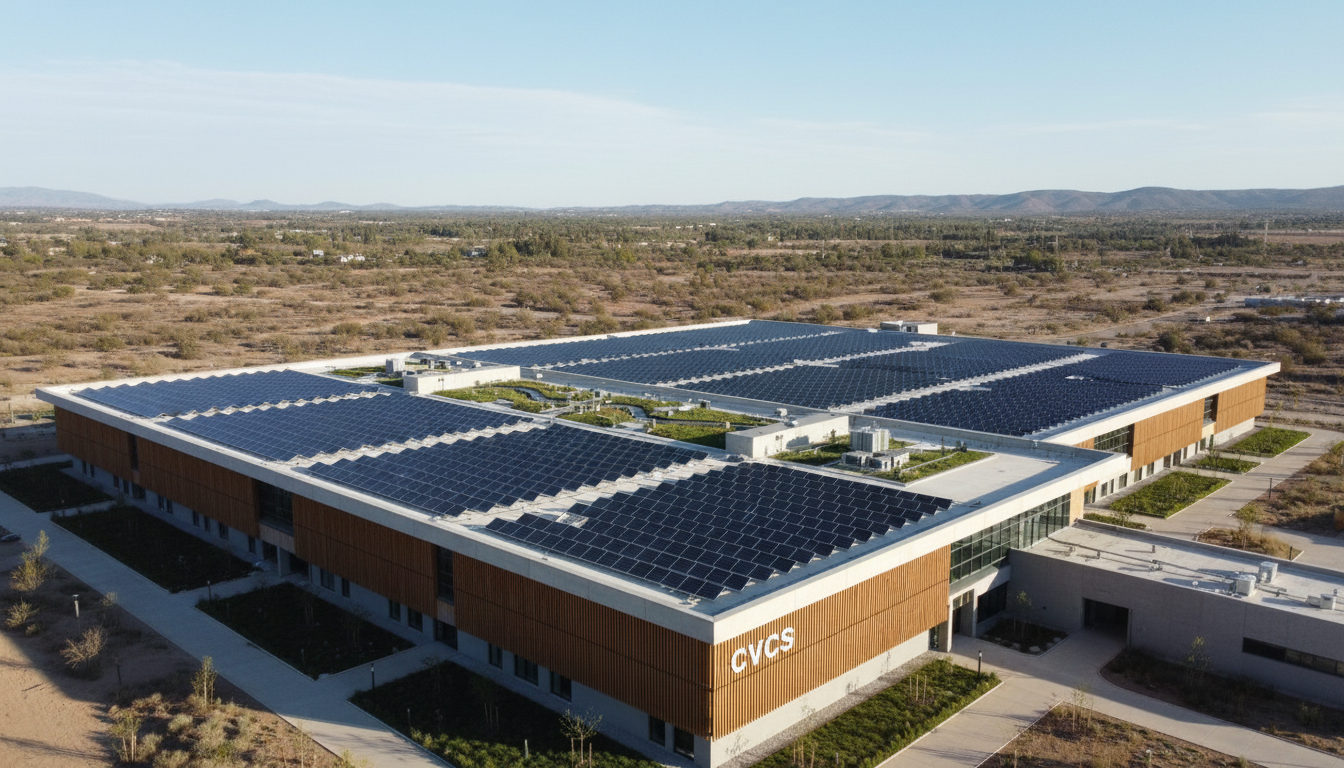
In the landscape of industrial development, the paradigm is shifting from simple capacity expansion to sophisticated energy autonomy. For procurement directors and enterprise RFP evaluators, the traditional metrics of square footage and location are being superseded by energy resilience and carbon intensity. Central Valley Cold Storage (CVCS) has established a new benchmark in this sector with its Madera, California facility—currently the largest off-grid solar and battery-powered cold storage operation in the United States. This facility is not merely a warehouse; it is a masterclass in sustainable cold storage design, offering a blueprint for how heavy industry can decouple growth from grid dependence and environmental degradation.
The Industrial Energy Challenge
The global cold chain is one of the most energy-intensive sectors in the modern economy. Industrial facilities, specifically those dedicated to thermal management and logistics, currently account for nearly 30% of US greenhouse gas emissions. The challenge for enterprise stakeholders is twofold: the rising cost and volatility of grid-supplied electricity, and the increasing regulatory pressure to eliminate High Global Warming Potential (GWP) refrigerants.
Traditional cold storage designs are inherently reactive. They rely on the municipal grid for primary power and diesel generators for redundancy. This model exposes operators to “Time of Use” (TOU) pricing surges and grid instability—factors that are becoming increasingly prevalent as extreme weather events stress the aging US electrical infrastructure. Furthermore, the legacy use of Hydrofluorocarbons (HFCs) as refrigerants creates a long-term liability, both environmentally and through the escalating costs associated with the HFC phase-down mandated by the AIM Act.
The CVCS blueprint addresses these systemic vulnerabilities by treating energy not as a utility to be purchased, but as an asset to be harvested, stored, and managed on-site. By integrating advanced sustainable cold storage design principles, the Madera facility demonstrates that the “Trilemma” of cost, reliability, and sustainability can be solved through integrated engineering.
When analyzing Sustainable Practices in Cold Storage: How Central Valley Cold Storage Leads the Way, it becomes clear that the shift toward green logistics is driven by a need for operational stability. For a procurement director, the CVCS model represents the ultimate hedge against energy inflation. When the grid fluctuates or prices spike, the CVCS facility remains thermally stable and financially insulated.
Engineering for 100% Autonomy
The technical core of the CVCS blueprint lies in its three-pillar approach to autonomy: generation, storage, and thermodynamic efficiency. Achieving total grid independence for a facility of this scale requires more than just “bolting on” solar panels; it requires a fundamental rethinking of the building’s metabolic processes.
1. The 1200kW Solar Array and Microgrid Integration
At the heart of the Madera facility is a 1200kW solar array. Unlike supplemental solar installations, this array is sized to meet the peak thermal load of the facility during the highest irradiance periods of the California summer. However, generation is only half of the equation. To achieve 100% autonomy, the solar array is integrated into a massive Battery Energy Storage System (BESS).
This microgrid configuration allows the facility to “load-shift” its energy consumption. During daylight hours, the solar array powers the transcritical CO2 refrigeration racks while simultaneously charging the battery reserves. During the night or during periods of low solar ceiling, the BESS discharges to maintain the thermal envelope. This creates a closed-loop energy ecosystem that operates entirely independently of the California ISO (Independent System Operator) grid.
2. Transcritical CO2 Refrigeration (R-744)
The choice of refrigerant is perhaps the most critical architectural decision in sustainable cold storage design. While many facilities still utilize ammonia (which is efficient but carries toxicity risks) or synthetic HFCs, CVCS utilizes a transcritical CO2 system. CO2 (R-744) has a GWP of exactly 1, compared to HFCs which can have GWPs in the thousands.
From a technical standpoint, the CO2 system at CVCS is engineered to handle the high ambient temperatures of the Central Valley. By utilizing specialized adiabatic gas coolers and parallel compression, the system maintains high Coefficient of Performance (COP) levels even when the external environment exceeds 100°F. This engineering choice ensures that the energy harvested by the solar array is utilized with maximum thermodynamic efficiency.
3. The Goose Integrated Control System
Autonomy cannot be managed manually at an enterprise scale. The CVCS blueprint utilizes the “Goose” system—an advanced, integrated control layer that acts as the facility’s central nervous system. The Goose system monitors real-time solar yield, battery State of Charge (SoC), and internal thermal mass. It uses predictive algorithms to adjust refrigeration cycles based on weather forecasts and operational schedules.
For example, if the system predicts a period of low solar generation, it may “sub-cool” the facility during peak sun hours, effectively using the frozen product itself as a thermal battery. This level of integrated control reduces the cycling strain on the mechanical hardware, extending the lifecycle of the equipment and further lowering the Total Cost of Ownership (TCO).
| Infrastructure Component | Traditional Design | CVCS Blueprint |
|---|---|---|
| Power Source | Grid / Diesel Backup | Solar / Battery Microgrid |
| Refrigerant | HFC (High GWP) | CO2 (Low GWP) |
| Efficiency Control | Manual/Fragmented | Integrated Goose System |
| Energy Resiliency | Vulnerable to Grid Outages | 100% Autonomous |
| Carbon Footprint | High (Scope 2 Emissions) | Net Zero (Operational) |
The Future of Green Logistics
The CVCS blueprint represents more than an environmental statement; it is a strategic evolution in logistics. For enterprise clients, the ability to guarantee a “Zero Carbon” cold chain is a significant competitive advantage. As Scope 3 emissions reporting becomes mandatory for large corporations, the infrastructure decisions made at the warehouse level will directly impact the marketability of the products stored within them.
The scalability of this model is often questioned by procurement teams. Can this work in less sunny climates? While the Madera facility benefits from California’s high insolation, the modular nature of the off-grid approach is adaptable. By adjusting the ratio of solar PV to wind or utilizing more intensive battery storage, the blueprint can be localized to various geographic regions. The core philosophy remains the same: treat the facility as a power plant that happens to store food.
Furthermore, the economic ROI of this sustainable cold storage design is becoming more pronounced. With the elimination of monthly utility bills and the reduction in maintenance costs associated with modern CO2 systems, the higher upfront CapEx of an off-grid facility is often recouped within a timeframe that aligns with institutional investment cycles. When factoring in federal tax credits for renewable energy (such as the Investment Tax Credit or ITC), the financial argument for the CVCS blueprint becomes even more compelling.
In conclusion, the Central Valley Cold Storage facility in Madera is a proof-of-concept for the next generation of industrial architecture. It proves that grid independence is not a futuristic concept but a functioning reality. For organizations looking to secure their supply chain against energy volatility while meeting aggressive ESG targets, the CVCS blueprint provides the necessary technical and operational roadmap.
Frequently Asked Questions
- Q: Can this model be scaled?
A: Yes, this modular off-grid approach is scalable for industrial facilities across high-insolation regions and can be adapted with hybridized energy sources for other climates. - Q: What happens if the solar panels are damaged?
A: The system is designed with redundancy. The BESS can provide significant operational uptime, and the modular nature of the 1200kW array allows for individual strings to be isolated and repaired without taking the entire facility offline. - Q: Is CO2 refrigeration safe for all product types?
A: CO2 is a natural refrigerant that is non-toxic and non-flammable, making it safer for food products and personnel than many traditional chemical alternatives.
Ready to revolutionize your cold chain infrastructure?