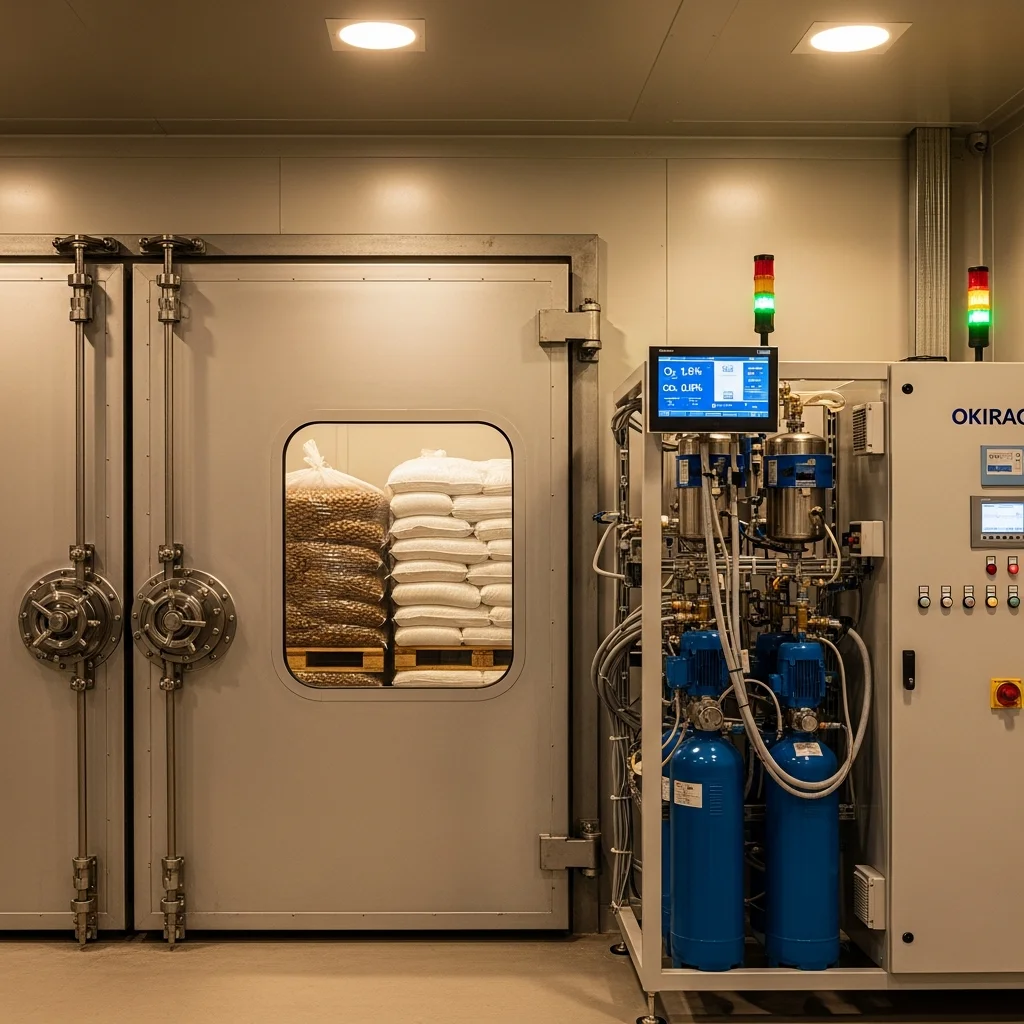
What Is Controlled Atmosphere Storage?
Controlled atmosphere (CA) storage modifies the gas composition inside a sealed storage room by reducing oxygen below ambient levels (from 21% to typically 1–3%) and elevating nitrogen or CO2 as the compensating gas. This modified atmosphere accomplishes two distinct preservation goals simultaneously: it dramatically slows lipid oxidation (the primary cause of rancidity in high-fat tree nuts) and it creates an atmosphere lethal to insects without any chemical fumigant application.
For California almond, pistachio, and walnut handlers who serve organic markets, export markets with fumigation restrictions, or customers seeking fumigant-free product, CA storage is increasingly the premium standard for long-hold inventory.
CA Storage for Almonds
California almonds are high in monounsaturated and polyunsaturated fats that oxidize progressively under ambient and refrigerated conditions. Standard refrigerated storage at 34°F extends almond shelf life to approximately 18 months. CA storage at 34°F with 1% O2 / 99% N2 extends shelf life to 24 months or longer while maintaining lower peroxide values (the primary measure of oxidative rancidity).
For export almonds destined for Asian markets — where almond flavor standards are particularly sensitive and shelf life requirements are long due to ocean transit and in-market distribution periods — CA storage provides a defensible quality advantage. Japanese, Korean, and Chinese buyers who pay premium prices for California almonds increasingly specify CA-stored or cold-stored product with documented temperature and atmosphere records.
Pistachio CA Storage and Aflatoxin Management
Pistachios are particularly susceptible to aflatoxin contamination, produced by Aspergillus fungi that grow at elevated moisture and temperature conditions. While CA storage does not directly prevent aflatoxin development (which is primarily managed through harvest timing, drying protocols, and moisture content control), the low-oxygen environment does suppress fungal growth by eliminating the oxygen that Aspergillus requires for aflatoxin production.
The combined strategy of: harvest at optimal hull split timing, rapid drying to ≤6% moisture content, and CA storage at 34°F with 1–2% O2 provides the most comprehensive aflatoxin risk management available without chemical treatment. For shippers targeting EU markets — which have among the strictest aflatoxin limits in the world (4 ppb total aflatoxins for nuts for human consumption) — this integrated approach is the standard of practice.
Walnut CA Storage: Managing Rancidity and Hull Stain
California walnuts are the most lipid-rich of the major tree nuts and accordingly the most susceptible to rancidity under improper storage conditions. In-shell walnuts stored at ambient temperature develop detectable rancidity within 3–4 months. Refrigerated storage at 32–34°F extends shelf life to 12 months. CA storage at these temperatures with 1% O2 extends acceptable shelf life to 18–24 months for in-shell and 12–18 months for shelled halves and pieces.
Hull stain — brown discoloration of the shell caused by oxidative enzymatic reactions following hull removal — is not a safety concern but significantly affects market acceptance, particularly for export markets where shell appearance determines market grade. CA storage following rapid post-harvest drying provides the best preservation of shell color and appearance.
Economic Analysis of CA vs. Conventional Cold Storage for Nuts
CA storage carries a premium over conventional cold storage, reflecting the cost of gas-tight room construction, nitrogen generation or CO2 delivery systems, and continuous atmosphere monitoring. The premium is typically 15–25% over standard refrigerated storage rates. For commodity handlers evaluating whether CA storage is economically justified, the key variables are: hold period (CA advantage increases with hold duration), destination market requirements (export and organic markets often require or strongly prefer CA), and current basis differential between immediate-sale and held inventory.