Why Sustainability Matters for California Cold Storage
California cold storage operators face a unique convergence of sustainability pressures: among the highest electricity rates in the nation (PG&E commercial rates regularly exceeding $0.25/kWh), mandatory reporting under California Air Resources Board (CARB) regulations for large emitters, water scarcity in the San Joaquin Valley, and increasingly explicit ESG requirements from multinational food companies evaluating their supply chain partners.
For cold storage operators, sustainability is no longer a branding exercise — it is a direct financial lever. Reducing electricity consumption by 20% through LED lighting, high-efficiency evaporator fans, and variable frequency drives (VFDs) can save $200,000–$500,000 annually for a 100,000-square-foot facility at California commercial rates.
Solar Microgrids and Energy Resilience
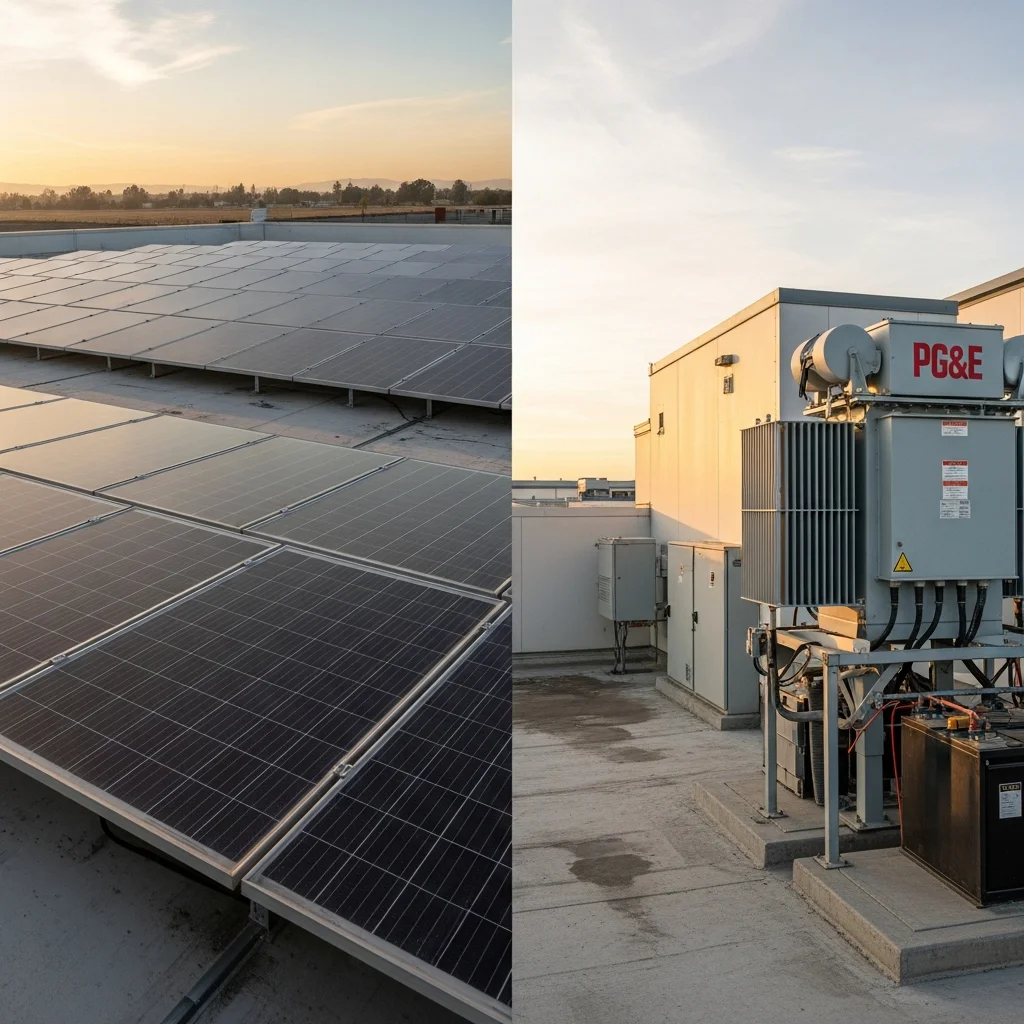
The California Central Valley receives some of the highest solar insolation in North America — an average of 5.5–6.5 peak sun hours per day year-round. This makes rooftop and ground-mounted solar economically compelling for cold storage operators who can offset significant portions of their daytime electricity demand from self-generated renewable power.
A typical 100,000-square-foot cold storage facility consumes approximately 2–4 MW of electricity at peak demand. A 1.5 MW solar array paired with battery storage can provide 30–50% energy independence, dramatically reducing both electricity cost and grid strain during summer peak demand periods (when California’s grid is most stressed and time-of-use rates are highest).
The combination of solar generation with battery storage creates a microgrid capable of island operation during grid outages — an increasingly important consideration in California’s wildfire-affected utility territory where Public Safety Power Shutoffs (PSPS) have become a regular seasonal risk. For cold storage operators, an outage that lasts longer than the thermal inertia of a well-insulated building can trigger catastrophic product loss. Battery-backed solar eliminates this risk.
Refrigerant Selection: The ESG Dimension
The choice of refrigerant has significant ESG implications. Older facilities may still operate on R-22 (now phased out under the Montreal Protocol) or R-404A (global warming potential of 3,922 — nearly 4,000 times the warming impact of CO2 over 100 years). California’s increasingly stringent HFC regulations, aligned with CARB’s Short-Lived Climate Pollutant Reduction Strategy, are accelerating refrigerant transitions in the cold storage sector.
R-744 (CO2/transcritical) refrigeration has a GWP of 1 and is increasingly the choice for new California cold storage construction seeking ESG credentials. Ammonia (R-717) has zero GWP and excellent thermodynamic efficiency, making it the benchmark for large-scale cold storage operations. Natural refrigerant systems — CO2, ammonia, or propane — are increasingly specified by multinational food company customers as a supply chain sustainability requirement.
Water Efficiency in Evaporative Cooling Systems
Many cold storage facilities use evaporative condensers or cooling towers that consume significant volumes of water — a growing regulatory and reputational concern in drought-prone Central Valley. Air-cooled condensers eliminate water consumption entirely but carry a 5–15% efficiency penalty compared to evaporative systems in California’s hot summer climate.
For facilities committed to minimizing water consumption, hybrid systems — evaporative in moderate weather, air-cooled during water restrictions or drought emergencies — provide the best balance of efficiency and water responsibility.
ESG Reporting for Cold Storage Supply Chain Partners
Multinational food and beverage companies are increasingly requiring ESG data from their cold storage and logistics partners as part of Scope 3 emissions reporting under frameworks like the GHG Protocol and CDP. Cold storage operators who can provide energy consumption data, renewable energy percentage, and refrigerant emissions records are better positioned to win and retain enterprise customer contracts from sustainability-conscious food companies.