Navigating California Cold Storage Energy Costs in 2026: A Data-Driven Benchmark for CVCS
For Central Valley Cold Storage (CVCS) in Madera, California, understanding and optimizing energy costs is paramount to operational efficiency and profitability. In 2026, California’s energy landscape, particularly within Pacific Gas and Electric (PG&E) territory, continues its evolution, presenting both challenges and significant opportunities for cold storage facilities. This data-driven analysis provides concrete benchmarks and strategic insights into PG&E rate structures, typical energy consumption, the compelling economics of solar-plus-battery systems, demand response programs, and the efficiency advantages of modern refrigeration technologies.
Cold Chain Energy Intensity
Cold storage facilities are among the most energy-intensive commercial buildings, with refrigeration accounting for over 70% of electricity usage. Maintaining precise, low temperatures 24/7 necessitates substantial power, making energy costs typically the second-highest operating expense after labor. Strategic energy management is crucial for profitability and sustainability.
PG&E Commercial & Industrial Rate Structures in 2026
PG&E’s commercial and industrial (C&I) rate structures in 2026 are complex, built around Time-of-Use (TOU) pricing and significant demand charges. While specific 2026 commercial TOU rate schedules (such as E-19 for large commercial and industrial customers) require direct consultation with PG&E due to numerous variables, the underlying structure remains critical. PG&E has actively adjusted rates, announcing a fixed monthly Base Services Charge starting March 2026, alongside an estimated $0.05 to $0.07 per kWh reduction in the average residential usage rate, with a general trend of stabilizing and lowering electricity prices since January 2024.
Time-of-Use (TOU) Rates
TOU rates mean electricity prices fluctuate based on the time of day, day of the week, and season. Peak hours, typically in the late afternoon and early evening (e.g., 4 PM to 9 PM), see the highest per-kWh charges, reflecting periods of high grid demand. Off-peak hours, often overnight and during weekends, offer significantly lower rates. For cold storage, where refrigeration loads are constant, shifting any non-critical operations or leveraging energy storage during peak periods is vital for cost containment.
Demand Charges
Demand charges are a critical component of C&I bills, often representing 30-70% of the total electricity cost for high-load customers. These charges are based on a facility’s highest instantaneous power draw (measured in kilowatts, kW) during a billing cycle, usually within a 15-30 minute interval, especially during peak TOU periods. Even short spikes in demand can lead to substantial charges for the entire month. Effective demand management, such as staggered compressor starts and integrating battery storage, is essential to mitigate these costs.
Typical Cold Storage Energy Consumption Benchmarks
Cold storage facilities are significant energy consumers due to the continuous operation required to maintain precise temperature ranges:
- Refrigerated Storage (Chill): A typical refrigerated warehouse consumes approximately 25 kWh of electricity per square foot per year.
- Frozen Storage: Facilities maintaining frozen temperatures require substantially more energy, often consuming 30-50 kWh per square foot per year. Some studies indicate usage around 1.54 kWh/cubic foot for typical operations, with efficient facilities achieving 0.6 kWh/cubic foot. For a 2,830 m3 cold store, consumption was 124 kWh per m3 per year, while an 85,000 m3 store used 99 kWh/m3.
Energy Cost per Pallet Position
To provide a benchmark relevant to storage capacity, we can estimate energy consumption per pallet position. Assuming an average industrial pallet footprint of 13.3 square feet (40"x48"):
- Refrigerated Pallet Position (Estimated): Approximately 27.7 kWh per pallet position per month (25 kWh/sq ft/year * 13.3 sq ft/pallet / 12 months).
- Frozen Pallet Position (Estimated): At roughly double the energy intensity of refrigerated, this could be around 55.4 kWh per pallet position per month.
Using an estimated average commercial electricity rate in California of $0.32/kWh (combining energy, demand, and other charges for illustrative purposes, as specific large commercial TOU rates are highly variable and customized):
- Estimated Monthly Energy Cost per Refrigerated Pallet: $8.86 (27.7 kWh * $0.32/kWh).
- Estimated Monthly Energy Cost per Frozen Pallet: $17.73 (55.4 kWh * $0.32/kWh).
These figures provide a generalized benchmark; actual costs will vary significantly based on specific PG&E rate schedules, load profiles, and operational efficiency.
Solar-plus-Battery Economics for Cold Storage in 2026
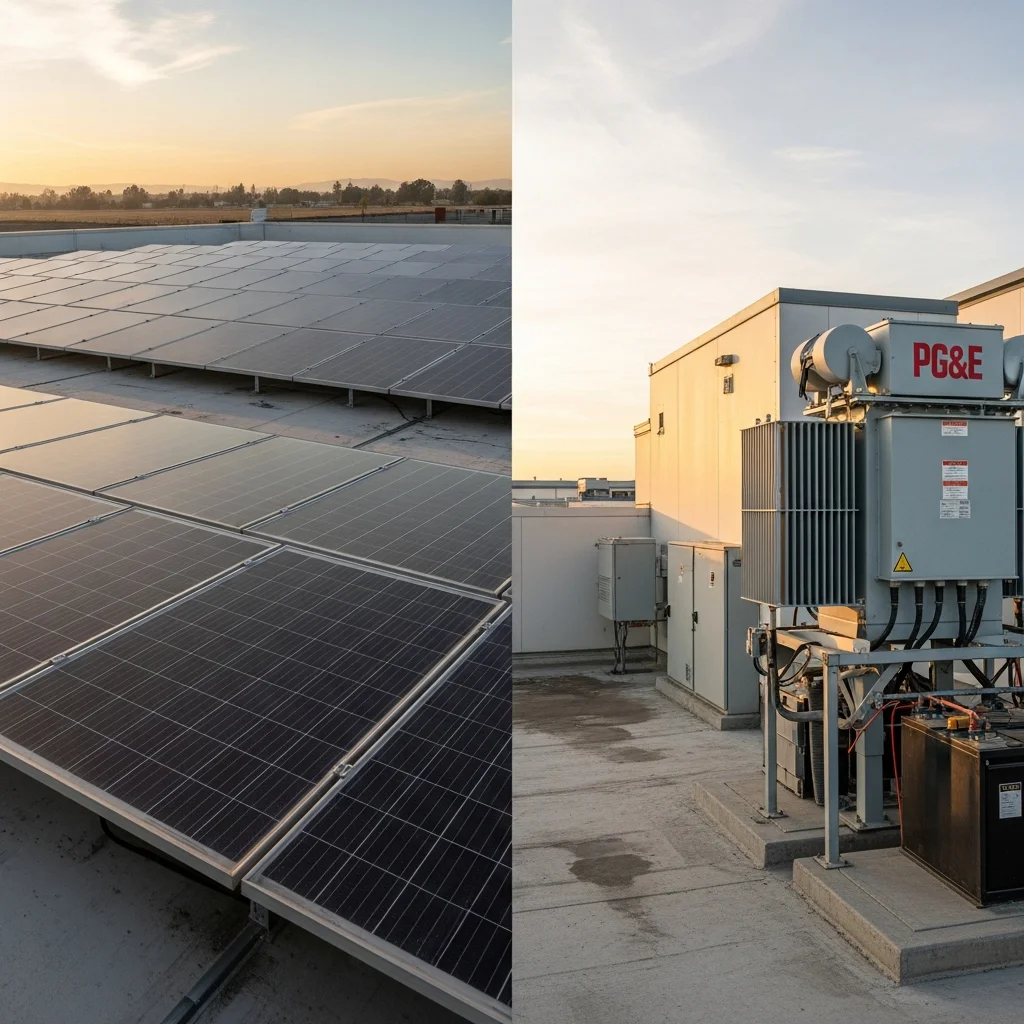
The integration of solar photovoltaic (PV) systems with battery energy storage systems (BESS) offers a powerful strategy for California cold storage facilities to mitigate rising electricity costs, reduce demand charges, and enhance energy resilience, particularly under NEM 3.0.
Installed Costs and LCOE
-
Commercial Solar PV: In 2026, commercial solar panel installations in California typically range from $2.50 to $3.50 per watt before incentives. After federal tax credits and local incentives, this can drop to $1.20 to $1.75 per watt. Other sources suggest an average of $1.40-$1.80 per watt installed.
-
Commercial Battery Storage (BESS): The fully installed turnkey cost for commercial-scale BESS projects in 2026 ranges from $360 to $690 per kWh. For larger, containerized systems (100 kWh or more), costs can be lower, potentially $180-$300 per kWh for the components in 2025, with utility-scale systems projected to fall below $250/kWh in 2026. Lithium Iron Phosphate (LFP) batteries are generally more cost-effective and safer.
Federal ITC and IRA Incentives
The federal Investment Tax Credit (ITC) remains a cornerstone incentive:
- 30% Base Credit: Commercial solar projects, including standalone battery storage systems (3 kWh or larger), are eligible for a 30% federal tax credit on total installed costs. To secure this, projects must begin construction by July 4, 2026, or be fully placed in service by December 31, 2027.
- Bonus Credits: Additional stackable credits can increase the ITC to 40-50% or more: a 10% Domestic Content Bonus, a 10% Energy Community Bonus, and a 10-20% Low-Income Community Bonus.
- Bonus Depreciation: Businesses can also benefit from accelerated depreciation (MACRS), allowing for a significant portion (around 80-85% of the adjusted basis) of the system’s cost to be depreciated in the first year.
California SGIP (Self-Generation Incentive Program)
The SGIP continues into 2026, offering cash rebates for clean energy systems, including battery storage. While the most generous rebates often target residential equity and resiliency categories (up to $1,100/kWh for low-income or critical needs households), the program supports commercial installations too. SGIP aims to improve grid reliability, reduce greenhouse gas emissions, and provide backup power. Commercial entities should investigate their eligibility, especially for projects that provide grid benefits or are located in disadvantaged communities.
NEM 3.0 Impact on Solar ROI
California’s Net Energy Metering (NEM) 3.0, implemented in April 2023, significantly reduced the value of excess solar energy exported to the grid by approximately 75% compared to NEM 2.0. This shift makes battery storage ‘crucial’ and ‘essential’ for maximizing solar ROI for commercial users. The focus has moved from exporting power to maximizing on-site consumption and strategic energy management. Solar-plus-storage systems under NEM 3.0 are estimated to achieve payback periods of 7-8 years, which is more attractive than the 8-10 years for solar-only installations.
Real Scenario: 50,000 sqft Cold Storage Annual Energy Cost Comparison
Consider a 50,000 square foot refrigerated cold storage facility in Madera, operating 24/7 with an average annual consumption of 25 kWh/sq ft/year.
- Annual Energy Consumption: 50,000 sq ft * 25 kWh/sq ft/year = 1,250,000 kWh per year (1.25 GWh).
PG&E Only Scenario (Estimated)
Assuming an average blended commercial rate of $0.32/kWh (including energy, demand, and fixed charges, acknowledging variability by rate schedule and load profile):
- Annual Energy Cost: 1,250,000 kWh * $0.32/kWh = $400,000.
Solar Plus Battery Hybrid Scenario (Estimated)
Let’s model a 750 kW solar PV system (sufficient to offset a significant portion of load) paired with a 1,500 kWh battery storage system (2-hour duration for peak shaving).
- Solar PV System Cost: 750 kW * $3.00/watt (pre-incentive average) = $2,250,000.
- Battery Storage System Cost: 1,500 kWh * $500/kWh (pre-incentive average installed) = $750,000.
- Total Initial Investment: $2,250,000 + $750,000 = $3,000,000.
- After 30% ITC: $3,000,000 * (1 – 0.30) = $2,100,000. (Further reductions possible with bonus credits and SGIP)
With optimal system sizing and dispatch under NEM 3.0, the facility aims for high self-consumption, minimizing peak demand charges and maximizing savings during high TOU periods. For example, if the system offsets 70% of electricity consumption at a blended average of $0.32/kWh and significantly reduces demand charges, annual savings could exceed $280,000. The payback period for such systems can range from 7-8 years. Additionally, bonus depreciation further improves the financial viability in the initial years.
Demand Response Programs: Monetizing Flexibility
PG&E offers various demand response (DR) programs designed to incentivize businesses to reduce electricity consumption during periods of high grid stress. These programs allow cold storage facilities to monetize their operational flexibility:
- Peak Day Pricing (PDP): Participants receive a discount on regular summer rates but pay higher prices on up to 15 Peak Pricing Event Days per year. Shifting compressor loads or leveraging battery discharge during these events can yield significant savings.
- Capacity Bidding Program (CBP): Managed by aggregators, participants commit to reducing load upon notification, receiving compensation for their commitment and actual reductions.
- Emergency Load Reduction Program (ELRP): A pilot program offering financial incentives for reducing energy use during high grid stress and emergencies.
PG&E also offers financial support, potentially covering up to 75% of building controls project costs, for businesses adopting energy management systems with DR capabilities. By automating compressor load shedding or pre-cooling prior to DR events, cold storage facilities can earn revenue while supporting grid stability.
R744 CO2 Efficiency Advantage Over Legacy Systems
The transition to natural refrigerant systems, particularly those utilizing R744 (CO2), offers substantial energy efficiency and environmental benefits compared to legacy hydrofluorocarbon (HFC) systems like R404A.
- Lower Energy Consumption: R744 transcritical booster systems have demonstrated significant energy cost savings, with case studies showing 19% savings compared to R404A systems and up to 20-30% lower annual operating costs. One analysis estimated annual electricity savings of 28%.
- Environmental Benefits: R744 has a Global Warming Potential (GWP) of 1, making it an ultra-low GWP refrigerant. In contrast, R404A has a GWP of 3,922, making it a potent greenhouse gas. Adopting R744 reduces a facility’s carbon footprint and helps future-proof operations against evolving F-gas regulations.
- Operational Advantages: R744 boasts a significantly higher volumetric cooling capacity, leading to smaller pipe diameters, reduced refrigerant charges, and more compact installations. While initial investment costs for R744 systems can be higher, payback periods are often favorable, such as 4.7 years observed in one case study.
Conclusion
In 2026, managing energy costs for cold storage in California requires a multifaceted approach. PG&E’s complex rate structures, dominated by TOU and demand charges, necessitate advanced energy management. Integrating solar PV with battery storage, supported by robust federal (ITC/IRA) and state (SGIP) incentives, and strategically leveraged under NEM 3.0, offers a clear path to reducing operational expenses and enhancing resilience. Furthermore, modernizing refrigeration systems to R744 CO2 technology provides substantial long-term energy savings and environmental advantages. For Central Valley Cold Storage, proactive adoption of these strategies is not just about cost reduction, but about solidifying a sustainable, competitive edge in California’s dynamic energy market.