Every ton of almonds, pistachios, or fresh produce that leaves a California farm represents months of capital, labor, and risk. What happens to that investment in the hours, days, and weeks after harvest determines whether a grower captures maximum value — or watches margin evaporate before a single sale is made.
Cold storage is not simply a warehouse that keeps things cold. It is the single most consequential infrastructure decision a Central Valley agricultural operation can make. This guide covers everything growers, handlers, and commodity traders need to know about the measurable benefits of refrigerated storage — and why location, compliance readiness, and energy infrastructure determine which cold storage partner actually delivers on the promise.
What Cold Storage Does That Nothing Else Can
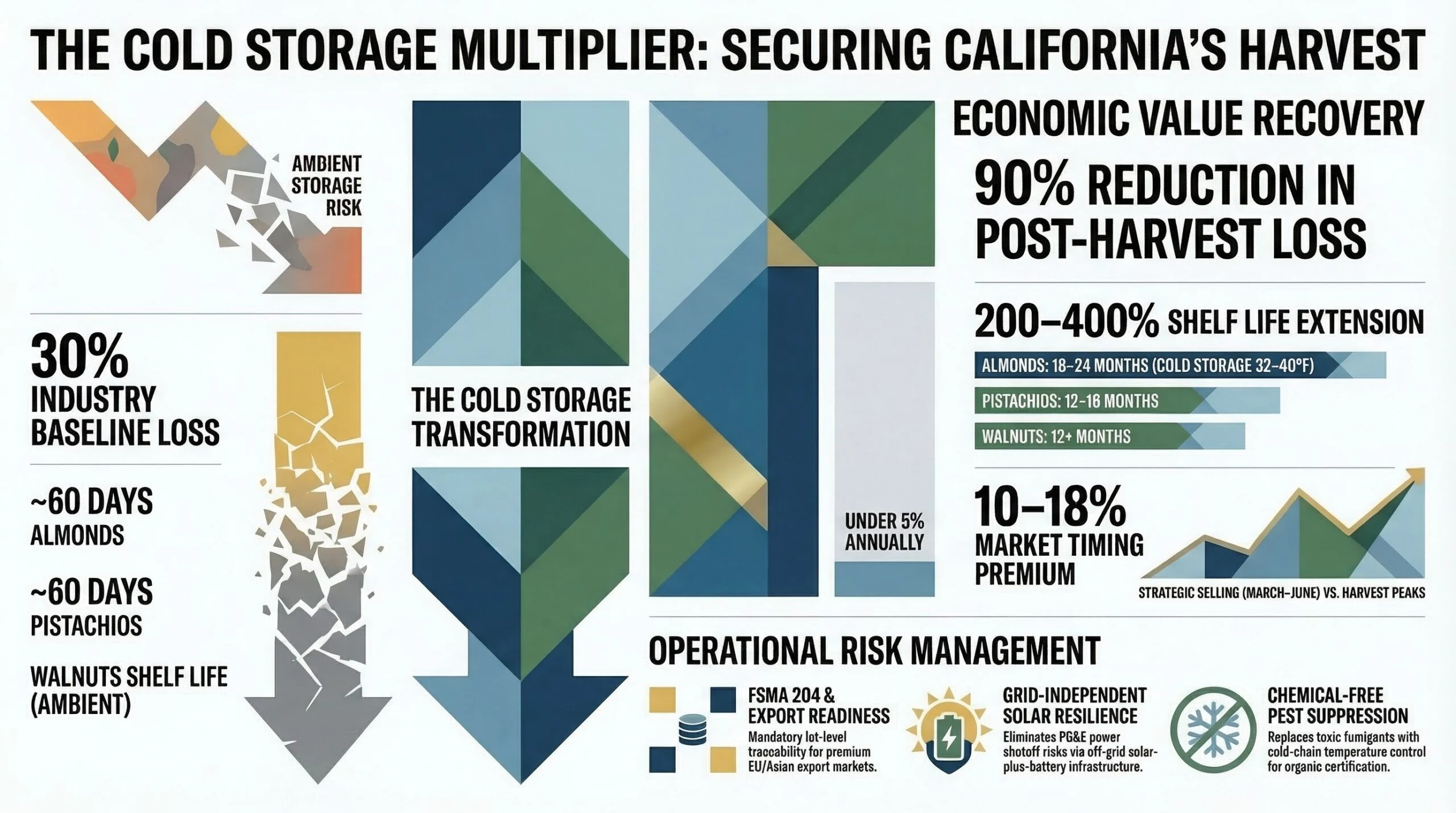
Post-harvest physiology is ruthless. The moment a nut is shelled or a piece of produce is harvested, biological decay begins. Respiration accelerates, moisture migrates, lipids oxidize, and microbial populations grow. Without intervention, California tree nut growers typically lose 15–30% of commodity value to quality degradation within the first 60 days of storage in ambient conditions. Fresh produce losses can reach 40–50% in the same window.
Refrigerated storage interrupts this cascade at the source. By reducing temperature to the optimal range for a given commodity — typically 32–38°F for fresh produce, 34–40°F for in-shell tree nuts — cold storage slows respiration, suppresses microbial activity, and stabilizes moisture content. The result is measurable: shelf life extensions of 200–400% compared to ambient storage, post-harvest loss rates reduced from 30% to under 5%, and product that arrives at domestic buyers or international ports in export-grade condition.
For a commodity as capital-intensive as California almonds — trading at $2.00–$3.50 per pound in 2025 — the difference between 5% and 30% post-harvest loss on a 500-ton lot exceeds $300,000 in a single season. Cold storage does not cost money. It recovers it.
The 8 Proven Benefits of Agricultural Cold Storage
1. Reduces Post-Harvest Loss by Up to 90%
The USDA and FAO estimate that globally, 526 million metric tons of food are lost annually due to inadequate cold chain infrastructure. In high-value California crops, this translates directly to lost grower income. Refrigerated storage at the correct temperature and humidity reduces loss rates from the industry baseline of 25–30% to under 5% for most commodities. For almonds and pistachios specifically, properly managed cold storage maintains kernel quality, free fatty acid levels, and moisture content within export specification for 18–24 months — a window that simply does not exist without refrigeration.
2. Extends Marketable Shelf Life by 200–400%
Temperature management does not merely slow decay — it fundamentally extends the commercial window during which a commodity can be sold at premium prices. Field-run almonds stored at ambient Central Valley temperatures (which reach 105°F+ in summer) begin experiencing aflatoxin risk, oil oxidation, and moisture migration within weeks. At 34–38°F with humidity control, the same lot maintains shell quality, interior color, and moisture within export specification for up to two years. This transforms almonds from a perishable to a strategic inventory asset.
3. Unlocks Market Timing Flexibility — the Most Undervalued Benefit
Commodity prices for California tree nuts fluctuate 15–25% within a single crop year. Growers who must sell immediately after harvest — because they lack cold storage — are price takers. Growers with refrigerated inventory are price setters. Historical data from the Almond Board of California shows that almonds sold in March through June consistently command 10–18% premiums over those sold in October and November at harvest peak, when supply is highest and prices are lowest. Six months of cold storage can return more than the storage cost in price premium alone, independent of any quality savings.
4. Enables Export-Grade Product for International Markets
International buyers — particularly in the EU, India, China, and the Middle East, which collectively represent more than 70% of California almond export volume — require temperature-controlled supply chains and documentation of cold chain integrity. Without documented refrigerated storage, California growers cannot access these premium export channels. Cold storage with FSMA 204-compliant traceability documentation transforms a domestic commodity into a globally tradeable one. Central Valley Cold Storage supports title transfer in-situ, meaning international buyers can take legal ownership of inventory while it remains under refrigeration in Madera — eliminating transport exposure during price negotiation.
5. Eliminates Fumigation Dependency for Pest Management
Methyl bromide fumigation — once the default pest management approach for stored California tree nuts — is a toxin with documented environmental and food safety concerns. California regulations on fumigation are tightening. Cold storage at 34°F achieves equivalent or superior pest suppression without chemical treatment, meeting CCOF organic certification requirements and EU market access standards that increasingly prohibit fumigant residues. For organic-certified growers, cold storage is not optional: it is the only viable storage method that preserves certification integrity.
6. Supports FSMA 204 Traceability Compliance
The FDA’s Food Safety Modernization Act Rule 204, which mandates enhanced traceability records for high-risk foods including tree nuts and fresh produce, requires Key Data Elements (KDEs) at every Critical Tracking Event (CTE) — including storage. Facilities that cannot produce lot-level traceability documentation for stored inventory put their customers’ compliance at risk. Modern cold storage operations maintain temperature logs, lot segregation records, and chain-of-custody documentation that satisfy FDA 204 requirements and provide legal protection in the event of a recall investigation.
7. Protects and Builds Price Premiums Through Quality Documentation
Buyers at major commodity handlers, export traders, and retail chains increasingly require third-party quality certification at the point of sale. Cold-stored inventory that arrives with temperature history, moisture content logs, and quality inspection records commands measurably higher prices than inventory sold without documentation. In commoditized markets where price differentiation is difficult, documented cold chain integrity is one of the few ways a grower can reliably command premium pricing.
8. Provides Energy Resilience Through Solar-Plus-Storage Infrastructure
California’s grid reliability continues to decline in the San Joaquin Valley, with PG&E PSPS (Public Safety Power Shutoff) events threatening refrigerated inventory during peak wildfire season — precisely when post-harvest storage demand is highest. Cold storage facilities operating on off-grid solar-plus-battery infrastructure eliminate this exposure entirely. Central Valley Cold Storage operates on a dedicated off-grid solar and battery system at the Madera Airport Industrial Park, providing uninterrupted refrigeration without grid dependency. For growers storing $1M+ in inventory, grid-independent power is not a feature — it is a fundamental requirement for risk management.
From Price Taker to Price Setter: The Economics of Cold Storage
Watch how refrigerated storage transforms commodity timing — and what that means for your margin per hundredweight.
Calculate Your Cold Storage ROI
Use the calculator below to estimate the annual financial benefit of refrigerated storage for your operation. Adjust inputs to match your commodity, volume, and current market price.
Cold Storage ROI Calculator
Estimate the annual financial benefit of refrigerated storage for your California commodity. Adjust the inputs and results update instantly.
Estimates based on industry averages: 30% uncooled post-harvest loss vs. 5% with refrigerated storage; 12% average price premium from market-timing flexibility. Actual results vary by commodity, season, and management.
Cold Storage by Commodity: What Central Valley Growers Need to Know
Almond Cold Storage
California produces approximately 80% of the world’s almond supply, with Madera County among the highest-density production regions in the state. In-shell and shelled almonds are highly susceptible to aflatoxin contamination above 50°F, lipid oxidation above 60°F, and moisture migration in uncontrolled humidity. Optimal almond storage conditions are 32–40°F with relative humidity between 60–65%. At these parameters, kernel quality, color grade, and free fatty acid levels remain within export specification for 18–24 months. Central Valley Cold Storage’s Madera facility offers multi-temperature zones specifically calibrated for nut storage, with lot segregation for organic and conventional inventory.
Pistachio Cold Storage
California produces over 400 million pounds of pistachios annually, second only to Iran in global production. Pistachios are particularly vulnerable to aflatoxin-producing mold when stored above 65°F with humidity exceeding 70%. Refrigerated storage at 35–38°F extends commercially viable shelf life from 3–4 months (ambient) to 12–18 months without quality degradation. For export-destined pistachios — which command significant premiums over domestic pricing — cold storage documentation supporting EU aflatoxin compliance limits (4 ppb total aflatoxin) is a market access requirement.
Walnut Cold Storage
English walnuts, grown extensively in Tulare, Fresno, and Madera counties, contain 65–70% unsaturated fat by weight — making them among the most oxidation-sensitive tree nuts in California agriculture. Rancidity development begins within 60–90 days at ambient temperatures, destroying both flavor profile and market value. Refrigerated storage at 32–36°F maintains walnut quality for 12+ months and supports premium pricing in Asian export markets, where California walnuts command 20–30% premiums over ambient-stored equivalents.
Fresh Produce Cold Storage
Stone fruits, table grapes, citrus, and field vegetables grown in the San Joaquin Valley require rapid pre-cooling to field heat removal within 4–6 hours of harvest, followed by continuous refrigerated storage through distribution. Every hour of delay between field and cold storage accelerates respiration, moisture loss, and microbial growth. Central Valley Cold Storage’s Madera location — within 30–45 minutes of major San Joaquin Valley growing regions — provides the field-to-cold-chain proximity that maximizes product quality and extends sellable shelf life.
The Agricultural Cold Chain Explained: Field to Market
The cold chain is not a single facility — it is an unbroken sequence of temperature-controlled environments that begins at harvest and ends at point of sale. Each link in the chain must function correctly, or the entire investment in upstream cold storage is partially or fully negated.
The critical links in a California agricultural cold chain are: field pre-cooling (or in-field harvest practices for tree nuts), transport from field to storage facility, primary refrigerated storage, quality inspection and lot management at the storage facility, transport from storage to processor or export consolidator, and export cold-chain documentation and customs compliance. Failures at any point — delayed pre-cooling, temperature excursions during transport, humidity mismanagement in storage, or documentation gaps at export — can result in rejection, downgraded pricing, or legal liability under FSMA 204. Working with a storage partner whose infrastructure is purpose-built for the specific commodity and supply chain reduces each of these risks systematically.
FSMA 204 and Why Compliance Starts in Storage
The FDA’s Food Safety Modernization Act Section 204 — the Food Traceability Rule — establishes mandatory recordkeeping requirements for facilities that manufacture, process, pack, or hold foods on the Food Traceability List (FTL). California tree nuts and fresh produce appear on this list. The rule requires that at each Critical Tracking Event (CTE), businesses capture and maintain Key Data Elements (KDEs) including traceability lot codes, location identifiers, and quantity and unit of measure data.
For cold storage operators, FSMA 204 compliance means maintaining temperature logs with lot-level attribution, chain-of-custody records for every inbound and outbound movement, and the ability to produce a full traceability report within 24 hours of an FDA request. Facilities that cannot provide this documentation are a liability to every buyer in their supply chain. Central Valley Cold Storage maintains full lot-level traceability documentation compliant with FSMA 204 requirements, supporting both grower and handler compliance obligations.
Solar-Powered Cold Storage: The Case for Off-Grid Refrigeration
Industrial refrigeration is among the most energy-intensive operations in agricultural logistics. A 100,000-square-foot cold storage facility operating at 35°F in the San Joaquin Valley consumes 1.5–2.5 million kWh annually at current grid utility rates. With PG&E commercial rates in the $0.18–$0.28 per kWh range and rising, energy represents 35–50% of total operating cost for grid-dependent cold storage — a cost that is ultimately passed to growers in storage rates.
Off-grid solar-plus-battery infrastructure fundamentally changes this equation. By generating power from photovoltaic arrays during peak production hours (which align closely with peak refrigeration demand in California’s high-temperature summer), and storing excess capacity in battery systems for overnight and cloudy-day operation, a well-designed solar cold storage facility can eliminate grid dependency entirely. The Levelized Cost of Energy (LCOE) for solar-plus-storage at this scale in California is $0.04–$0.07 per kWh — 60–75% below grid utility rates. Central Valley Cold Storage operates on this model, with dedicated off-grid solar and battery infrastructure at Madera providing uninterrupted refrigeration independent of PG&E PSPS events.
Central Valley Cold Storage at Madera Airport Industrial Park
Central Valley Cold Storage is a purpose-built agricultural refrigerated storage facility located at the Madera Airport Industrial Park in Madera, California. The facility was designed specifically for the San Joaquin Valley’s nut and produce supply chains, with infrastructure choices reflecting the specific demands of high-value commodity storage, FSMA compliance, and export-oriented supply chains.
Key facility attributes: multi-temperature storage zones calibrated for tree nuts and fresh produce; off-grid solar-plus-battery power infrastructure; FSMA 204-compliant traceability and documentation systems; organic and conventional lot segregation; inventory protection capacity exceeding $100 million in total commodity value; and title transfer capabilities supporting in-situ ownership changes for international commodity transactions.
Madera’s geographic position — at the intersection of Highway 99 and Highway 145, within 30 minutes of the primary almond and pistachio production corridors of Madera, Fresno, and Merced counties — provides field-to-storage proximity that is operationally significant. Pre-cooling effectiveness decreases measurably with every hour of transit time, and the cost of transporting commodity to distant storage facilities adds logistics overhead that erodes the financial case for cold storage. Proximity is not a convenience — it is a quality-preservation variable.
How to Choose the Right Cold Storage Partner
Temperature precision and documentation. Can the facility demonstrate actual temperature uniformity throughout the storage space, not just at a single monitoring point? FSMA 204 requires lot-level temperature documentation. Facilities with inadequate monitoring cannot provide it.
Commodity-specific expertise. Tree nut storage requirements differ substantially from fresh produce. Verify that the facility has documented experience with your specific commodity and the specific post-harvest conditions it presents.
Power infrastructure. Ask directly: what happens to your inventory during a PSPS event? Off-grid solar-plus-battery is the only infrastructure that eliminates this risk category entirely. Diesel backup is a partial mitigation, not a solution.
Compliance infrastructure. Request a sample FSMA 204 traceability report. If the facility cannot produce one, it is not compliant, and storing with that facility creates downstream compliance exposure for every buyer in your supply chain.
Location relative to production. Calculate the actual field-to-cold-chain time including loading, transport, and facility intake. For fresh produce, this number should be under four hours. For tree nuts, under 24 hours from final processing to refrigerated storage is the target threshold.
Frequently Asked Questions About Agricultural Cold Storage
What temperature should almonds be stored at?
In-shell and shelled almonds should be stored at 32–40°F with relative humidity between 60–65%. At these conditions, kernel quality, free fatty acid levels, and moisture content remain within export specification for 18–24 months. Storage above 50°F accelerates lipid oxidation and increases aflatoxin risk.
How long can pistachios be stored in cold storage?
Properly refrigerated pistachios stored at 35–38°F with humidity control maintain commercial quality for 12–18 months. Without refrigeration, quality degradation and aflatoxin risk become significant after 3–4 months in Central Valley ambient temperatures.
Does cold storage qualify for organic certification?
Yes. Refrigerated storage is compatible with CCOF and USDA NOP organic certification, provided no prohibited substances are used in pest management. Cold temperatures achieve equivalent or superior pest suppression to fumigation without chemical treatment, making refrigeration the preferred storage method for organic-certified tree nuts.
What is FSMA 204 and does my cold storage facility need to comply?
FDA Rule 204 under the Food Safety Modernization Act requires enhanced traceability records for facilities that hold foods on the Food Traceability List, including tree nuts and fresh produce. Cold storage operators must maintain lot-level temperature logs, chain-of-custody records, and traceability data producible within 24 hours of an FDA request. Non-compliant facilities create downstream liability for growers and handlers.
How does off-grid solar cold storage work?
Off-grid solar cold storage uses photovoltaic arrays to generate electricity during daylight hours, with excess capacity stored in battery systems for overnight operation. A properly sized system eliminates grid dependency entirely, providing uninterrupted refrigeration regardless of utility grid status. The Levelized Cost of Energy for this model is 60–75% below PG&E commercial grid rates.
Can I transfer title to stored commodity while it remains in cold storage?
Yes. Central Valley Cold Storage supports in-situ title transfer, allowing commodity ownership to change hands legally while inventory remains under refrigeration. This is particularly valuable for international commodity transactions where buyers take legal ownership before export shipment, eliminating transit exposure during price negotiation and financing.
What is the difference between controlled atmosphere and refrigerated storage?
Refrigerated storage controls temperature and humidity. Controlled atmosphere storage additionally manages oxygen and carbon dioxide levels to further slow respiration and extend shelf life. Most California tree nuts achieve target shelf life with refrigeration alone; controlled atmosphere is more commonly used for apples and some stone fruits.
How far in advance should I arrange cold storage?
Cold storage capacity in California’s Central Valley is constrained at peak harvest (August through November for tree nuts). Growers and handlers should confirm storage availability at minimum 60 days before anticipated harvest — 90–120 days is preferable for large-volume commitments. Waiting until harvest results in either inadequate capacity or suboptimal facility choices made under time pressure.
Ready to Protect Your Inventory?
Central Valley Cold Storage serves almond growers, pistachio handlers, walnut shellers, fresh produce distributors, and commodity traders operating across the San Joaquin Valley. Our Madera Airport Industrial Park facility offers purpose-built refrigerated storage with off-grid solar infrastructure, FSMA 204-compliant traceability, organic and conventional lot segregation, and the field-to-storage proximity that preserves the quality your inventory was grown to deliver.
Storage commitments for peak harvest season fill early. Contact our team to confirm availability and discuss your post-harvest inventory needs.
The Thermal Ledger: A Reference Guide for California Commodity Storage
The document below is a condensed field reference covering the core temperature, humidity, and shelf-life parameters for California’s primary stored commodities — almonds, pistachios, walnuts, and fresh produce. It also includes a plain-language breakdown of how off-grid solar infrastructure and FSMA 204 traceability requirements interact with day-to-day cold storage operations.
This is intended as a practical supplement to the article above — something a grower, handler, or logistics manager can keep on file, share with a supply chain partner, or reference during harvest planning. Read or download it directly below.
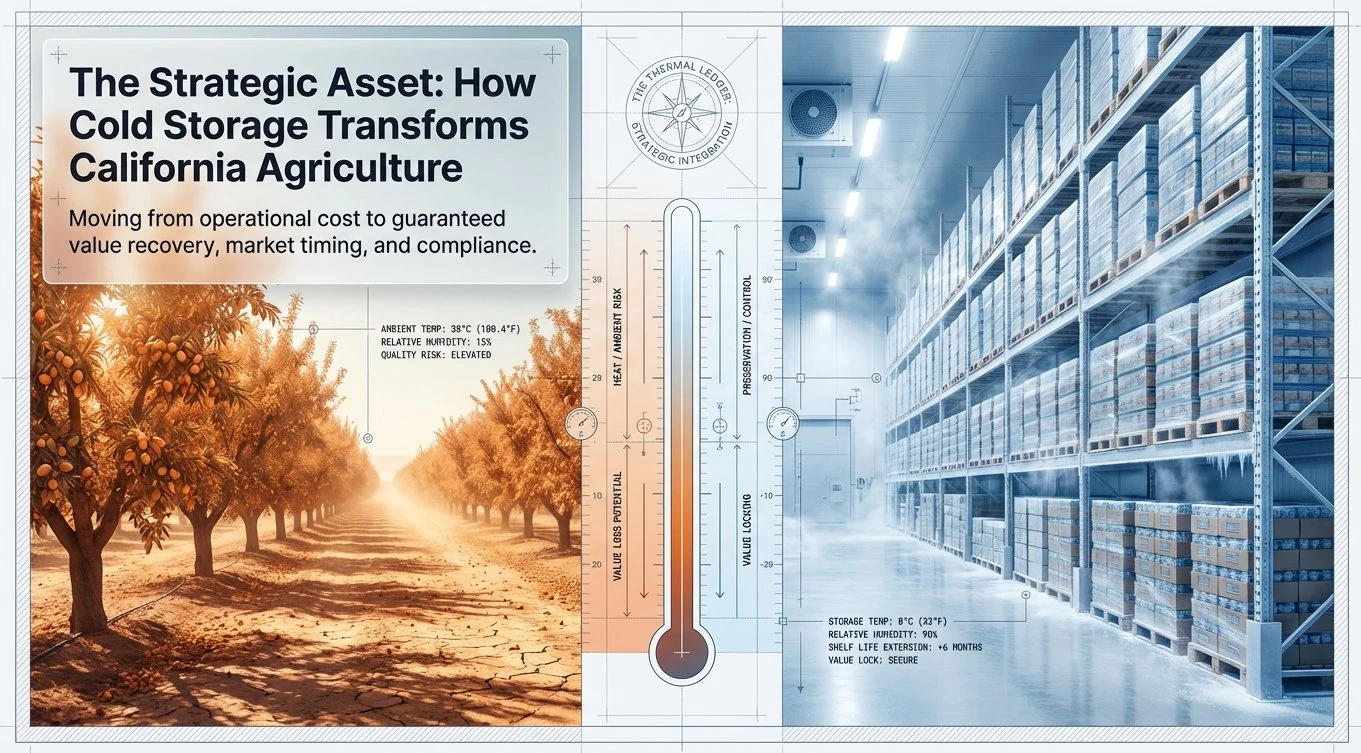
The Thermal Ledger is produced by Central Valley Cold Storage as an educational resource for San Joaquin Valley agricultural operators. For questions about storage parameters, available capacity, or compliance documentation, contact our team directly.